

Powers and Boyer, 2014) versus stock enhancement
(Bell et al., 2005; Luckenbach et al., 2005; Arnold, 2008).
As described elsewhere, we define restoration as “The process of establishing or reestablishing a habitat that in
time will come to closely resemble a natural condition in
terms of structure and function” (see Coen and Luckenbach,
2000; Coen et al., 2004; Baggett et al., 2014). One of the
key differences among sites has been either a deficiency
of adequate (¼appropriate) shell or other hard substrate
for settlement (Figure 15a, b) or a limitation of oyster
larval recruits (“spat”). Modeling is beginning to get at
those sites that have enhanced larval recruitment (e.g.,
Kim et al., 2013). In areas where larval supply is limited
(e.g., Hudson River Estuary; Levinton and Waldman,
2011; Starke et al., 2011; Levinton et al., 2012; Grizzle
et al., 2013), spat on shell (“SOS”) is one approach. Shell
(“cultch”) with small set oysters (“spat”) either from hatcheries or from field sets can be required (Figures 16a, c)
(Coen and Luckenbach, 2000; Coen et al., 2004;
Brumbaugh et al., 2006; Baggett et al., 2014). Once the oysters reach a given size (perhaps 25-40 mm shell height) or
have a thick enough shell, they can be added to reefs on
the shell or if larger, seeded directly onto newly constructed
reefs (Figures 16b, d). Connections among oyster reefs and
regions (Eggleston, 1999; Eggleston et al., 1999; Mroch
et al., 2012; Puckett and Eggleston, 2012) are also key to
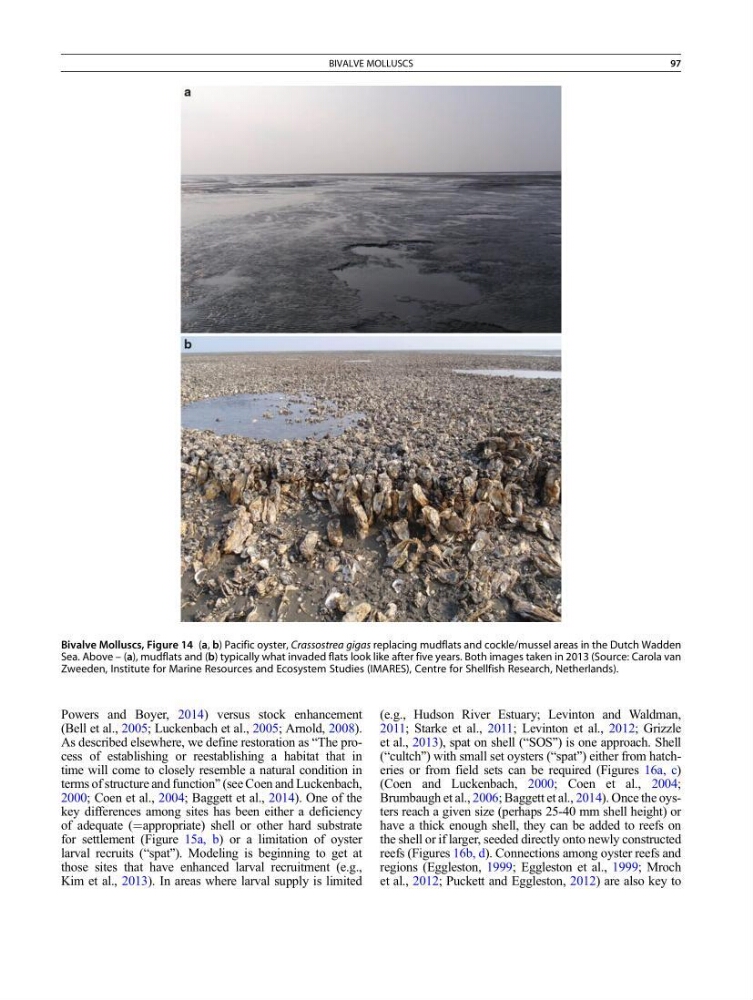
Bivalve Molluscs, Figure 14 (a, b) Pacific oyster, Crassostrea gigas replacing mudflats and cockle/mussel areas in the Dutch Wadden
Sea. Above – (a), mudflats and (b) typically what invaded flats look like after five years. Both images taken in 2013 (Source: Carola van
Zweeden, Institute for Marine Resources and Ecosystem Studies (IMARES), Centre for Shellfish Research, Netherlands).
BIVALVE MOLLUSCS
97
(Bell et al., 2005; Luckenbach et al., 2005; Arnold, 2008).
As described elsewhere, we define restoration as “The process of establishing or reestablishing a habitat that in
time will come to closely resemble a natural condition in
terms of structure and function” (see Coen and Luckenbach,
2000; Coen et al., 2004; Baggett et al., 2014). One of the
key differences among sites has been either a deficiency
of adequate (¼appropriate) shell or other hard substrate
for settlement (Figure 15a, b) or a limitation of oyster
larval recruits (“spat”). Modeling is beginning to get at
those sites that have enhanced larval recruitment (e.g.,
Kim et al., 2013). In areas where larval supply is limited
(e.g., Hudson River Estuary; Levinton and Waldman,
2011; Starke et al., 2011; Levinton et al., 2012; Grizzle
et al., 2013), spat on shell (“SOS”) is one approach. Shell
(“cultch”) with small set oysters (“spat”) either from hatcheries or from field sets can be required (Figures 16a, c)
(Coen and Luckenbach, 2000; Coen et al., 2004;
Brumbaugh et al., 2006; Baggett et al., 2014). Once the oysters reach a given size (perhaps 25-40 mm shell height) or
have a thick enough shell, they can be added to reefs on
the shell or if larger, seeded directly onto newly constructed
reefs (Figures 16b, d). Connections among oyster reefs and
regions (Eggleston, 1999; Eggleston et al., 1999; Mroch
et al., 2012; Puckett and Eggleston, 2012) are also key to
Bivalve Molluscs, Figure 14 (a, b) Pacific oyster, Crassostrea gigas replacing mudflats and cockle/mussel areas in the Dutch Wadden
Sea. Above – (a), mudflats and (b) typically what invaded flats look like after five years. Both images taken in 2013 (Source: Carola van
Zweeden, Institute for Marine Resources and Ecosystem Studies (IMARES), Centre for Shellfish Research, Netherlands).
BIVALVE MOLLUSCS
97