

away from shore-lines (Figures 7a box and 8 inset a) or
along fringing marsh (Spartina), on mangroves and
around their islands, bordering creeks, rivers, sounds,
and embayments (Figures 7b rectangle and Figure 8
inset b, Galtsoff, 1964; Bahr and Lanier, 1981; Burrell,
1986; ASMFC, 2007; Volety, 2013; Baggett et al.,
2014). Mussels (e.g., Geukensia spp.) also can be quite
abundant (Figures 1c, e, and Figure 9) in fringing marshes
and intertidal and subtidal natural and restored oyster reefs
(Bertness and Grosholz, 1985; Franz, 2001; Luckenbach
et al., 2005; Walters and Coen, 2006).
Grabowski and Peterson (2007) and others (Coen et al.,
1999a; Coen et al., 2007; Baggett et al., 2014) have delineated ecosystem services provided by oyster reef habitats:
(1) oyster production; (2) water filtration/fecal concentration; (3) nutrient sequestration; (4) habitat for fish and
invertebrates and augmented production; (5) stabilization
of adjacent habitats/shorelines; and (6) enhancement of
ecosystem complexity. Recent research has attempted to
quantify the contribution of oyster habitats to ecosystem
functioning in economic terms (Peterson et al., 2003;
Grabowski and Peterson, 2007; Grabowski et al., 2012).
For example, oysters create vertical, three-dimensional
reef or bed habitats utilized by numerous fishes, crustaceans, other invertebrates, birds, and mammals
(reviewed in Coen et al., 1999a; Coen et al., 2007;
ASMFC, 2007). The abundances and biomasses can rival
SAV, salt marshes, or mangroves in terms of harboring
Bivalve Molluscs, Figure 5 Image of a shallow subtidal
Crassostrea virginica restored reef from Chesapeake Bay, MD,
USA (Source: K. Paynter, University of Maryland, College Park).
Bivalve Molluscs, Figure 6 Restored oyster reef in the Great
Wicomico River on the western shore of lower Chesapeake Bay,
USA. The high-relief reef harbored about 1,000 oysters m
-2 of
four age classes (Schulte et al. 2009) and is thought to resemble
historical reefs from Colonial times (Source: R.P. Burke and R.N.
Lipcius, VIMS, VA, USA, image taken from Remotely operated
underwater vehicle or ROV video).
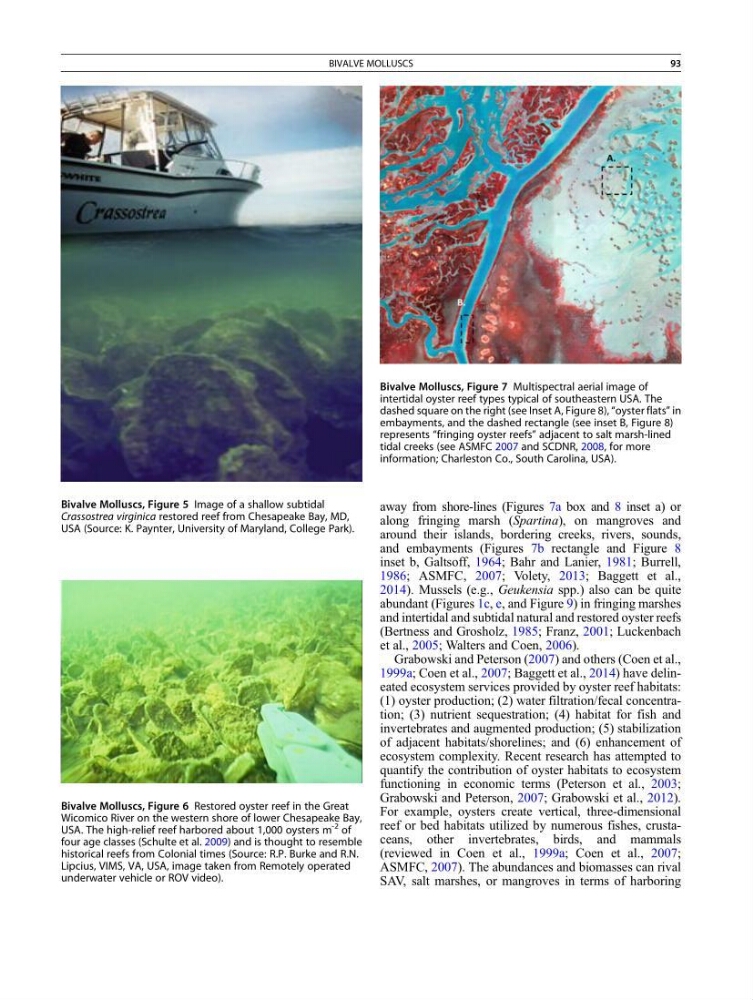
Bivalve Molluscs, Figure 7 Multispectral aerial image of
intertidal oyster reef types typical of southeastern USA. The
dashed square on the right (see Inset A, Figure 8), “oyster flats” in
embayments, and the dashed rectangle (see inset B, Figure 8)
represents “fringing oyster reefs” adjacent to salt marsh-lined
tidal creeks (see ASMFC 2007 and SCDNR, 2008, for more
information; Charleston Co., South Carolina, USA).
BIVALVE MOLLUSCS
93
along fringing marsh (Spartina), on mangroves and
around their islands, bordering creeks, rivers, sounds,
and embayments (Figures 7b rectangle and Figure 8
inset b, Galtsoff, 1964; Bahr and Lanier, 1981; Burrell,
1986; ASMFC, 2007; Volety, 2013; Baggett et al.,
2014). Mussels (e.g., Geukensia spp.) also can be quite
abundant (Figures 1c, e, and Figure 9) in fringing marshes
and intertidal and subtidal natural and restored oyster reefs
(Bertness and Grosholz, 1985; Franz, 2001; Luckenbach
et al., 2005; Walters and Coen, 2006).
Grabowski and Peterson (2007) and others (Coen et al.,
1999a; Coen et al., 2007; Baggett et al., 2014) have delineated ecosystem services provided by oyster reef habitats:
(1) oyster production; (2) water filtration/fecal concentration; (3) nutrient sequestration; (4) habitat for fish and
invertebrates and augmented production; (5) stabilization
of adjacent habitats/shorelines; and (6) enhancement of
ecosystem complexity. Recent research has attempted to
quantify the contribution of oyster habitats to ecosystem
functioning in economic terms (Peterson et al., 2003;
Grabowski and Peterson, 2007; Grabowski et al., 2012).
For example, oysters create vertical, three-dimensional
reef or bed habitats utilized by numerous fishes, crustaceans, other invertebrates, birds, and mammals
(reviewed in Coen et al., 1999a; Coen et al., 2007;
ASMFC, 2007). The abundances and biomasses can rival
SAV, salt marshes, or mangroves in terms of harboring
Bivalve Molluscs, Figure 5 Image of a shallow subtidal
Crassostrea virginica restored reef from Chesapeake Bay, MD,
USA (Source: K. Paynter, University of Maryland, College Park).
Bivalve Molluscs, Figure 6 Restored oyster reef in the Great
Wicomico River on the western shore of lower Chesapeake Bay,
USA. The high-relief reef harbored about 1,000 oysters m
-2 of
four age classes (Schulte et al. 2009) and is thought to resemble
historical reefs from Colonial times (Source: R.P. Burke and R.N.
Lipcius, VIMS, VA, USA, image taken from Remotely operated
underwater vehicle or ROV video).
Bivalve Molluscs, Figure 7 Multispectral aerial image of
intertidal oyster reef types typical of southeastern USA. The
dashed square on the right (see Inset A, Figure 8), “oyster flats” in
embayments, and the dashed rectangle (see inset B, Figure 8)
represents “fringing oyster reefs” adjacent to salt marsh-lined
tidal creeks (see ASMFC 2007 and SCDNR, 2008, for more
information; Charleston Co., South Carolina, USA).
BIVALVE MOLLUSCS
93