

or accumulated at shucking houses] is used for rehabilitation and restoration of other bivalves (LaSalle and de la
Cruz, 1985; Kraeuter et al., 2003; Waldbusser and
Salisbury, 2014).
Many bivalve species, especially the reef-forming
oysters (e.g., the True Oysters, Ostreidae, genus
Crassostrea; see Carriker and Gaffney, 1996), are under
pressure or have already been impacted significantly
across the globe (e.g., Rothschild et al., 1994; Lotze
et al., 2006; ASMFC, 2007; Beck et al., 2009, 2011,
zu Ermgassen et al., 2012). It is these reef-forming species
(often called “ecosystem engineers,” Gutiérrez et al.,
2003; Byers et al., 2006) that have been the focus of recent
and current restoration efforts (Beck et al., 2011; Powers
and Boyer, 2014), especially for their “ecosystem services” in North America (e.g., Coen et al., 1999a, 2007;
Coen and Luckenbach, 2000; ASMFC, 2007; Grabowski
and Peterson, 2007; Grabowski et al., 2012; Brown
et al., 2014; La Peyre et al., 2014b).
One widely ranging species, the Eastern oyster,
Crassostrea virginica, forms living subtidal and intertidal
biogenic reefs that are a dominant feature of many Atlantic
and Gulf US coastal estuaries (Chestnut, 1974; DeAlteris,
1988; ASMFC, 2007; Beck et al., 2011). Because of its
extensive range and importance as a major fishery species
in the USA dating back to the late eighteenth century
(Brooks, 1891), there exists an extensive body of information on the biology of this species and their populations
(Marshall, 1954; Galtsoff, 1964; Bahr and Lanier, 1981;
Sellers and Stanley, 1984; Stanley and Sellers, 1986;
Kennedy et al., 1996). However, its populations have
declined significantly in many US estuaries that once
had major fisheries (Rothschild et al., 1994; Kirby, 2004;
NRC, 2004; Lotze et al., 2006). The causes are numerous
and interrelated including overharvesting, pollution and
related impacts, habitat destruction, and oyster diseases.
Most harvestable oyster populations were primarily
subtidal (Figures 5 and 6), such as those in the Chesapeake
Bay (Maryland and Virginia), Delaware Bay (Delaware
and New Jersey), and the Gulf of Mexico (Florida to
Texas) (MacKenzie, 1996; MacKenzie et al., 1997a; zu
Ermgassen et al., 2012).
In contrast, many intertidal C. virginica reefs (Figures 7
and 8) such as those in the southeastern (Galtsoff, 1964;
Bahr and Lanier, 1981; ASMFC, 2007) and southwestern
USA develop in locations where salinities is often moderately high, water column and resuspended food are sufficient, and siltation is not excessive, although most
oysters can thrive in highly turbid waters (Coen, 1995).
In these areas intertidal oysters often grow in isolated patches
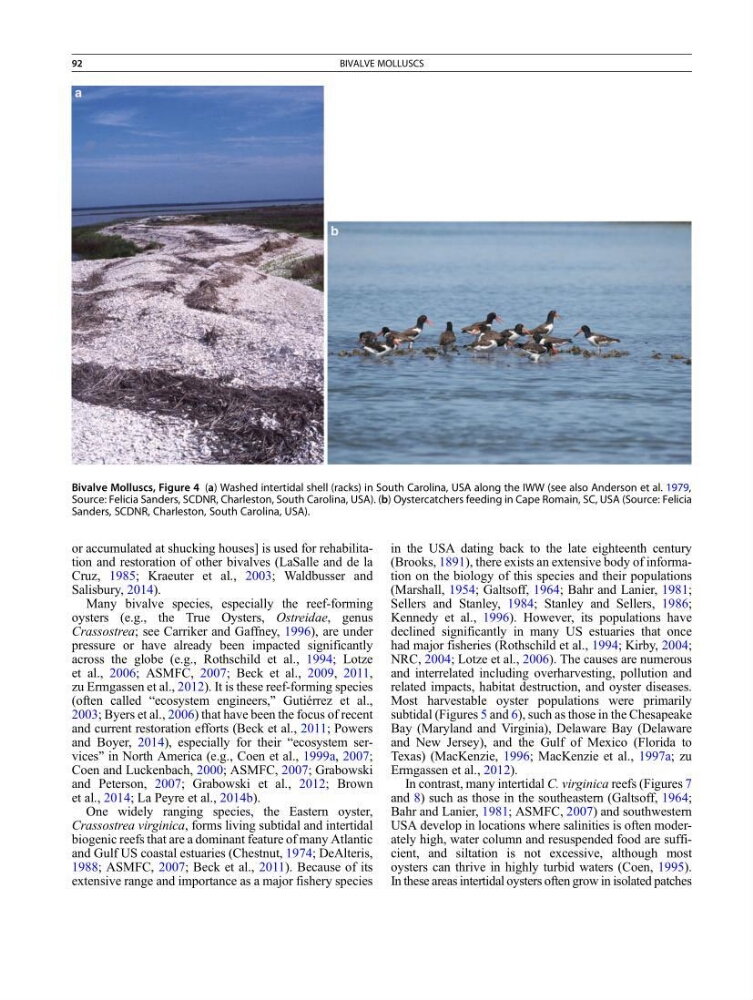
Bivalve Molluscs, Figure 4 (a) Washed intertidal shell (racks) in South Carolina, USA along the IWW (see also Anderson et al. 1979,
Source: Felicia Sanders, SCDNR, Charleston, South Carolina, USA). (b) Oystercatchers feeding in Cape Romain, SC, USA (Source: Felicia
Sanders, SCDNR, Charleston, South Carolina, USA).
92
BIVALVE MOLLUSCS
Cruz, 1985; Kraeuter et al., 2003; Waldbusser and
Salisbury, 2014).
Many bivalve species, especially the reef-forming
oysters (e.g., the True Oysters, Ostreidae, genus
Crassostrea; see Carriker and Gaffney, 1996), are under
pressure or have already been impacted significantly
across the globe (e.g., Rothschild et al., 1994; Lotze
et al., 2006; ASMFC, 2007; Beck et al., 2009, 2011,
zu Ermgassen et al., 2012). It is these reef-forming species
(often called “ecosystem engineers,” Gutiérrez et al.,
2003; Byers et al., 2006) that have been the focus of recent
and current restoration efforts (Beck et al., 2011; Powers
and Boyer, 2014), especially for their “ecosystem services” in North America (e.g., Coen et al., 1999a, 2007;
Coen and Luckenbach, 2000; ASMFC, 2007; Grabowski
and Peterson, 2007; Grabowski et al., 2012; Brown
et al., 2014; La Peyre et al., 2014b).
One widely ranging species, the Eastern oyster,
Crassostrea virginica, forms living subtidal and intertidal
biogenic reefs that are a dominant feature of many Atlantic
and Gulf US coastal estuaries (Chestnut, 1974; DeAlteris,
1988; ASMFC, 2007; Beck et al., 2011). Because of its
extensive range and importance as a major fishery species
in the USA dating back to the late eighteenth century
(Brooks, 1891), there exists an extensive body of information on the biology of this species and their populations
(Marshall, 1954; Galtsoff, 1964; Bahr and Lanier, 1981;
Sellers and Stanley, 1984; Stanley and Sellers, 1986;
Kennedy et al., 1996). However, its populations have
declined significantly in many US estuaries that once
had major fisheries (Rothschild et al., 1994; Kirby, 2004;
NRC, 2004; Lotze et al., 2006). The causes are numerous
and interrelated including overharvesting, pollution and
related impacts, habitat destruction, and oyster diseases.
Most harvestable oyster populations were primarily
subtidal (Figures 5 and 6), such as those in the Chesapeake
Bay (Maryland and Virginia), Delaware Bay (Delaware
and New Jersey), and the Gulf of Mexico (Florida to
Texas) (MacKenzie, 1996; MacKenzie et al., 1997a; zu
Ermgassen et al., 2012).
In contrast, many intertidal C. virginica reefs (Figures 7
and 8) such as those in the southeastern (Galtsoff, 1964;
Bahr and Lanier, 1981; ASMFC, 2007) and southwestern
USA develop in locations where salinities is often moderately high, water column and resuspended food are sufficient, and siltation is not excessive, although most
oysters can thrive in highly turbid waters (Coen, 1995).
In these areas intertidal oysters often grow in isolated patches
Bivalve Molluscs, Figure 4 (a) Washed intertidal shell (racks) in South Carolina, USA along the IWW (see also Anderson et al. 1979,
Source: Felicia Sanders, SCDNR, Charleston, South Carolina, USA). (b) Oystercatchers feeding in Cape Romain, SC, USA (Source: Felicia
Sanders, SCDNR, Charleston, South Carolina, USA).
92
BIVALVE MOLLUSCS