

dominated by cropped tissues (Peterson and Quammen,
1982; Lindsay et al., 1996; Meyer and Byers, 2005).
Another common estuarine to marine bivalve, pen shells
(family Pinnidae) are relatively large bivalves that bury
themselves partly into the substrate and are anchored by
byssal threads. Only the upper portion of the shell is
exposed above the sediment (referred to as “emergent shellfish beds”; see ASMFC, 2007), providing additional
habitat (Figure 3a, b) for other organisms, when either live
or dead (Keough, 1984; Kuhlmann, 1998; Cummings
et al. 1998, 2001; Munguia, 2004). In dense numbers, these
live and dead pen shells create a critical habitat in many
systems (Connell and Keough, 1985; Munguia, 2004).
In some areas stranding events point to large nearshore
populations such as those near Sanibel Island, Florida,
USA (L. Coen personal observations. Perry, 1936).
Many bivalve “foundation species” support enhanced
diversity quite often and complex communities (Altieri
and Witman, 2006).
Many smaller clams such as the estuarine wedge clam,
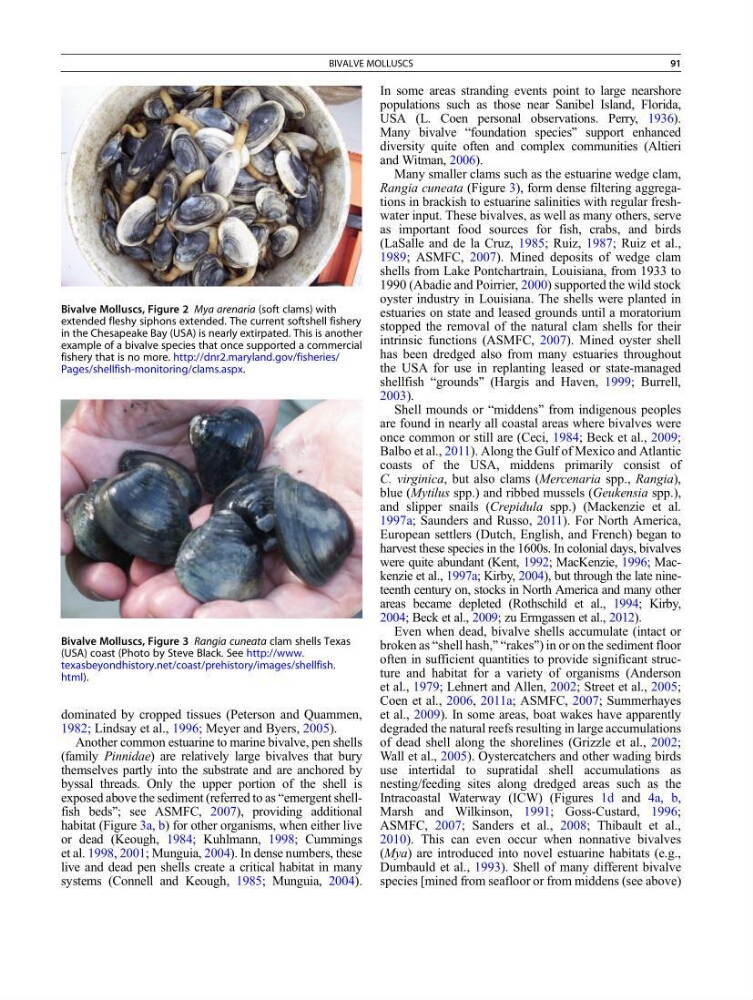
Rangia cuneata (Figure 3), form dense filtering aggregations in brackish to estuarine salinities with regular freshwater input. These bivalves, as well as many others, serve
as important food sources for fish, crabs, and birds
(LaSalle and de la Cruz, 1985; Ruiz, 1987; Ruiz et al.,
1989; ASMFC, 2007). Mined deposits of wedge clam
shells from Lake Pontchartrain, Louisiana, from 1933 to
1990 (Abadie and Poirrier, 2000) supported the wild stock
oyster industry in Louisiana. The shells were planted in
estuaries on state and leased grounds until a moratorium
stopped the removal of the natural clam shells for their
intrinsic functions (ASMFC, 2007). Mined oyster shell
has been dredged also from many estuaries throughout
the USA for use in replanting leased or state-managed
shellfish “grounds” (Hargis and Haven, 1999; Burrell,
2003).
Shell mounds or “middens” from indigenous peoples
are found in nearly all coastal areas where bivalves were
once common or still are (Ceci, 1984; Beck et al., 2009;
Balbo et al., 2011). Along the Gulf of Mexico and Atlantic
coasts of the USA, middens primarily consist of
C. virginica, but also clams (Mercenaria spp., Rangia),
blue (Mytilus spp.) and ribbed mussels (Geukensia spp.),
and slipper snails (Crepidula spp.) (Mackenzie et al.
1997a; Saunders and Russo, 2011). For North America,
European settlers (Dutch, English, and French) began to
harvest these species in the 1600s. In colonial days, bivalves
were quite abundant (Kent, 1992; MacKenzie, 1996; Mackenzie et al., 1997a; Kirby, 2004), but through the late nineteenth century on, stocks in North America and many other
areas became depleted (Rothschild et al., 1994; Kirby,
2004; Beck et al., 2009; zu Ermgassen et al., 2012).
Even when dead, bivalve shells accumulate (intact or
broken as “shell hash,” “rakes”) in or on the sediment floor
often in sufficient quantities to provide significant structure and habitat for a variety of organisms (Anderson
et al., 1979; Lehnert and Allen, 2002; Street et al., 2005;
Coen et al., 2006, 2011a; ASMFC, 2007; Summerhayes
et al., 2009). In some areas, boat wakes have apparently
degraded the natural reefs resulting in large accumulations
of dead shell along the shorelines (Grizzle et al., 2002;
Wall et al., 2005). Oystercatchers and other wading birds
use intertidal to supratidal shell accumulations as
nesting/feeding sites along dredged areas such as the
Intracoastal Waterway (ICW) (Figures 1d and 4a, b,
Marsh and Wilkinson, 1991; Goss-Custard, 1996;
ASMFC, 2007; Sanders et al., 2008; Thibault et al.,
2010). This can even occur when nonnative bivalves
(Mya) are introduced into novel estuarine habitats (e.g.,
Dumbauld et al., 1993). Shell of many different bivalve
species [mined from seafloor or from middens (see above)
Bivalve Molluscs, Figure 2 Mya arenaria (soft clams) with
extended fleshy siphons extended. The current softshell fishery
in the Chesapeake Bay (USA) is nearly extirpated. This is another
example of a bivalve species that once supported a commercial
fishery that is no more. http://dnr2.maryland.gov/fisheries/
Pages/shellfish-monitoring/clams.aspx.
Bivalve Molluscs, Figure 3 Rangia cuneata clam shells Texas
(USA) coast (Photo by Steve Black. See http://www.
texasbeyondhistory.net/coast/prehistory/images/shellfish.
html).
BIVALVE MOLLUSCS
91
1982; Lindsay et al., 1996; Meyer and Byers, 2005).
Another common estuarine to marine bivalve, pen shells
(family Pinnidae) are relatively large bivalves that bury
themselves partly into the substrate and are anchored by
byssal threads. Only the upper portion of the shell is
exposed above the sediment (referred to as “emergent shellfish beds”; see ASMFC, 2007), providing additional
habitat (Figure 3a, b) for other organisms, when either live
or dead (Keough, 1984; Kuhlmann, 1998; Cummings
et al. 1998, 2001; Munguia, 2004). In dense numbers, these
live and dead pen shells create a critical habitat in many
systems (Connell and Keough, 1985; Munguia, 2004).
In some areas stranding events point to large nearshore
populations such as those near Sanibel Island, Florida,
USA (L. Coen personal observations. Perry, 1936).
Many bivalve “foundation species” support enhanced
diversity quite often and complex communities (Altieri
and Witman, 2006).
Many smaller clams such as the estuarine wedge clam,
Rangia cuneata (Figure 3), form dense filtering aggregations in brackish to estuarine salinities with regular freshwater input. These bivalves, as well as many others, serve
as important food sources for fish, crabs, and birds
(LaSalle and de la Cruz, 1985; Ruiz, 1987; Ruiz et al.,
1989; ASMFC, 2007). Mined deposits of wedge clam
shells from Lake Pontchartrain, Louisiana, from 1933 to
1990 (Abadie and Poirrier, 2000) supported the wild stock
oyster industry in Louisiana. The shells were planted in
estuaries on state and leased grounds until a moratorium
stopped the removal of the natural clam shells for their
intrinsic functions (ASMFC, 2007). Mined oyster shell
has been dredged also from many estuaries throughout
the USA for use in replanting leased or state-managed
shellfish “grounds” (Hargis and Haven, 1999; Burrell,
2003).
Shell mounds or “middens” from indigenous peoples
are found in nearly all coastal areas where bivalves were
once common or still are (Ceci, 1984; Beck et al., 2009;
Balbo et al., 2011). Along the Gulf of Mexico and Atlantic
coasts of the USA, middens primarily consist of
C. virginica, but also clams (Mercenaria spp., Rangia),
blue (Mytilus spp.) and ribbed mussels (Geukensia spp.),
and slipper snails (Crepidula spp.) (Mackenzie et al.
1997a; Saunders and Russo, 2011). For North America,
European settlers (Dutch, English, and French) began to
harvest these species in the 1600s. In colonial days, bivalves
were quite abundant (Kent, 1992; MacKenzie, 1996; Mackenzie et al., 1997a; Kirby, 2004), but through the late nineteenth century on, stocks in North America and many other
areas became depleted (Rothschild et al., 1994; Kirby,
2004; Beck et al., 2009; zu Ermgassen et al., 2012).
Even when dead, bivalve shells accumulate (intact or
broken as “shell hash,” “rakes”) in or on the sediment floor
often in sufficient quantities to provide significant structure and habitat for a variety of organisms (Anderson
et al., 1979; Lehnert and Allen, 2002; Street et al., 2005;
Coen et al., 2006, 2011a; ASMFC, 2007; Summerhayes
et al., 2009). In some areas, boat wakes have apparently
degraded the natural reefs resulting in large accumulations
of dead shell along the shorelines (Grizzle et al., 2002;
Wall et al., 2005). Oystercatchers and other wading birds
use intertidal to supratidal shell accumulations as
nesting/feeding sites along dredged areas such as the
Intracoastal Waterway (ICW) (Figures 1d and 4a, b,
Marsh and Wilkinson, 1991; Goss-Custard, 1996;
ASMFC, 2007; Sanders et al., 2008; Thibault et al.,
2010). This can even occur when nonnative bivalves
(Mya) are introduced into novel estuarine habitats (e.g.,
Dumbauld et al., 1993). Shell of many different bivalve
species [mined from seafloor or from middens (see above)
Bivalve Molluscs, Figure 2 Mya arenaria (soft clams) with
extended fleshy siphons extended. The current softshell fishery
in the Chesapeake Bay (USA) is nearly extirpated. This is another
example of a bivalve species that once supported a commercial
fishery that is no more. http://dnr2.maryland.gov/fisheries/
Pages/shellfish-monitoring/clams.aspx.
Bivalve Molluscs, Figure 3 Rangia cuneata clam shells Texas
(USA) coast (Photo by Steve Black. See http://www.
texasbeyondhistory.net/coast/prehistory/images/shellfish.
html).
BIVALVE MOLLUSCS
91