

pared to the contributions by man from other sources, the amounts of cancer-causing
polycyclic aromatic hydrocarbons that can be transfered to fish and other marine
edibles via petroleum seem to be insignificant (see Chap. 5.2).
Of greater significance are the adverse effects that marine bird life suffers from oil
pollution. Right after World War I, the Royal Society for the Protection of Birds in
Great Britain began a study of oiled birds on the coasts. As a result, the International
Conference on Oil Pollution of Navigable Waters, at which 14 nations took part,
came into being in 1926. This was the first attempt on an international level to
achive a reduction of oil pollution by ocean traffic. Finally, the 1954 IMCO convention on oil pollution (see Chap. 10) also goes back to the activity of British ornithologists in the British Advisory Committee on Oil Pollution of the Sea.
There have been numerous surveys about the number of birds that die annually as a
result of oil pollution (Bourne 1976). In the period of 1950, there were said to have
been 50,000-250,000 sea bird casualties annually in the area of the British Isles. The
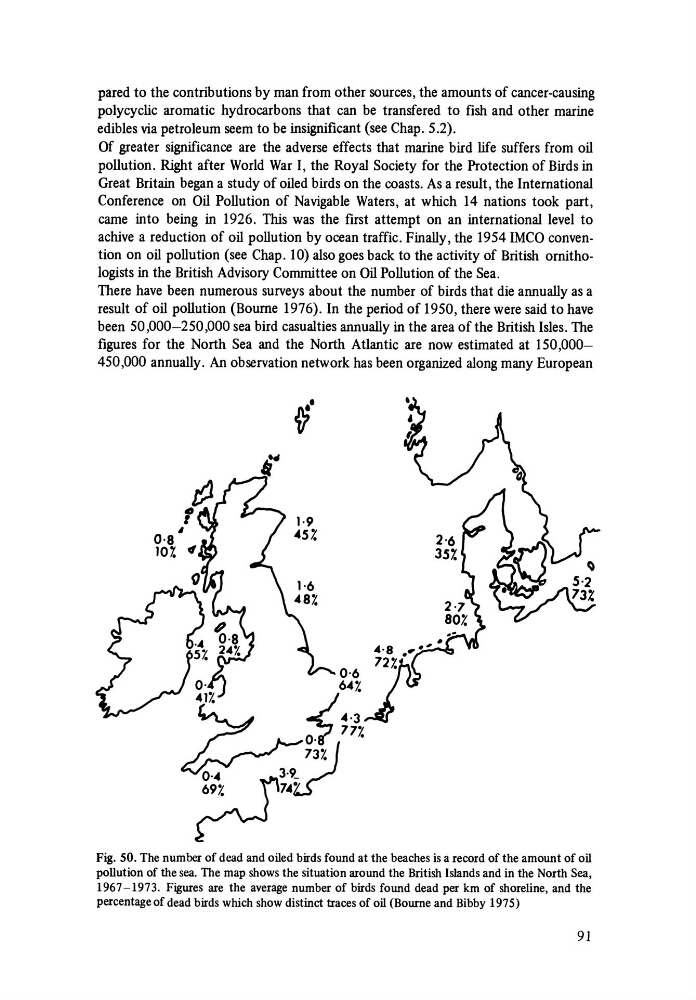
figures for the North Sea and the North Atlantic are now estimated at 150,000450,000 annually. An observation network has been organized along many European
'lil
0·6
i.;~
~
37.
~9~ _ r
3
.
9
-
~7'.
Fig. 50. The number of dead and oiled birds found at the beaches is a record of the amount of oil
pollution of the sea. The map shows the situation around the British Is1ands and in the North Sea,
1967-1973. Figures are the average number of birds found dead per km of shoreline, and the
percentage of dead birds which show distinct traces of oil (Bourne and Bibby 1975)
91
polycyclic aromatic hydrocarbons that can be transfered to fish and other marine
edibles via petroleum seem to be insignificant (see Chap. 5.2).
Of greater significance are the adverse effects that marine bird life suffers from oil
pollution. Right after World War I, the Royal Society for the Protection of Birds in
Great Britain began a study of oiled birds on the coasts. As a result, the International
Conference on Oil Pollution of Navigable Waters, at which 14 nations took part,
came into being in 1926. This was the first attempt on an international level to
achive a reduction of oil pollution by ocean traffic. Finally, the 1954 IMCO convention on oil pollution (see Chap. 10) also goes back to the activity of British ornithologists in the British Advisory Committee on Oil Pollution of the Sea.
There have been numerous surveys about the number of birds that die annually as a
result of oil pollution (Bourne 1976). In the period of 1950, there were said to have
been 50,000-250,000 sea bird casualties annually in the area of the British Isles. The
figures for the North Sea and the North Atlantic are now estimated at 150,000450,000 annually. An observation network has been organized along many European
'lil
0·6
i.;~
~
37.
~9~ _ r
3
.
9
-
~7'.
Fig. 50. The number of dead and oiled birds found at the beaches is a record of the amount of oil
pollution of the sea. The map shows the situation around the British Is1ands and in the North Sea,
1967-1973. Figures are the average number of birds found dead per km of shoreline, and the
percentage of dead birds which show distinct traces of oil (Bourne and Bibby 1975)
91