

Table 16. Even in concentrations in which crude oil shows no damaging effects in experimental situations, subtle effects can influence the reproduction of organisms. In precopulation, the male and
female amphipodes clasp each other for a fairly long period of time and only complete their copulation during the next moulting procedure. If the partners are separated during precopulation, they
usually find their way back to each other quickly. But in seawater into which very small amounts
of Venezuelan crude oil have been introduced, this behavior patter is disturbed in GamfTlllrus
oceanicus (Linden 1976)
Concentration of oil
o (Control)
1
10
20
40
Number of pairs out of 10 that pre couple after separation
Period of oil effect in days
1
2 4 8
10
10
o
o
o
10
10
o
o
o
10
10
2
o
o
10
10
5
o
o
If Pachygrapsus crassipes crabs are exposed to a water-soluble extract of crude oil for
24 h, they do not react as usual, with quick movements of their mouth appendices
to the amino acid taurine which usually signals food to them. On the other hand, it is
said that oil-soaked rags and bricks attract lobsters into traps as well as any other
bait, and there are experiments which show that the perception of chemical stimuli
is interfered with by petroleum components, not only in predator crabs and snails,
but also in mobile bacteria.
Signal substances which are synthesized in an organism and released into the water in
order to inform another organisms of the same species are called pheromones. Watersoluble extracts from crude oil cause the pheromones produced by the femalePachygrapsus crab to be ineffectual and they do not generate seeking movements and the mating
position as is usually the case when they reach the male (Takahashi and Kittredge 1973).
In some cases these animals must be kept up to 6 days in clean seawater before the
pheromone effect is normal again. Instead of using crude oil, the same inhibiting effect
can be temporarily achieved by using various monocyclic aromatic compounds; it can
be longer-lasting using naphthalene, anthracene, and other polycyclic aromatic hydrocarbons at concentrations of 1-10 Jlg/l. It is not yet known whether or not the hampering effect of oil in chemical Signaling plays an essential role between marine organisms
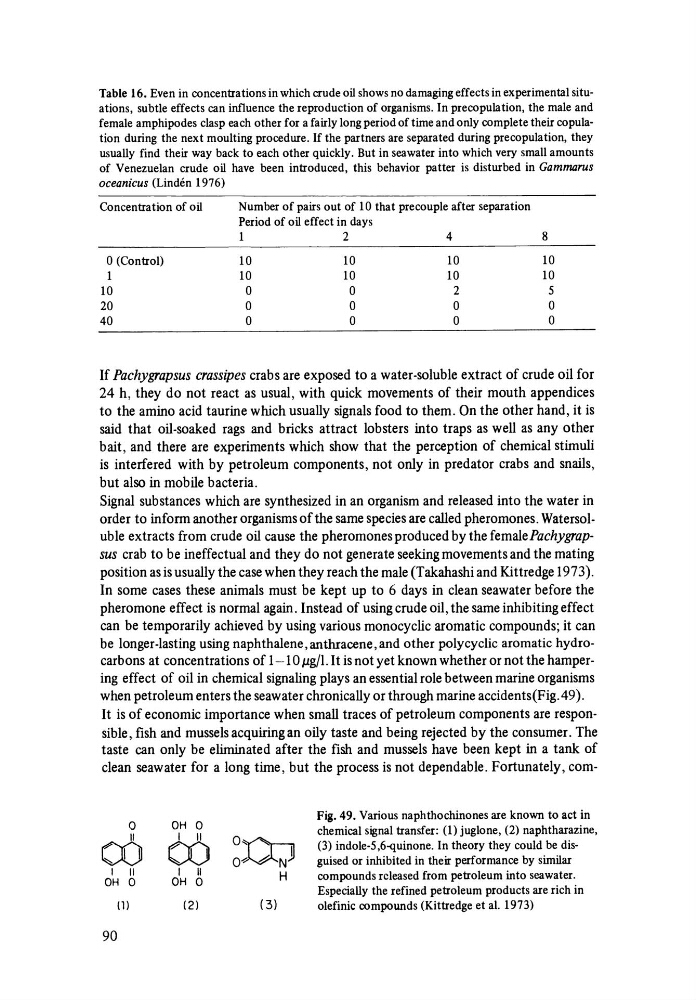
when petroleum enters the seawater chronically or through marine accidents(Fig.49).
It is of economic importance when small traces of petroleum components are responsible, fish and mussels acquiring an oily taste and being rejected by the consumer. The
taste can only be eliminated after the fish and mussels have been kept in a tank of
clean seawater for a long time, but the process is not dependable. Fortunately, como
II
00 I II
OH 0
(1)
90
OH 0
ro I II
OH 0
(2)
(3)
Fig. 49. Various naphthochinones are known to act in
chemical signal transfer: (1) juglone, (2) naphtharazine,
(3) indole-5,6-quinone. In theory they could be disguised or inhibited in their performance by similar
compounds released from petroleum into seawater.
Especially the refined petroleum products are rich in
olefinic compounds (Kittredge et al. 1973)
female amphipodes clasp each other for a fairly long period of time and only complete their copulation during the next moulting procedure. If the partners are separated during precopulation, they
usually find their way back to each other quickly. But in seawater into which very small amounts
of Venezuelan crude oil have been introduced, this behavior patter is disturbed in GamfTlllrus
oceanicus (Linden 1976)
Concentration of oil
o (Control)
1
10
20
40
Number of pairs out of 10 that pre couple after separation
Period of oil effect in days
1
2 4 8
10
10
o
o
o
10
10
o
o
o
10
10
2
o
o
10
10
5
o
o
If Pachygrapsus crassipes crabs are exposed to a water-soluble extract of crude oil for
24 h, they do not react as usual, with quick movements of their mouth appendices
to the amino acid taurine which usually signals food to them. On the other hand, it is
said that oil-soaked rags and bricks attract lobsters into traps as well as any other
bait, and there are experiments which show that the perception of chemical stimuli
is interfered with by petroleum components, not only in predator crabs and snails,
but also in mobile bacteria.
Signal substances which are synthesized in an organism and released into the water in
order to inform another organisms of the same species are called pheromones. Watersoluble extracts from crude oil cause the pheromones produced by the femalePachygrapsus crab to be ineffectual and they do not generate seeking movements and the mating
position as is usually the case when they reach the male (Takahashi and Kittredge 1973).
In some cases these animals must be kept up to 6 days in clean seawater before the
pheromone effect is normal again. Instead of using crude oil, the same inhibiting effect
can be temporarily achieved by using various monocyclic aromatic compounds; it can
be longer-lasting using naphthalene, anthracene, and other polycyclic aromatic hydrocarbons at concentrations of 1-10 Jlg/l. It is not yet known whether or not the hampering effect of oil in chemical Signaling plays an essential role between marine organisms
when petroleum enters the seawater chronically or through marine accidents(Fig.49).
It is of economic importance when small traces of petroleum components are responsible, fish and mussels acquiring an oily taste and being rejected by the consumer. The
taste can only be eliminated after the fish and mussels have been kept in a tank of
clean seawater for a long time, but the process is not dependable. Fortunately, como
II
00 I II
OH 0
(1)
90
OH 0
ro I II
OH 0
(2)
(3)
Fig. 49. Various naphthochinones are known to act in
chemical signal transfer: (1) juglone, (2) naphtharazine,
(3) indole-5,6-quinone. In theory they could be disguised or inhibited in their performance by similar
compounds released from petroleum into seawater.
Especially the refined petroleum products are rich in
olefinic compounds (Kittredge et al. 1973)