

100
90
80
70
Q) 60
<11
1: 50
~
'0 40
-/30
20
10
,,,'
~
I
I
I
I
I
I
I
I
I
I
I
J
.....
J
....
J
I
I
..
I
..... /
I
I
I
•• :.::..: • .:.;: ......... ,.J.~ •••••• /
' ..... _"
o 10 20 30 40 50 60 70 80 90 '/,
Concentration of Saturated Solution
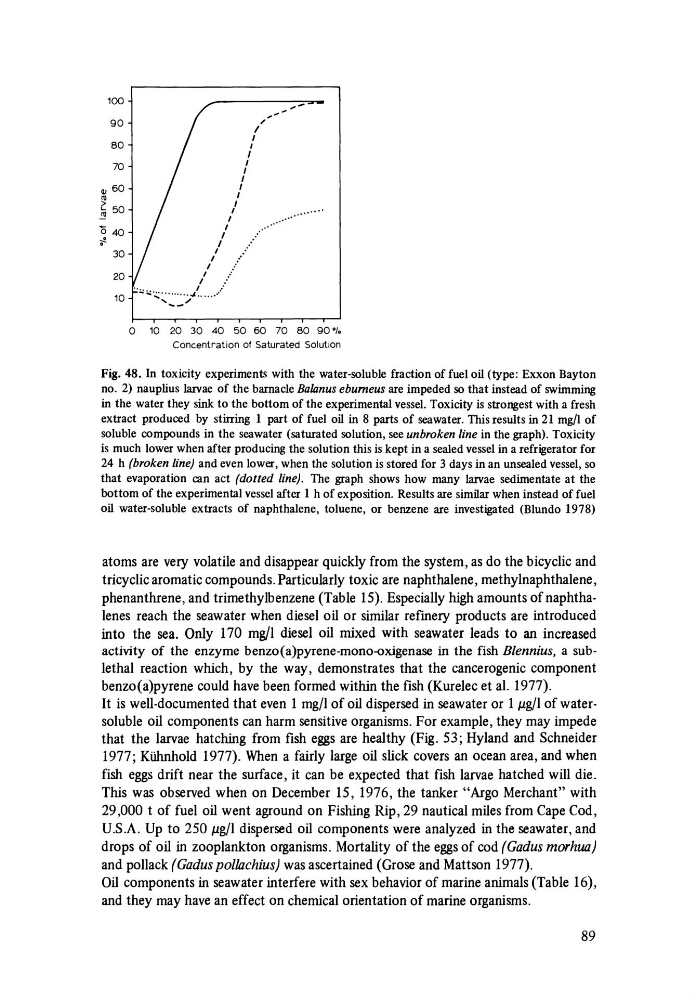
Fig. 48. In toxicity experiments with the water-soluble fraction of fuel oil (type: Exxon Bay ton
no. 2) nauplius larvae of the barnacle Balanus ebumeus are impeded so that instead of swimming
in the water they sink to the bottom of the experimental vessel. Toxicity is strongest with a fresh
extract produced by stirring 1 part of fuel oil in 8 parts of seawater. This results in 21 mg/l of
soluble compounds in the seawater (saturated solution, see unbroken line in the graph). Toxicity
is much lower when after producing the solution this is kept in a sealed vessel in a refrigerator for
24 h (broken line) and even lower, when the solution is stored for 3 days in an unsealed vessel, so
that evaporation can act (dotted line). The graph shows how many larvae sedimentate at the
bottom of the experimental vessel after I h of exposition. Results are similar when instead of fuel
oil water-soluble extracts of naphthalene, toluene, or benzene are investigated (Blundo 1978)
atoms are very volatile and disappear quickly from the system, as do the bicyclic and
tricyclic aromatic compounds. Particularly toxic are naphthalene, methylnaphthalene,
phenanthrene, and trimethylbenzene (Table 15). Especially high amounts of naphthalenes reach the seawater when diesel oil or similar refmery products are introduced
into the sea. Only 170 mg/l diesel oil mixed with seawater leads to an increased
activity of the enzyme benzo(a)pyrene-mono-oxigenase in the fish Blennius, a sublethal reaction which, by the way, demonstrates that the cancerogenic component
benzo(a)pyrene could have been formed within the fish (Kurelec et al. 1977).
It is well-documented that even 1 mg/l of oil dispersed in seawater or 1 J1g/1 of watersoluble oil components can harm sensitive organisms. For example, they may impede
that the larvae hatching from fish eggs are healthy (Fig. 53; Hyland and Schneider
1977; Kiihnhold 1977). When a fairly large oil slick covers an ocean area, and when
fish eggs drift near the surface, it can be expected that fish larvae hatched will die.
This was observed when on December 15, 1976, the tanker "Argo Merchant" with
29,000 t of fuel oil went aground on Fishing Rip, 29 nautical miles from Cape Cod,
U.S.A. Up to 250 J..lg/I dispersed oil components were analyzed in the seawater, and
drops of oil in zooplankton organisms. Mortality of the eggs of cod (Gadus morhua)
and pollack (Gadus po/kzchius) was ascertained (Grose and Mattson 1977).
Oil components in seawater interfere with sex behavior of marine animals (Table 16),
and they may have an effect on chemical orientation of marine organisms.
89
90
80
70
Q) 60
<11
1: 50
~
'0 40
-/30
20
10
,,,'
~
I
I
I
I
I
I
I
I
I
I
I
J
.....
J
....
J
I
I
..
I
..... /
I
I
I
•• :.::..: • .:.;: ......... ,.J.~ •••••• /
' ..... _"
o 10 20 30 40 50 60 70 80 90 '/,
Concentration of Saturated Solution
Fig. 48. In toxicity experiments with the water-soluble fraction of fuel oil (type: Exxon Bay ton
no. 2) nauplius larvae of the barnacle Balanus ebumeus are impeded so that instead of swimming
in the water they sink to the bottom of the experimental vessel. Toxicity is strongest with a fresh
extract produced by stirring 1 part of fuel oil in 8 parts of seawater. This results in 21 mg/l of
soluble compounds in the seawater (saturated solution, see unbroken line in the graph). Toxicity
is much lower when after producing the solution this is kept in a sealed vessel in a refrigerator for
24 h (broken line) and even lower, when the solution is stored for 3 days in an unsealed vessel, so
that evaporation can act (dotted line). The graph shows how many larvae sedimentate at the
bottom of the experimental vessel after I h of exposition. Results are similar when instead of fuel
oil water-soluble extracts of naphthalene, toluene, or benzene are investigated (Blundo 1978)
atoms are very volatile and disappear quickly from the system, as do the bicyclic and
tricyclic aromatic compounds. Particularly toxic are naphthalene, methylnaphthalene,
phenanthrene, and trimethylbenzene (Table 15). Especially high amounts of naphthalenes reach the seawater when diesel oil or similar refmery products are introduced
into the sea. Only 170 mg/l diesel oil mixed with seawater leads to an increased
activity of the enzyme benzo(a)pyrene-mono-oxigenase in the fish Blennius, a sublethal reaction which, by the way, demonstrates that the cancerogenic component
benzo(a)pyrene could have been formed within the fish (Kurelec et al. 1977).
It is well-documented that even 1 mg/l of oil dispersed in seawater or 1 J1g/1 of watersoluble oil components can harm sensitive organisms. For example, they may impede
that the larvae hatching from fish eggs are healthy (Fig. 53; Hyland and Schneider
1977; Kiihnhold 1977). When a fairly large oil slick covers an ocean area, and when
fish eggs drift near the surface, it can be expected that fish larvae hatched will die.
This was observed when on December 15, 1976, the tanker "Argo Merchant" with
29,000 t of fuel oil went aground on Fishing Rip, 29 nautical miles from Cape Cod,
U.S.A. Up to 250 J..lg/I dispersed oil components were analyzed in the seawater, and
drops of oil in zooplankton organisms. Mortality of the eggs of cod (Gadus morhua)
and pollack (Gadus po/kzchius) was ascertained (Grose and Mattson 1977).
Oil components in seawater interfere with sex behavior of marine animals (Table 16),
and they may have an effect on chemical orientation of marine organisms.
89