

Numerous studies have been conducted to learn about the toxic effect of oil on
marine organisms. There are, however, major experimental problems when complex
oil samples are investigated, as they are represented by all kinds of crude and refmed
oil. Stirring oil with seawater results in a labile system with particulate, colloidal and
dissolved hydrocarbons. The different toxic components of oil are volatile in different
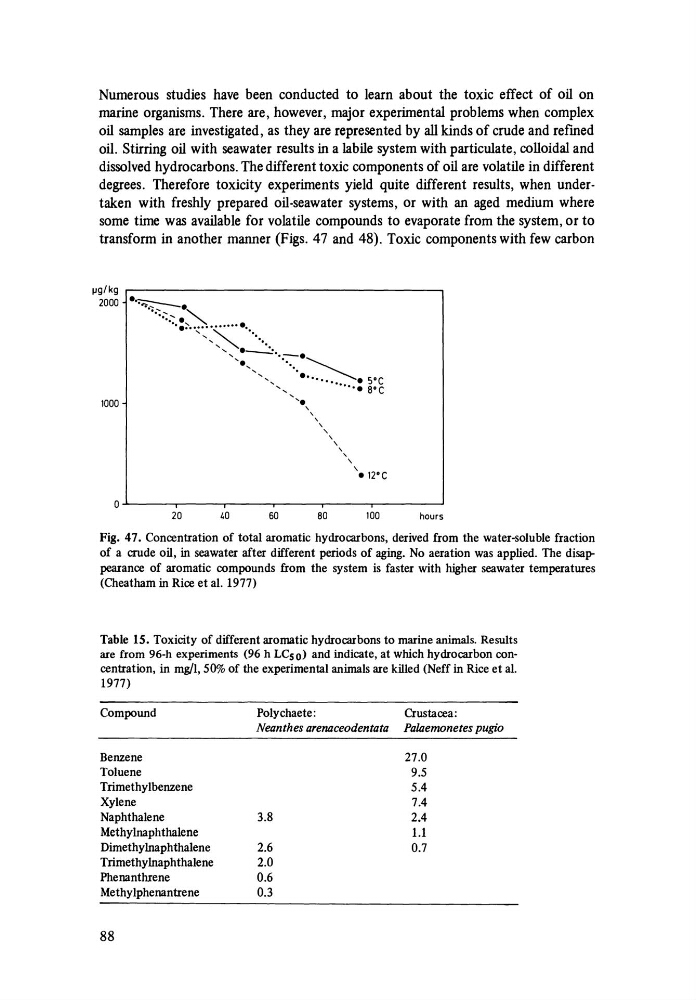
degrees. Therefore toxicity experiments yield quite different results, when undertaken with freshly prepared oil-seawater systems, or with an aged medium where
some time was available for volatile compounds to evaporate from the system, or to
transform in another manner (Figs. 47 and 48). Toxic components with few carbon
~g/kg . - - - - - - - - - - - - - - - - - - - - - - - ,
2000
1000
.. ~., .. ;-...... ~"
.... ::-.. ~::~~ •........
",:~ ... ~.,,...........
• ...•• ~. Soc
...........
. .•• Soc
' . , , , , , , , , , , ,
.12'C
O~--_r---.--_.---._--,_---~
20
La
60
80
100
hours
Fig. 47. Concentration of total aromatic hydrocarbons, derived from the water-soluble fraction
of a crude oil, in seawater after different periods of aging. No aeration was applied. The disappearance of aromatic compounds from the system is faster with higher seawater temperatures
(Cheatham in Rice et al. 1977)
Table 15. Toxicity of different aromatic hydrocarbons to marine animals. Results
are from 96-h experiments (96 h LCs 0) and indicate, at which hydrocarbon concentration, in mg/l, 50% of the experimental animals are killed (Neff in Rice et al.
1977)
Compound
Benzene
Toluene
Trimethylbenzene
Xylene
Naphthalene
Methylnaphthalene
Dimethylnaphthalene
Trimethylnaphthalene
Phenanthrene
Methylphenantrene
88
Polychaete:
Neanthes arenaceodentata
3.8
2.6
2.0
0.6
0.3
Crustacea:
Palaemonetes pugio
27.0
9.5
5.4
7.4
2.4
1.1
0.7
marine organisms. There are, however, major experimental problems when complex
oil samples are investigated, as they are represented by all kinds of crude and refmed
oil. Stirring oil with seawater results in a labile system with particulate, colloidal and
dissolved hydrocarbons. The different toxic components of oil are volatile in different
degrees. Therefore toxicity experiments yield quite different results, when undertaken with freshly prepared oil-seawater systems, or with an aged medium where
some time was available for volatile compounds to evaporate from the system, or to
transform in another manner (Figs. 47 and 48). Toxic components with few carbon
~g/kg . - - - - - - - - - - - - - - - - - - - - - - - ,
2000
1000
.. ~., .. ;-...... ~"
.... ::-.. ~::~~ •........
",:~ ... ~.,,...........
• ...•• ~. Soc
...........
. .•• Soc
' . , , , , , , , , , , ,
.12'C
O~--_r---.--_.---._--,_---~
20
La
60
80
100
hours
Fig. 47. Concentration of total aromatic hydrocarbons, derived from the water-soluble fraction
of a crude oil, in seawater after different periods of aging. No aeration was applied. The disappearance of aromatic compounds from the system is faster with higher seawater temperatures
(Cheatham in Rice et al. 1977)
Table 15. Toxicity of different aromatic hydrocarbons to marine animals. Results
are from 96-h experiments (96 h LCs 0) and indicate, at which hydrocarbon concentration, in mg/l, 50% of the experimental animals are killed (Neff in Rice et al.
1977)
Compound
Benzene
Toluene
Trimethylbenzene
Xylene
Naphthalene
Methylnaphthalene
Dimethylnaphthalene
Trimethylnaphthalene
Phenanthrene
Methylphenantrene
88
Polychaete:
Neanthes arenaceodentata
3.8
2.6
2.0
0.6
0.3
Crustacea:
Palaemonetes pugio
27.0
9.5
5.4
7.4
2.4
1.1
0.7