

55~r-----------=~""":'!'~r---or--...,
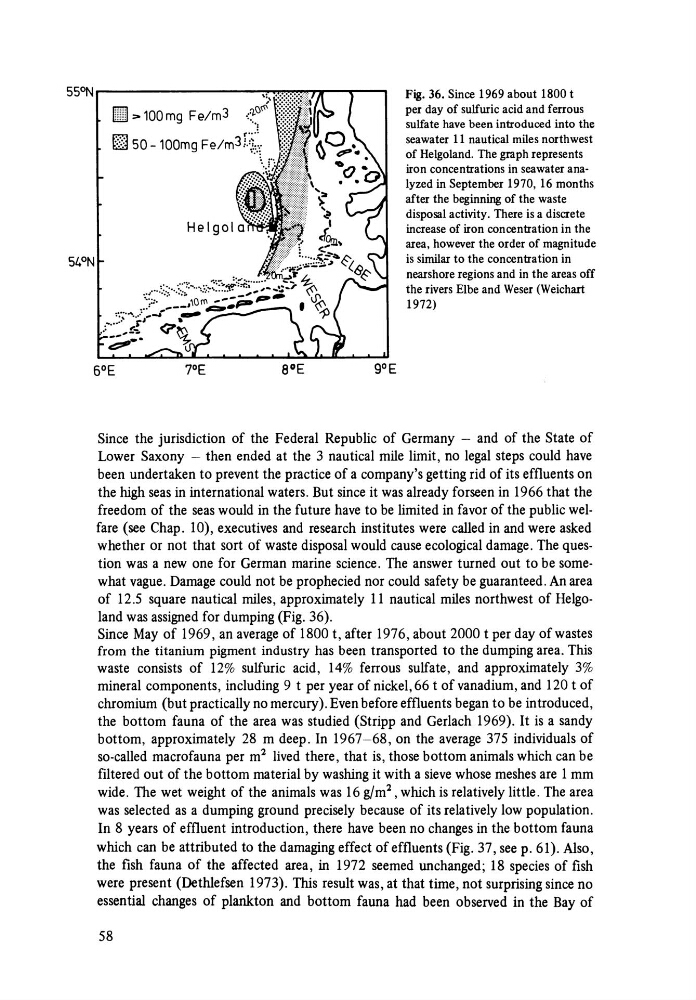
~ > 100 mg Felm 3
fj] 50 -100mg Fe/m 3
Fig. 36. Since 1969 about 1800 t
per day of sulfuric acid and ferrous
sulfate have been introduced into the
seawater 11 nautical miles northwest
of Helgoland. The graph represents
iron concentrations in seawater analyzed in September 1970, 16 months
after the beginning of the waste
disposal activity. There is a discrete
increase of iron concentration in the
area, however the order of magnitude
is similar to the concentration in
nearshore regions and in the areas off
the rivers Elbe and Weser (Weichart
1972)
Since the jurisdiction of the Federal Republic of Germany - and of the State of
Lower Saxony - then ended at the 3 nautical mile limit, no legal steps could have
been undertaken to prevent the practice of a company's getting rid of its effluents on
the high seas in international waters. But since it was already forseen in 1966 that the
freedom of the seas would in the future have to be limited in favor of the public welfare (see Chap. 10), executives and research institutes were called in and were asked
whether or not that sort of waste disposal would cause ecological damage. The question was a new one for German marine science. The answer turned out to be somewhat vague. Damage could not be prophecied nor could safety be guaranteed. An area
of 12.5 square nautical miles, approximately 11 nautical miles northwest of Helgoland was assigned for dumping (Fig. 36).
Since May of 1969, an average of 1800 t, after 1976, about 2000 t per day of wastes
from the titanium pigment industry has been transported to the dumping area. This
waste consists of 12% sulfuric acid, 14% ferrous sulfate, and approximately 3%
mineral components, including 9 t per year of nickel, 66 t of vanadium, and 120 t of
chromium (but practically no mercury). Even before effluents began to be introduced,
the bottom fauna of the area was studied (Stripp and Gerlach 1969). It is a sandy
bottom, approximately 28 m deep. In 1967-68, on the average 375 individuals of
so-called macrofauna per m 2 lived there, that is, those bottom animals which can be
filtered out of the bottom material by washing it with a sieve whose meshes are 1 mm
wide. The wet weight of the animals was 16 gjm 2 , which is relatively little. The area
was selected as a dumping ground precisely because of its relatively low population.
In 8 years of effluent introduction, there have been no changes in the bottom fauna
which can be attributed to the damaging effect of effluents (Fig. 37, see p. 61). Also,
the fish fauna of the affected area, in 1972 seemed unchanged; 18 species of fish
were present (Dethlefsen 1973). This result was, at that time, not surprising since no
essential changes of plankton and bottom fauna had been observed in the Bay of
58
~ > 100 mg Felm 3
fj] 50 -100mg Fe/m 3
Fig. 36. Since 1969 about 1800 t
per day of sulfuric acid and ferrous
sulfate have been introduced into the
seawater 11 nautical miles northwest
of Helgoland. The graph represents
iron concentrations in seawater analyzed in September 1970, 16 months
after the beginning of the waste
disposal activity. There is a discrete
increase of iron concentration in the
area, however the order of magnitude
is similar to the concentration in
nearshore regions and in the areas off
the rivers Elbe and Weser (Weichart
1972)
Since the jurisdiction of the Federal Republic of Germany - and of the State of
Lower Saxony - then ended at the 3 nautical mile limit, no legal steps could have
been undertaken to prevent the practice of a company's getting rid of its effluents on
the high seas in international waters. But since it was already forseen in 1966 that the
freedom of the seas would in the future have to be limited in favor of the public welfare (see Chap. 10), executives and research institutes were called in and were asked
whether or not that sort of waste disposal would cause ecological damage. The question was a new one for German marine science. The answer turned out to be somewhat vague. Damage could not be prophecied nor could safety be guaranteed. An area
of 12.5 square nautical miles, approximately 11 nautical miles northwest of Helgoland was assigned for dumping (Fig. 36).
Since May of 1969, an average of 1800 t, after 1976, about 2000 t per day of wastes
from the titanium pigment industry has been transported to the dumping area. This
waste consists of 12% sulfuric acid, 14% ferrous sulfate, and approximately 3%
mineral components, including 9 t per year of nickel, 66 t of vanadium, and 120 t of
chromium (but practically no mercury). Even before effluents began to be introduced,
the bottom fauna of the area was studied (Stripp and Gerlach 1969). It is a sandy
bottom, approximately 28 m deep. In 1967-68, on the average 375 individuals of
so-called macrofauna per m 2 lived there, that is, those bottom animals which can be
filtered out of the bottom material by washing it with a sieve whose meshes are 1 mm
wide. The wet weight of the animals was 16 gjm 2 , which is relatively little. The area
was selected as a dumping ground precisely because of its relatively low population.
In 8 years of effluent introduction, there have been no changes in the bottom fauna
which can be attributed to the damaging effect of effluents (Fig. 37, see p. 61). Also,
the fish fauna of the affected area, in 1972 seemed unchanged; 18 species of fish
were present (Dethlefsen 1973). This result was, at that time, not surprising since no
essential changes of plankton and bottom fauna had been observed in the Bay of
58