

Authorities sometimes react nervously when events take place that do not actually
justify such a reaction (Anon 1975). For example, the 115,000 t tanker "Enskeris"
left Finland in March, 1975, with a load of around 100 to of arsenic compounds
packed into 500 barrels and destined to be thrown overboard on the high sea of the
South Atlantic. This aroused public anger, and the governments of Brasil and South
Africa protested. As a result, the Finnish government ordered the ship back. In the
meantime, international agreements have been worked out which either prohibit the
dumping of poisonous compounds or make dumping dependent on a thorough analysis of the situation before a permit to do so is issued (see Chap. 10).
4.2 Waste Acids and Ferrous Sulfate of the Titanium Pigment Industry
and the Problem of the Indicator Communities
The impetus for a thorough-going scientific study of the problems of marine pollution in the coastal area of the Federal Republic of Germany was the 1966 plan by
Kronos Titan Ltd. to establish a plant on the Blexer Groden, near Nordenham in the
Weser Estuary, for the manufacture of titanium dioxide as an important paint pigment. Titanium ore (ilmenite) is to be cleaned by means of sulfuric acid. As the waste
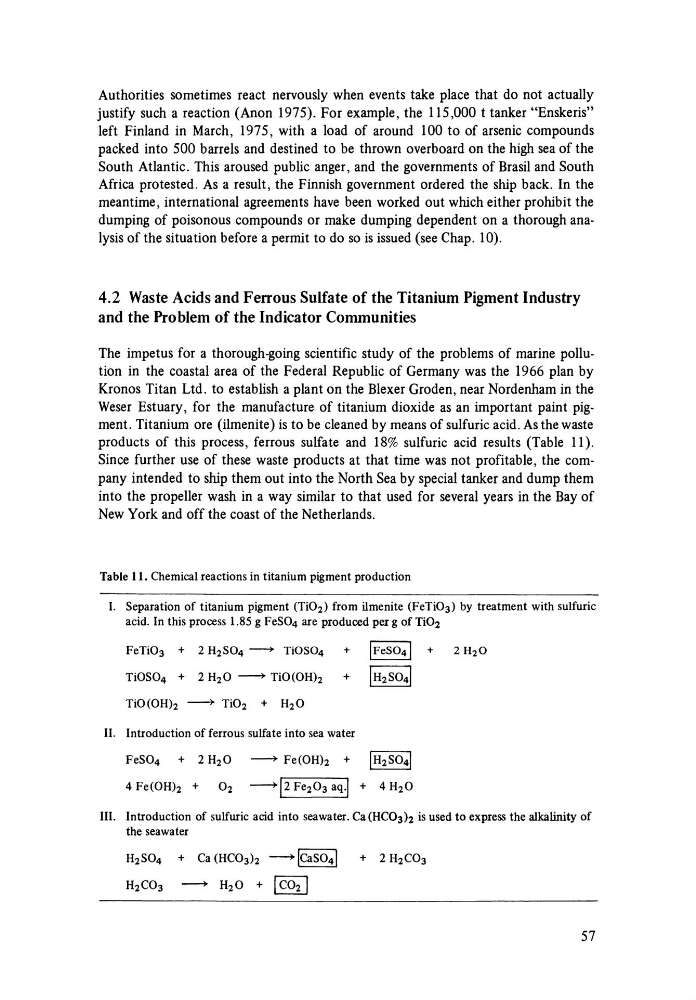
products of this process, ferrous sulfate and 18% sulfuric acid results (Table 11).
Since further use of these waste products at that time was not profitable, the company intended to ship them out into the North Sea by special tanker and dump them
into the propeller wash in a way similar to that used for several years in the Bay of
New York and off the coast of the Netherlands.
Table 11. Chemical reactions in titanium pigment production
1. Separation of titanium pigment (Ti02) from ilmenite (FeTi03) by treatment with sulfuric
acid. In this process 1.85 g FeS04 are produced per g of Ti02
FeTi03 + 2 H2S04 ----+ TiOS04
+
IFeS041 +
2 H2O
TiOS04 + 2 H20 ~ TiO(OHh
+
I H 2 s0 41
TiO(OHh ~ Ti02 + H2 O
II. Introduction of ferrous sulfate into sea water
FeS04 + 2 H2 O ~ Fe(OHh +
IH2S041
4 Fe(OHh +
O2 ~12 Fe203 aq·1 + 4 H2O
III. Introduction of sulfuric acid into seawater. Ca (HC03h is used to express the alkalinity of
the seawater
H2S04 + Ca (HC03h ---+ leas041
+ 2 H2C03
H2 C03 ---+ H20 + 1 C02 I
57
justify such a reaction (Anon 1975). For example, the 115,000 t tanker "Enskeris"
left Finland in March, 1975, with a load of around 100 to of arsenic compounds
packed into 500 barrels and destined to be thrown overboard on the high sea of the
South Atlantic. This aroused public anger, and the governments of Brasil and South
Africa protested. As a result, the Finnish government ordered the ship back. In the
meantime, international agreements have been worked out which either prohibit the
dumping of poisonous compounds or make dumping dependent on a thorough analysis of the situation before a permit to do so is issued (see Chap. 10).
4.2 Waste Acids and Ferrous Sulfate of the Titanium Pigment Industry
and the Problem of the Indicator Communities
The impetus for a thorough-going scientific study of the problems of marine pollution in the coastal area of the Federal Republic of Germany was the 1966 plan by
Kronos Titan Ltd. to establish a plant on the Blexer Groden, near Nordenham in the
Weser Estuary, for the manufacture of titanium dioxide as an important paint pigment. Titanium ore (ilmenite) is to be cleaned by means of sulfuric acid. As the waste
products of this process, ferrous sulfate and 18% sulfuric acid results (Table 11).
Since further use of these waste products at that time was not profitable, the company intended to ship them out into the North Sea by special tanker and dump them
into the propeller wash in a way similar to that used for several years in the Bay of
New York and off the coast of the Netherlands.
Table 11. Chemical reactions in titanium pigment production
1. Separation of titanium pigment (Ti02) from ilmenite (FeTi03) by treatment with sulfuric
acid. In this process 1.85 g FeS04 are produced per g of Ti02
FeTi03 + 2 H2S04 ----+ TiOS04
+
IFeS041 +
2 H2O
TiOS04 + 2 H20 ~ TiO(OHh
+
I H 2 s0 41
TiO(OHh ~ Ti02 + H2 O
II. Introduction of ferrous sulfate into sea water
FeS04 + 2 H2 O ~ Fe(OHh +
IH2S041
4 Fe(OHh +
O2 ~12 Fe203 aq·1 + 4 H2O
III. Introduction of sulfuric acid into seawater. Ca (HC03h is used to express the alkalinity of
the seawater
H2S04 + Ca (HC03h ---+ leas041
+ 2 H2C03
H2 C03 ---+ H20 + 1 C02 I
57