

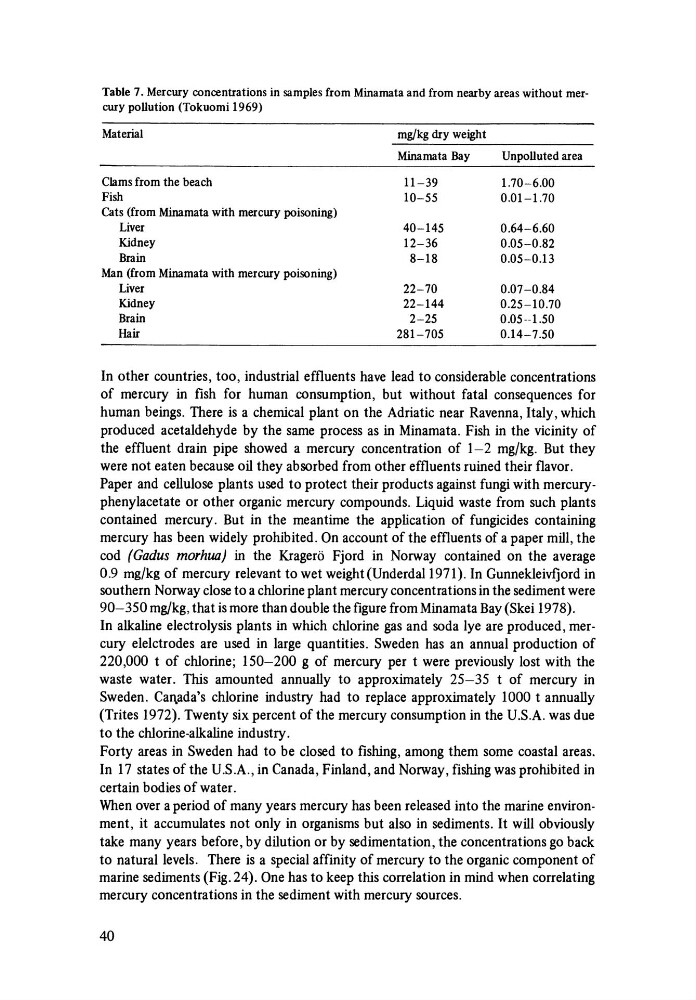
Table 7. Mercury concentrations in samples from Minamata and from nearby areas without mercury pollution (Tokuomi 1969)
Material
Clams from the beach
Fish
Cats (from Minamata with mercury poisoning)
Liver
Kidney
Brain
Man (from Minamata with mercury poisoning)
Liver
Kidney
Brain
Hair
mg/kg dry weight
Minamata Bay
11-39
10-55
40-145
12-36
8-18
22-70
22-144
2-25
281-705
Unpolluted area
1.70-6.00
0.01-1.70
0.64-6.60
0.05-0.82
0.05-0.13
0.07-0.84
0.25-10.70
0.05--1.50
0.14-7.50
In other countries, too, industrial effluents have lead to considerable concentrations
of mercury in fish for human consumption, but without fatal consequences for
human beings. There is a chemical plant on the Adriatic near Ravenna, Italy, which
produced acetaldehyde by the same process as in Minamata. Fish in the vicinity of
the effluent drain pipe showed a mercury concentration of 1-2 mg/kg. But they
were not eaten because oil they absorbed from other effluents ruined their flavor.
Paper and cellulose plants used to protect their products against fungi with mercuryphenylacetate or other organic mercury compounds. Liquid waste from such plants
contained mercury. But in the meantime the application of fungicides containing
mercury has been widely prohibited. On account of the effluents of a paper mill, the
cod (Gadus morhua) in the Kragero Fjord in Norway contained on the average
0.9 mg/kg of mercury relevant to wet weight (Underdal 1971}. In Gunnekleivfjord in
southern Norway close to a chlorine plant mercury concentrations in the sediment were
90-350 mg/kg, that is more than double the figure from Minamata Bay (Skei 1978).
In alkaline electrolysis plants in which chlorine gas and soda lye are produced, mercury elelctrodes are used in large quantities. Sweden has an annual production of
220,000 t of chlorine; 150-200 g of mercury per t were previously lost with the
waste water. This amounted annually to approximately 25-35 t of mercury in
Sweden. Cal\ada's chlorine industry had to replace approximately 1000 t annually
(Trites 1972). Twenty six percent of the mercury consumption in the U.S.A. was due
to the chlorine-alkaline industry.
Forty areas in Sweden had to be closed to fishing, among them some coastal areas.
In 17 states of the U.S.A., in Canada, Finland, and Norway, fishing was prohibited in
certain bodies of water.
When over a period of many years mercury has been released into the marine environment, it accumulates not only in organisms but also in sediments. It will obviously
take many years before, by dilution or by sedimentation, the concentrations go back
to natural levels. There is a special affinity of mercury to the organic component of
marine sediments (Fig. 24). One has to keep this correlation in mind when correlating
mercury concentrations in the sediment with mercury sources.
40
Material
Clams from the beach
Fish
Cats (from Minamata with mercury poisoning)
Liver
Kidney
Brain
Man (from Minamata with mercury poisoning)
Liver
Kidney
Brain
Hair
mg/kg dry weight
Minamata Bay
11-39
10-55
40-145
12-36
8-18
22-70
22-144
2-25
281-705
Unpolluted area
1.70-6.00
0.01-1.70
0.64-6.60
0.05-0.82
0.05-0.13
0.07-0.84
0.25-10.70
0.05--1.50
0.14-7.50
In other countries, too, industrial effluents have lead to considerable concentrations
of mercury in fish for human consumption, but without fatal consequences for
human beings. There is a chemical plant on the Adriatic near Ravenna, Italy, which
produced acetaldehyde by the same process as in Minamata. Fish in the vicinity of
the effluent drain pipe showed a mercury concentration of 1-2 mg/kg. But they
were not eaten because oil they absorbed from other effluents ruined their flavor.
Paper and cellulose plants used to protect their products against fungi with mercuryphenylacetate or other organic mercury compounds. Liquid waste from such plants
contained mercury. But in the meantime the application of fungicides containing
mercury has been widely prohibited. On account of the effluents of a paper mill, the
cod (Gadus morhua) in the Kragero Fjord in Norway contained on the average
0.9 mg/kg of mercury relevant to wet weight (Underdal 1971}. In Gunnekleivfjord in
southern Norway close to a chlorine plant mercury concentrations in the sediment were
90-350 mg/kg, that is more than double the figure from Minamata Bay (Skei 1978).
In alkaline electrolysis plants in which chlorine gas and soda lye are produced, mercury elelctrodes are used in large quantities. Sweden has an annual production of
220,000 t of chlorine; 150-200 g of mercury per t were previously lost with the
waste water. This amounted annually to approximately 25-35 t of mercury in
Sweden. Cal\ada's chlorine industry had to replace approximately 1000 t annually
(Trites 1972). Twenty six percent of the mercury consumption in the U.S.A. was due
to the chlorine-alkaline industry.
Forty areas in Sweden had to be closed to fishing, among them some coastal areas.
In 17 states of the U.S.A., in Canada, Finland, and Norway, fishing was prohibited in
certain bodies of water.
When over a period of many years mercury has been released into the marine environment, it accumulates not only in organisms but also in sediments. It will obviously
take many years before, by dilution or by sedimentation, the concentrations go back
to natural levels. There is a special affinity of mercury to the organic component of
marine sediments (Fig. 24). One has to keep this correlation in mind when correlating
mercury concentrations in the sediment with mercury sources.
40