

acetaldehyd
production
4000t/ month
3000
2000
1000
1935
40
I
I
I
45
50
55
60
,},
80 mg/kg Hg
I '
in clams
I
,
I
,
I
,
60
I
, ,
\ ~ I,
I':,"
40
", \
l : 20
,
'i",
1'1 AI V .....
50 patients
40
30
20
10
65
70
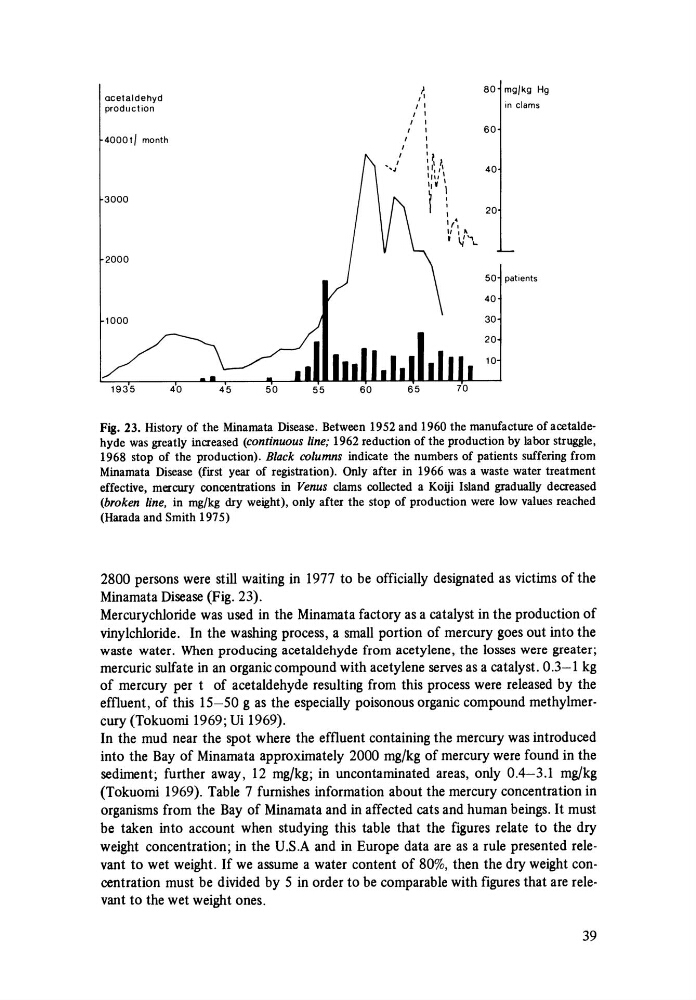
Fig. 23. History of the Minamata Disease. Between 1952 and 1960 the manufacture of acetal dehyde was greatly increased (continuous line; 1962 reduction of the production by labor struggle,
1968 stop of the production). Black columns indicate the numbers of patients suffering from
Minamata Disease (first year of registration). Only after in 1966 was a waste water treatment
effective, mercury concentrations in Venus clams collected a Koiji Island gradually decreased
(broken line, in mg/kg dry weight), only after the stop of production were low values reached
(Harada and Smith 1975)
2800 persons were still waiting in 1977 to be officially deSignated as victims of the
Minamata Disease (Fig. 23).
MercurycWoride was used in the Minamata factory as a catalyst in the production of
vinylcWoride. In the washing process, a small portion of mercury goes out into the
waste water. When producing acetaldehyde from acetylene, the losses were greater;
mercuric sulfate in an organic compound with acetylene serves as a catalyst. 0.3-1 kg
of mercury per t of acetaldehyde resulting from this process were released by the
effiuent, of this 15-50 g as the especially poisonous organic compound methylmercury (Tokuomi 1969; Ui 1969).
In the mud near the spot where the effiuent containing the mercury was introduced
into the Bay of Minamata approximately 2000 mg/kg of mercury were found in the
sediment; further away, 12 mg/kg; in uncontaminated areas, only 0.4-3.1 mg/kg
(Tokuomi 1969). Table 7 furnishes information about the mercury concentration in
organisms from the Bay of Minamata and in affected cats and human beings. It must
be taken into account when studying this table that the figures relate to the dry
weight concentration; in the U.S.A and in Europe data are as a rule presented relevant to wet weight. If we assume a water content of 80%, then the dry weight concentration must be divided by 5 in order to be comparable with figures that are relevant to the wet weight ones.
39
production
4000t/ month
3000
2000
1000
1935
40
I
I
I
45
50
55
60
,},
80 mg/kg Hg
I '
in clams
I
,
I
,
I
,
60
I
, ,
\ ~ I,
I':,"
40
", \
l : 20
,
'i",
1'1 AI V .....
50 patients
40
30
20
10
65
70
Fig. 23. History of the Minamata Disease. Between 1952 and 1960 the manufacture of acetal dehyde was greatly increased (continuous line; 1962 reduction of the production by labor struggle,
1968 stop of the production). Black columns indicate the numbers of patients suffering from
Minamata Disease (first year of registration). Only after in 1966 was a waste water treatment
effective, mercury concentrations in Venus clams collected a Koiji Island gradually decreased
(broken line, in mg/kg dry weight), only after the stop of production were low values reached
(Harada and Smith 1975)
2800 persons were still waiting in 1977 to be officially deSignated as victims of the
Minamata Disease (Fig. 23).
MercurycWoride was used in the Minamata factory as a catalyst in the production of
vinylcWoride. In the washing process, a small portion of mercury goes out into the
waste water. When producing acetaldehyde from acetylene, the losses were greater;
mercuric sulfate in an organic compound with acetylene serves as a catalyst. 0.3-1 kg
of mercury per t of acetaldehyde resulting from this process were released by the
effiuent, of this 15-50 g as the especially poisonous organic compound methylmercury (Tokuomi 1969; Ui 1969).
In the mud near the spot where the effiuent containing the mercury was introduced
into the Bay of Minamata approximately 2000 mg/kg of mercury were found in the
sediment; further away, 12 mg/kg; in uncontaminated areas, only 0.4-3.1 mg/kg
(Tokuomi 1969). Table 7 furnishes information about the mercury concentration in
organisms from the Bay of Minamata and in affected cats and human beings. It must
be taken into account when studying this table that the figures relate to the dry
weight concentration; in the U.S.A and in Europe data are as a rule presented relevant to wet weight. If we assume a water content of 80%, then the dry weight concentration must be divided by 5 in order to be comparable with figures that are relevant to the wet weight ones.
39