

2.2 Infections
At this point we cannot discuss whether treatment plants, from an economic point of
view, are effective in destroying infectious organisms, or whether other means of
sterilization might be applied. Since it is desirable to keep the sea coasts hygienically
clean as recreational beaches, the removal of communicable organisms from effluents
in coastal areas is often more important than the reduction of the organic effluent
load.
Particularly strict bacteriological requirements must be met in those areas where there
are shellfish cultures in the vicinity of effluent drain pipes. Mussels and oysters filter
bacteria out of seawater and store them up without the vitality of the bacteria suffering. For this reason, oyster culture areas are rightly subject to very strict hygiene
controls.
Of the 230000 km 2 of shellfish culture area along the coasts of the U.S.A., a quarter
is closed because the water quality is sub-standard. In these waters more than 700 coliform bacteria per 100 ml were found to be present (Wood 1972). There is a law that
at 70-700 coliforms per 100 rnl of water, shellfish must be held in clean water so
that they will give off the organisms they have absorbed.
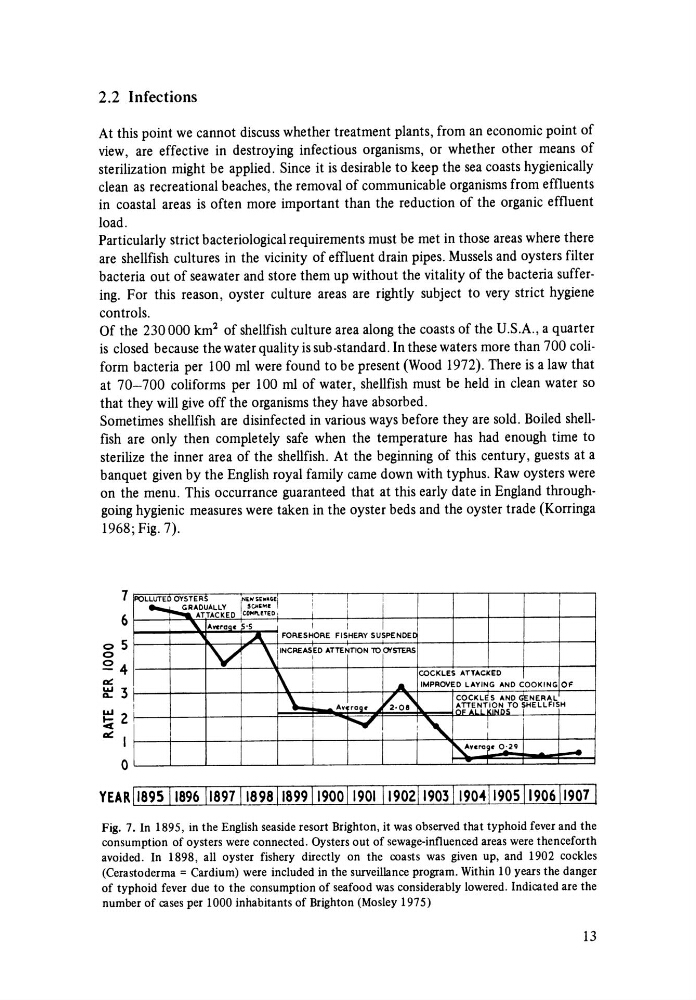
Sometimes shellfish are disinfected in various ways before they are sold. Boiled shellfish are only then completely safe when the temperature has had enough time to
sterilize the inner area of the shellfish. At the beginning of this century, guests at a
banquet given by the English royal family came down with typhus. Raw oysters were
on the menu. This occurrance guaranteed that at this early date in England throughgoing hygienic measures were taken in the oyster beds and the oyster trade (Korringa
1968; Fig. 7).
7
6
05
o
24
«
~3
LIJ
~2
«I
o
I
POLLUTED OYSTERS.
C.W ...... I
!
i
i
~ADUALLY
."" ....
ATTACKED CO ..... T.D
i
"A .. ra •• 5·S
I
I
.l
A
FORESHORE FISHERY SUSPENOEt
vr \
INCREASED ATTENnON TO C/fSTEP.S
i
r\
I
I
A.
\..' Av rag .. K:o~
I
~
COCKLES ATTACKED
IMPROVED LAYING AND COOKING 01'
COCKL.§.S AND GENERAL
ATTfLN:~~~;O ~HELLFISH
i'
I
i
I
~y.ra? 0·29
..
YEARI189S11896 1189711898118991190011901 1190211903119041190s11906119071
Fig. 7. In 1895, in the English seaside resort Brighton, it was observed that typhoid fever and the
consumption of oysters were connected. Oysters out of sewage-influenced areas were thenceforth
avoided. In 1898, all oyster fishery directly on the coasts was given up, and 1902 cockles
(Cerastoderma = Cardium) were included in the surveillance program. Within 10 years the danger
of typhoid fever due to the consumption of seafood was considerably lowered. Indicated are the
number of cases per 1000 inhabitants of Brighton (Mosley 1975)
13
At this point we cannot discuss whether treatment plants, from an economic point of
view, are effective in destroying infectious organisms, or whether other means of
sterilization might be applied. Since it is desirable to keep the sea coasts hygienically
clean as recreational beaches, the removal of communicable organisms from effluents
in coastal areas is often more important than the reduction of the organic effluent
load.
Particularly strict bacteriological requirements must be met in those areas where there
are shellfish cultures in the vicinity of effluent drain pipes. Mussels and oysters filter
bacteria out of seawater and store them up without the vitality of the bacteria suffering. For this reason, oyster culture areas are rightly subject to very strict hygiene
controls.
Of the 230000 km 2 of shellfish culture area along the coasts of the U.S.A., a quarter
is closed because the water quality is sub-standard. In these waters more than 700 coliform bacteria per 100 ml were found to be present (Wood 1972). There is a law that
at 70-700 coliforms per 100 rnl of water, shellfish must be held in clean water so
that they will give off the organisms they have absorbed.
Sometimes shellfish are disinfected in various ways before they are sold. Boiled shellfish are only then completely safe when the temperature has had enough time to
sterilize the inner area of the shellfish. At the beginning of this century, guests at a
banquet given by the English royal family came down with typhus. Raw oysters were
on the menu. This occurrance guaranteed that at this early date in England throughgoing hygienic measures were taken in the oyster beds and the oyster trade (Korringa
1968; Fig. 7).
7
6
05
o
24
«
~3
LIJ
~2
«I
o
I
POLLUTED OYSTERS.
C.W ...... I
!
i
i
~ADUALLY
."" ....
ATTACKED CO ..... T.D
i
"A .. ra •• 5·S
I
I
.l
A
FORESHORE FISHERY SUSPENOEt
vr \
INCREASED ATTENnON TO C/fSTEP.S
i
r\
I
I
A.
\..' Av rag .. K:o~
I
~
COCKLES ATTACKED
IMPROVED LAYING AND COOKING 01'
COCKL.§.S AND GENERAL
ATTfLN:~~~;O ~HELLFISH
i'
I
i
I
~y.ra? 0·29
..
YEARI189S11896 1189711898118991190011901 1190211903119041190s11906119071
Fig. 7. In 1895, in the English seaside resort Brighton, it was observed that typhoid fever and the
consumption of oysters were connected. Oysters out of sewage-influenced areas were thenceforth
avoided. In 1898, all oyster fishery directly on the coasts was given up, and 1902 cockles
(Cerastoderma = Cardium) were included in the surveillance program. Within 10 years the danger
of typhoid fever due to the consumption of seafood was considerably lowered. Indicated are the
number of cases per 1000 inhabitants of Brighton (Mosley 1975)
13