

We would very much like to know more exactly how cholera bacteria, typhus, and
paratyphus germs, polyomyelitis viruses, jaundice viruses, and certain other pathogenic organisms really behave in water, how long they are capable of living, and. how
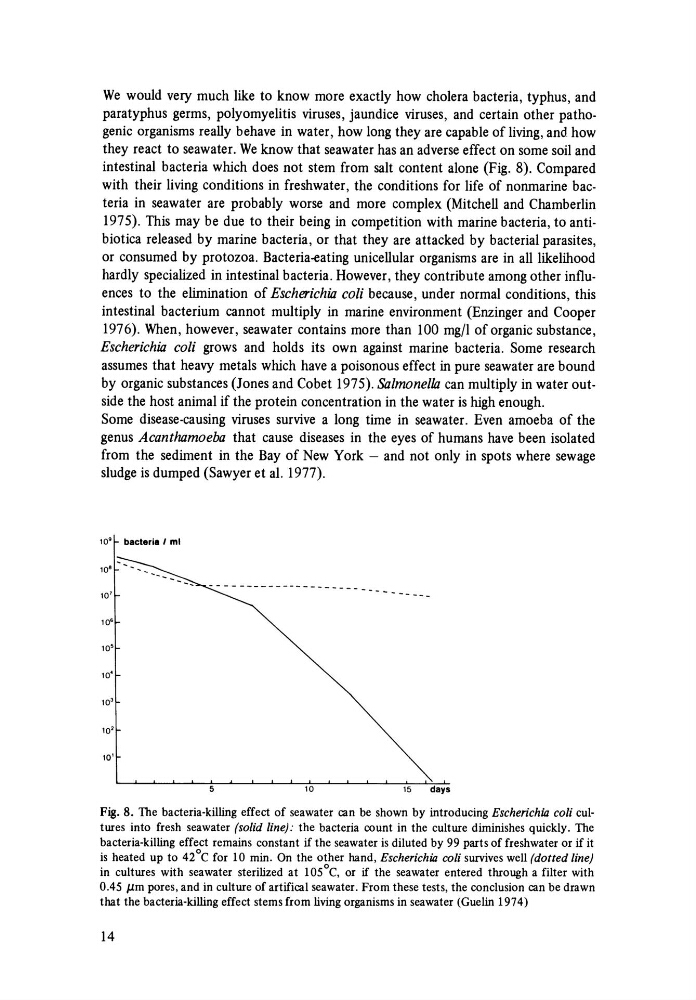
they react to seawater. We know that seawater has an adverse effect on some soil and
intestinal bacteria which does not stem from salt content alone (Fig. 8). Compared
with their living conditions in freshwater, the conditions for life of nonmarine bacteria in seawater are probably worse and more complex (Mitchell and Chamberlin
1975). This may be due to their being in competition with marine bacteria, to antibiotica released by marine bacteria, or that they are attacked by bacterial parasites,
or consumed by protozoa. Bacteria-eating unicellular organisms are in all likelihood
hardly specialized in intestinal bacteria. However, they contribute among other influences to the elimination of Escherichia coli because, under normal conditions, this
intestinal bacterium cannot multiply in marine environment (Enzinger and Cooper
1976). When, however, seawater contains more than 100 mg/l of organic substance,
Escherichia coli grows and holds its own against marine bacteria. Some research
assumes that heavy metals which have a poisonous effect in pure seawater are bound
by organic substances (Jones and Cobet 1975). SalmonelllI can multiply in water outside the host animal if the protein concentration in the water is high enough.
Some disease-causing viruses survive a long time in seawater. Even amoeba of the
genus Acanthamoeba that cause diseases in the eyes of humans have been isolated
from the sediment in the Bay of New York - and not only in spots where sewage
sludge is dumped (Sawyer et al. 1977).
10' bacteria I ml
---10'
10'
10 3
la'
10'
5
10
15
days
Fig. 8. The bacteria-killing effect of seawater can be shown by introducing Escherichia coli cultures into fresh seawater (solid line): the bacteria count in the culture diminishes quickly. The
bacteria-killing effect remains constant if the seawater is diluted by 99 parts of freshwater or if it
is heated up to 42°C for 10 min. On the other hand, Escherichia coli survives well (dotted line)
in cultures with seawater sterilized at 105°C, or if the seawater entered through a filter with
0.45 pm pores, and in culture of artifical seawater. From these tests, the conclusion can be drawn
that the bacteria-killing effect stems from living organisms in seawater (Guelin 1974)
14
paratyphus germs, polyomyelitis viruses, jaundice viruses, and certain other pathogenic organisms really behave in water, how long they are capable of living, and. how
they react to seawater. We know that seawater has an adverse effect on some soil and
intestinal bacteria which does not stem from salt content alone (Fig. 8). Compared
with their living conditions in freshwater, the conditions for life of nonmarine bacteria in seawater are probably worse and more complex (Mitchell and Chamberlin
1975). This may be due to their being in competition with marine bacteria, to antibiotica released by marine bacteria, or that they are attacked by bacterial parasites,
or consumed by protozoa. Bacteria-eating unicellular organisms are in all likelihood
hardly specialized in intestinal bacteria. However, they contribute among other influences to the elimination of Escherichia coli because, under normal conditions, this
intestinal bacterium cannot multiply in marine environment (Enzinger and Cooper
1976). When, however, seawater contains more than 100 mg/l of organic substance,
Escherichia coli grows and holds its own against marine bacteria. Some research
assumes that heavy metals which have a poisonous effect in pure seawater are bound
by organic substances (Jones and Cobet 1975). SalmonelllI can multiply in water outside the host animal if the protein concentration in the water is high enough.
Some disease-causing viruses survive a long time in seawater. Even amoeba of the
genus Acanthamoeba that cause diseases in the eyes of humans have been isolated
from the sediment in the Bay of New York - and not only in spots where sewage
sludge is dumped (Sawyer et al. 1977).
10' bacteria I ml
---10'
10'
10 3
la'
10'
5
10
15
days
Fig. 8. The bacteria-killing effect of seawater can be shown by introducing Escherichia coli cultures into fresh seawater (solid line): the bacteria count in the culture diminishes quickly. The
bacteria-killing effect remains constant if the seawater is diluted by 99 parts of freshwater or if it
is heated up to 42°C for 10 min. On the other hand, Escherichia coli survives well (dotted line)
in cultures with seawater sterilized at 105°C, or if the seawater entered through a filter with
0.45 pm pores, and in culture of artifical seawater. From these tests, the conclusion can be drawn
that the bacteria-killing effect stems from living organisms in seawater (Guelin 1974)
14