

-100
c:
0
~ 80
iii III
~ 60
c: Q)
CI
>x 40
0
"0
Q)
>
<5 20
III
III
"0
0
.c:
lil f! 30
.!.1
.c
~
III 20
c:
III
London
Mogden Bridge Beckton
Southend
I
I
I
.?\..-v~~~~~1 ~ . 0
10
20
6O~
Teddington
Crossness G~avesend
Weir
\ \
"'
20
1893
1950 -1959
1970
,/
----- ........... _-"
40
60
,/
I
I
/
/ '
I
I
I
I
I
I
I
I
i
!
I
/
".
80
i
i
i
;
i
i
100
km seawards of Teddington Weir at half-tide
i\. ·
• /V' ---j·\
j. \
~ 10 I
• .'\
c,
........
•
~ 0 I I I I . \ . . . . . . . . .
1945
1950
1955
1960
1965
1970
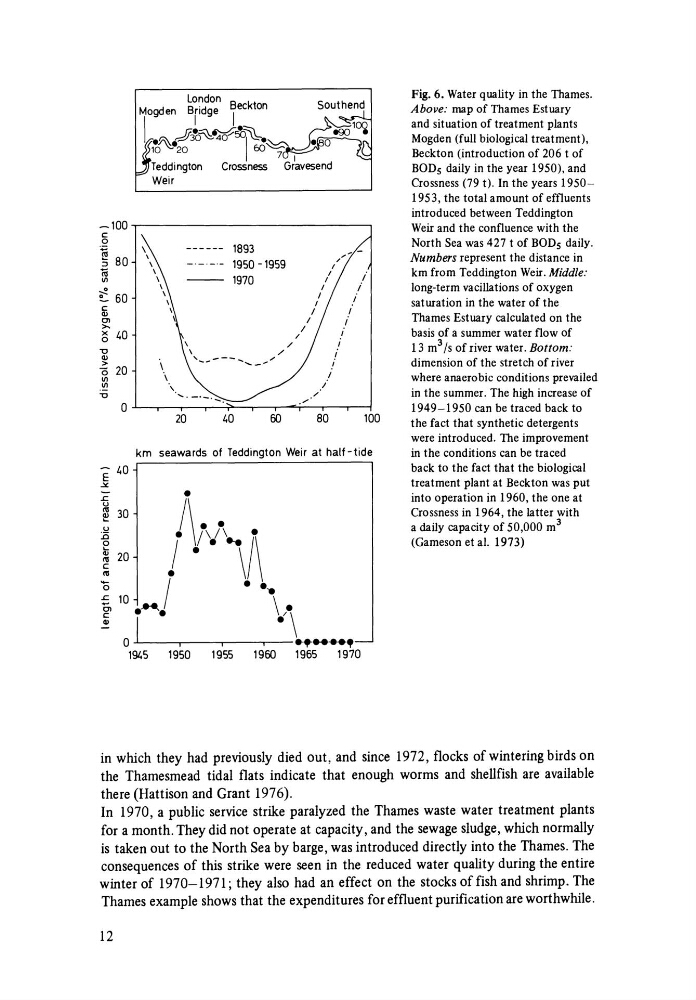
Fig. 6. Water quality in the Thames.
Above: map of Thames Estuary
and situation of treatment plants
Mogden (full biological treatment),
Beckton (introduction of 206 t of
BODs daily in the year 1950), and
Crossness (79 t). In the years 19501953, the total amount of effluents
introduced between Teddington
Weir and the confluence with the
North Sea was 427 t of BODs daily.
Numbers represent the distance in
km from Teddington Weir. Middle:
long-term vacillations of oxygen
saturation in the water of the
Thames Estuary calculated on the
basis of a summer water flow of
13 m 3 /s of river water. Bottom:
dimension of the stretch of river
where anaerobic conditions prevailed
in the summer. The high increase of
1949-1950 can be traced back to
the fact that synthetic detergents
were introduced. The improvement
in the conditions can be traced
back to the fact that the biological
treatment plant at Beckton was put
into operation in 1960, the one at
Crossness in 1964, the latter with
a daily capacity of 50,000 m 3
(Gameson et al. 1973)
in which they had previously died out, and since 1972, flocks of wintering birds on
the Thamesmead tidal flats indicate that enough worms and shellfish are available
there (Hattison and Grant 1976).
In 1970, a public service strike paralyzed the Thames waste water treatment plants
for a month. They did not operate at capacity, and the sewage sludge, which normally
is taken out to the North Sea by barge, was introduced directly into the Thames. The
consequences of this strike were seen in the reduced water quality during the entire
winter of 1970-1971; they also had an effect on the stocks of fish and shrimp. The
Thames example shows that the expenditures for effluent purification are worthwhile.
12
c:
0
~ 80
iii III
~ 60
c: Q)
CI
>x 40
0
"0
Q)
>
<5 20
III
III
"0
0
.c:
lil f! 30
.!.1
.c
~
III 20
c:
III
London
Mogden Bridge Beckton
Southend
I
I
I
.?\..-v~~~~~1 ~ . 0
10
20
6O~
Teddington
Crossness G~avesend
Weir
\ \
"'
20
1893
1950 -1959
1970
,/
----- ........... _-"
40
60
,/
I
I
/
/ '
I
I
I
I
I
I
I
I
i
!
I
/
".
80
i
i
i
;
i
i
100
km seawards of Teddington Weir at half-tide
i\. ·
• /V' ---j·\
j. \
~ 10 I
• .'\
c,
........
•
~ 0 I I I I . \ . . . . . . . . .
1945
1950
1955
1960
1965
1970
Fig. 6. Water quality in the Thames.
Above: map of Thames Estuary
and situation of treatment plants
Mogden (full biological treatment),
Beckton (introduction of 206 t of
BODs daily in the year 1950), and
Crossness (79 t). In the years 19501953, the total amount of effluents
introduced between Teddington
Weir and the confluence with the
North Sea was 427 t of BODs daily.
Numbers represent the distance in
km from Teddington Weir. Middle:
long-term vacillations of oxygen
saturation in the water of the
Thames Estuary calculated on the
basis of a summer water flow of
13 m 3 /s of river water. Bottom:
dimension of the stretch of river
where anaerobic conditions prevailed
in the summer. The high increase of
1949-1950 can be traced back to
the fact that synthetic detergents
were introduced. The improvement
in the conditions can be traced
back to the fact that the biological
treatment plant at Beckton was put
into operation in 1960, the one at
Crossness in 1964, the latter with
a daily capacity of 50,000 m 3
(Gameson et al. 1973)
in which they had previously died out, and since 1972, flocks of wintering birds on
the Thamesmead tidal flats indicate that enough worms and shellfish are available
there (Hattison and Grant 1976).
In 1970, a public service strike paralyzed the Thames waste water treatment plants
for a month. They did not operate at capacity, and the sewage sludge, which normally
is taken out to the North Sea by barge, was introduced directly into the Thames. The
consequences of this strike were seen in the reduced water quality during the entire
winter of 1970-1971; they also had an effect on the stocks of fish and shrimp. The
Thames example shows that the expenditures for effluent purification are worthwhile.
12