

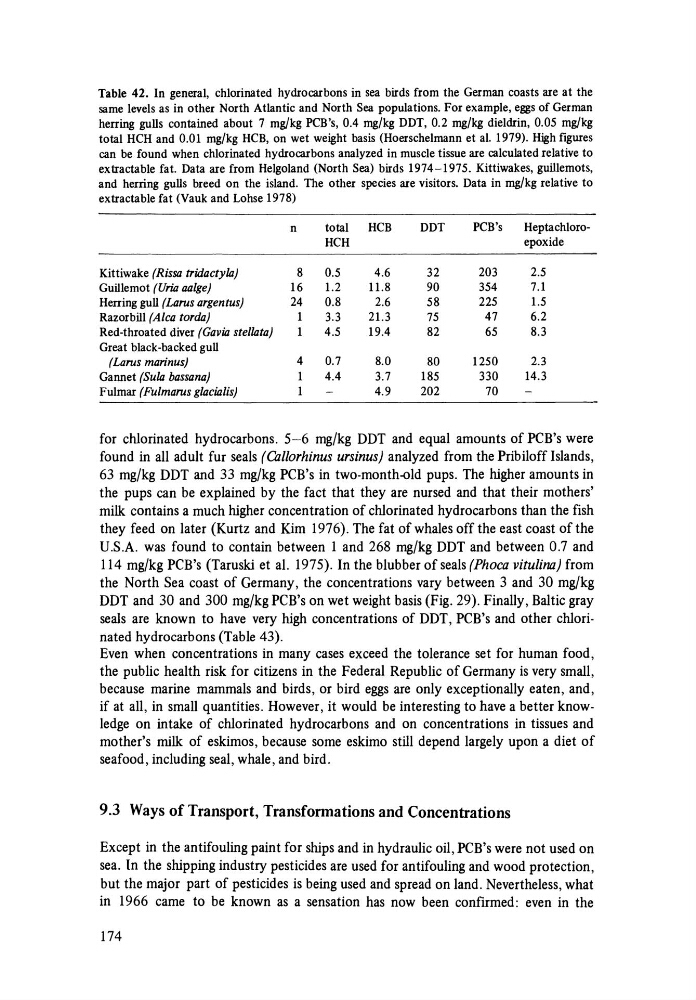
Table 42. In general, chlorinated hydrocarbons in sea birds from the German coasts are at the
same levels as in other North Atlantic and North Sea populations. For example, eggs of German
herring gulls contained about 7 mg/kg PCB's, 0.4 mg/kg DDT, 0.2 mg/kg dieldrin, 0.05 mg/kg
total HCH and 0.01 mg/kg HCB, on wet weight basis (Hoerschelmann et al. 1979). High figures
can be found when chlorinated hydrocarbons analyzed in muscle tissue are calculated relative to
extractable fat. Data are from Helgoland (North Sea) birds 1974-1975. Kittiwakes, guillemots,
and herring gulls breed on the island. The other species are visitors. Data in mg/kg relative to
extractable fat (Vauk and Lohse 1978)
n
total
HCB
DDT
PCB's
HeptachloroHCH
epoxide
Kittiwake (Risso tridactyla)
8
0.5
4.6
32
203
2.5
Guillemot (Urio aalge)
16
1.2
11.8
90
354
7.1
Herring gull (Larus argentus)
24
0.8
2.6
58
225
1.5
Razorbill (Alca tonia)
1
3.3
21.3
75
47
6.2
Red-throated diver (Gavia stellata)
1
4.5
19.4
82
65
8.3
Great black-backed gull
(Larus marinus)
4
0.7
8.0
80
1250
2.3
Gannet (Sula bassana)
1
4.4
3.7
185
330
14.3
Fulmar (Fulmarus g/acia/is)
4.9
202
70
for chlorinated hydrocarbons. 5-6 mg/kg DDT and equal amounts of PCB's were
found in all adult fur seals (Callorhinus ursinus) analyzed from the Pribiloff Islands,
63 mg/kg DDT and 33 mg/kg PCB's in two-month-old pups. The higher amounts in
the pups can be explained by the fact that they are nursed and that their mothers'
milk contains a much higher concentration of chlorinated hydrocarbons than the fish
they feed on later (Kurtz and Kim 1976). The fat of whales off the east coast of the
U.S.A. was found to contain between 1 and 268 mg/kg DDT and between 0.7 and
114 mg/kg PCB's (Taruski et al. 1975). In the blubber of seals (Phoca vitulina) from
the North Sea coast of Germany, the concentrations vary between 3 and 30 mg/kg
DDT and 30 and 300 mg/kg PCB's on wet weight basis (Fig. 29). Finally, Baltic gray
seals are known to have very high concentrations of DDT, PCB's and other chlorinated hydrocarbons (Table 43).
Even when concentrations in many cases exceed the tolerance set for human food,
the public health risk for citizens in the Federal Republic of Germany is very small,
because marine mammals and birds, or bird eggs are only exceptionally eaten, and,
if at all, in small quantities. However, it would be interesting to have a better knowledge on intake of chlorinated hydrocarbons and on concentrations in tissues and
mother's milk of eskimos, because some eskimo still depend largely upon a diet of
seafood, including seal, whale, and bird.
9.3 Ways of Transport, Transformations and Concentrations
Except in the antifouling paint for ships and in hydraulic oil, PCB's were not used on
sea. In the shipping industry pesticides are used for antifouling and wood protection,
but the major part of pesticides is being used and spread on land. Nevertheless, what
in 1966 came to be known as a sensation has now been confirmed: even in the
174
same levels as in other North Atlantic and North Sea populations. For example, eggs of German
herring gulls contained about 7 mg/kg PCB's, 0.4 mg/kg DDT, 0.2 mg/kg dieldrin, 0.05 mg/kg
total HCH and 0.01 mg/kg HCB, on wet weight basis (Hoerschelmann et al. 1979). High figures
can be found when chlorinated hydrocarbons analyzed in muscle tissue are calculated relative to
extractable fat. Data are from Helgoland (North Sea) birds 1974-1975. Kittiwakes, guillemots,
and herring gulls breed on the island. The other species are visitors. Data in mg/kg relative to
extractable fat (Vauk and Lohse 1978)
n
total
HCB
DDT
PCB's
HeptachloroHCH
epoxide
Kittiwake (Risso tridactyla)
8
0.5
4.6
32
203
2.5
Guillemot (Urio aalge)
16
1.2
11.8
90
354
7.1
Herring gull (Larus argentus)
24
0.8
2.6
58
225
1.5
Razorbill (Alca tonia)
1
3.3
21.3
75
47
6.2
Red-throated diver (Gavia stellata)
1
4.5
19.4
82
65
8.3
Great black-backed gull
(Larus marinus)
4
0.7
8.0
80
1250
2.3
Gannet (Sula bassana)
1
4.4
3.7
185
330
14.3
Fulmar (Fulmarus g/acia/is)
4.9
202
70
for chlorinated hydrocarbons. 5-6 mg/kg DDT and equal amounts of PCB's were
found in all adult fur seals (Callorhinus ursinus) analyzed from the Pribiloff Islands,
63 mg/kg DDT and 33 mg/kg PCB's in two-month-old pups. The higher amounts in
the pups can be explained by the fact that they are nursed and that their mothers'
milk contains a much higher concentration of chlorinated hydrocarbons than the fish
they feed on later (Kurtz and Kim 1976). The fat of whales off the east coast of the
U.S.A. was found to contain between 1 and 268 mg/kg DDT and between 0.7 and
114 mg/kg PCB's (Taruski et al. 1975). In the blubber of seals (Phoca vitulina) from
the North Sea coast of Germany, the concentrations vary between 3 and 30 mg/kg
DDT and 30 and 300 mg/kg PCB's on wet weight basis (Fig. 29). Finally, Baltic gray
seals are known to have very high concentrations of DDT, PCB's and other chlorinated hydrocarbons (Table 43).
Even when concentrations in many cases exceed the tolerance set for human food,
the public health risk for citizens in the Federal Republic of Germany is very small,
because marine mammals and birds, or bird eggs are only exceptionally eaten, and,
if at all, in small quantities. However, it would be interesting to have a better knowledge on intake of chlorinated hydrocarbons and on concentrations in tissues and
mother's milk of eskimos, because some eskimo still depend largely upon a diet of
seafood, including seal, whale, and bird.
9.3 Ways of Transport, Transformations and Concentrations
Except in the antifouling paint for ships and in hydraulic oil, PCB's were not used on
sea. In the shipping industry pesticides are used for antifouling and wood protection,
but the major part of pesticides is being used and spread on land. Nevertheless, what
in 1966 came to be known as a sensation has now been confirmed: even in the
174