

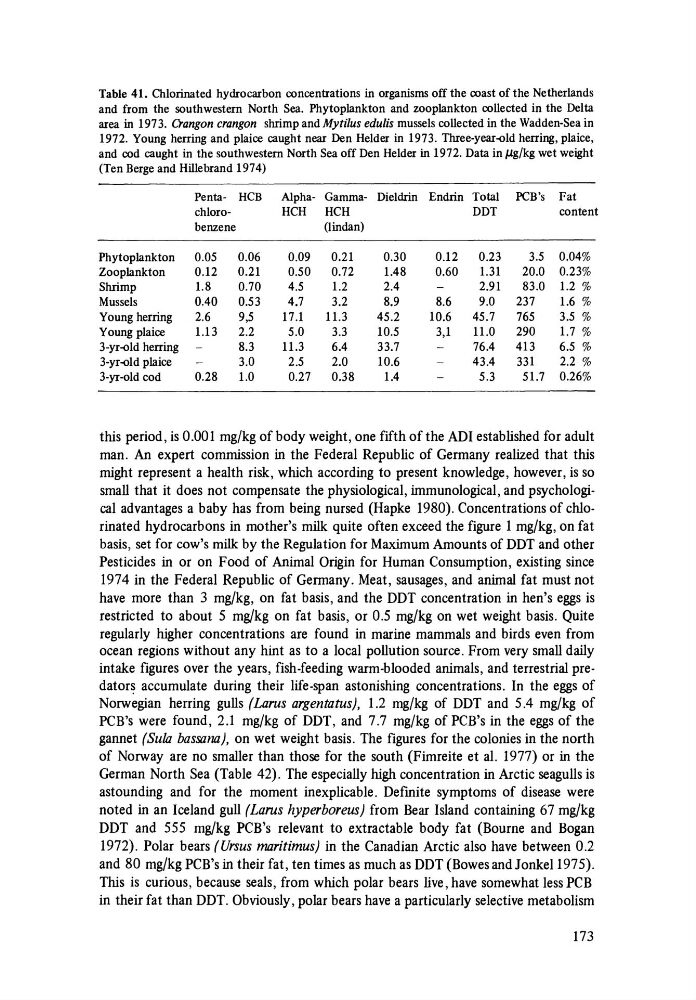
Table 41. Chlorinated hydrocarbon concentrations in organisms off the coast of the Netherlands
and from the southwestern North Sea. Phytoplankton and zooplankton collected in the Delta
area in 1973. Crangon crangon shrimp and Mytilus edulis mussels collected in the Wadden-Sea in
1972. Young herring and plaice caught near Den Helder in 1973. Three-yearo()ld herring, plaice,
and cod caught in the southwestern North Sea off Den Helder in 1972. Data in /1g/kg wet weight
(Ten Berge and Hillebrand 1974)
Penta- HCB
Alpha- Gamma- Dieldrin Endrin Total PCB's Fat
chloroHCH
HeH
DDT
content
benzene
(lindan)
Phytoplankton
0.05
0.06
0.09
0.21
0.30
0.12
0.23
3.5 0.04%
Zooplankton
0.12
0.21
0.50
0.72
1.48
0.60
1.31
20.0 0.23%
Shrimp
1.8
0.70
4.5
1.2
2.4
2.91
83.0 1.2%
Mussels
0.40
0.53
4.7
3.2
8.9
8.6
9.0
237
1.6 %
Young herring
2.6
9,5
17.1
11.3
45.2
10.6
45.7
765
3.5 %
Young plaice
1.13
2.2
5.0
3.3
10.5
3,1
11.0
290
1.7%
3-yro()ld herring
8.3
11.3
6.4
33.7
76.4
413
6.5 %
3-yro()ld plaice
3.0
2.5
2.0
10.6
43.4
331
2.2 %
3-yr-old cod
0.28
1.0
0.27
0.38
1.4
5.3
51.7 0.26%
this period, is 0.001 mg/kg of body weight, one fifth of the AD! established for adult
man. An expert commission in the Federal Republic of Germany realized that this
might represent a health risk, which according to present knowledge, however, is so
small that it does not compensate the physiological, immunological, and psychological advantages a baby has from being nursed (Hapke 1980). Concentrations of chlorinated hydrocarbons in mother's milk quite often exceed the figure 1 mg/kg, on fat
basis, set for cow's milk by the Regulation for Maximum Amounts of DDT and other
Pesticides in or on Food of Animal Origin for Human Consumption, existing since
1974 in the Federal Republic of Germany. Meat, sausages, and animal fat must not
have more than 3 mg/kg, on fat basis, and the DDT concentration in hen's eggs is
restricted to about 5 mg/kg on fat basis, or 0.5 mg/kg on wet weight basis. Quite
regularly higher concentrations are found in marine mammals and birds even from
ocean regions without any hint as to a local pollution source. From very small daily
intake figures over the years, fish-feeding warm-blooded animals, and terrestrial predator~ accumulate during their life-span astonishing concentrations. In the eggs of
Norwegian herring gulls (Larus argentatus), 1.2 mg/kg of DDT and 5.4 mg/kg of
PCB's were found, 2.1 mg/kg of DDT, and 7.7 mg/kg of PCB's in the eggs of the
gannet (Sulo bassana), on wet weight basis. The figures for the colonies in the north
of Norway are no smaller than those for the south (Fimreite et al. 1977) or in the
German North Sea (Table 42). The especially high concentration in Arctic seagulls is
astounding and for the moment inexplicable. Defmite symptoms of disease were
noted in an Iceland gull (Lams hyperboreus) from Bear Island containing 67 mg/kg
DDT and 555 mg/kg PCB's relevant to extractable body fat (Bourne and Bogan
1972). Polar bears (Ursus maritimus) in the Canadian Arctic also have between 0.2
and 80 mg/kg PCB's in their fat, ten times as much as DDT (Bowes and J onkel197 5).
This is curious, because seals, from which polar bears live, have somewhat less PCB
in their fat than DDT. Obviously, polar bears have a particularly selective metabolism
173
and from the southwestern North Sea. Phytoplankton and zooplankton collected in the Delta
area in 1973. Crangon crangon shrimp and Mytilus edulis mussels collected in the Wadden-Sea in
1972. Young herring and plaice caught near Den Helder in 1973. Three-yearo()ld herring, plaice,
and cod caught in the southwestern North Sea off Den Helder in 1972. Data in /1g/kg wet weight
(Ten Berge and Hillebrand 1974)
Penta- HCB
Alpha- Gamma- Dieldrin Endrin Total PCB's Fat
chloroHCH
HeH
DDT
content
benzene
(lindan)
Phytoplankton
0.05
0.06
0.09
0.21
0.30
0.12
0.23
3.5 0.04%
Zooplankton
0.12
0.21
0.50
0.72
1.48
0.60
1.31
20.0 0.23%
Shrimp
1.8
0.70
4.5
1.2
2.4
2.91
83.0 1.2%
Mussels
0.40
0.53
4.7
3.2
8.9
8.6
9.0
237
1.6 %
Young herring
2.6
9,5
17.1
11.3
45.2
10.6
45.7
765
3.5 %
Young plaice
1.13
2.2
5.0
3.3
10.5
3,1
11.0
290
1.7%
3-yro()ld herring
8.3
11.3
6.4
33.7
76.4
413
6.5 %
3-yro()ld plaice
3.0
2.5
2.0
10.6
43.4
331
2.2 %
3-yr-old cod
0.28
1.0
0.27
0.38
1.4
5.3
51.7 0.26%
this period, is 0.001 mg/kg of body weight, one fifth of the AD! established for adult
man. An expert commission in the Federal Republic of Germany realized that this
might represent a health risk, which according to present knowledge, however, is so
small that it does not compensate the physiological, immunological, and psychological advantages a baby has from being nursed (Hapke 1980). Concentrations of chlorinated hydrocarbons in mother's milk quite often exceed the figure 1 mg/kg, on fat
basis, set for cow's milk by the Regulation for Maximum Amounts of DDT and other
Pesticides in or on Food of Animal Origin for Human Consumption, existing since
1974 in the Federal Republic of Germany. Meat, sausages, and animal fat must not
have more than 3 mg/kg, on fat basis, and the DDT concentration in hen's eggs is
restricted to about 5 mg/kg on fat basis, or 0.5 mg/kg on wet weight basis. Quite
regularly higher concentrations are found in marine mammals and birds even from
ocean regions without any hint as to a local pollution source. From very small daily
intake figures over the years, fish-feeding warm-blooded animals, and terrestrial predator~ accumulate during their life-span astonishing concentrations. In the eggs of
Norwegian herring gulls (Larus argentatus), 1.2 mg/kg of DDT and 5.4 mg/kg of
PCB's were found, 2.1 mg/kg of DDT, and 7.7 mg/kg of PCB's in the eggs of the
gannet (Sulo bassana), on wet weight basis. The figures for the colonies in the north
of Norway are no smaller than those for the south (Fimreite et al. 1977) or in the
German North Sea (Table 42). The especially high concentration in Arctic seagulls is
astounding and for the moment inexplicable. Defmite symptoms of disease were
noted in an Iceland gull (Lams hyperboreus) from Bear Island containing 67 mg/kg
DDT and 555 mg/kg PCB's relevant to extractable body fat (Bourne and Bogan
1972). Polar bears (Ursus maritimus) in the Canadian Arctic also have between 0.2
and 80 mg/kg PCB's in their fat, ten times as much as DDT (Bowes and J onkel197 5).
This is curious, because seals, from which polar bears live, have somewhat less PCB
in their fat than DDT. Obviously, polar bears have a particularly selective metabolism
173