

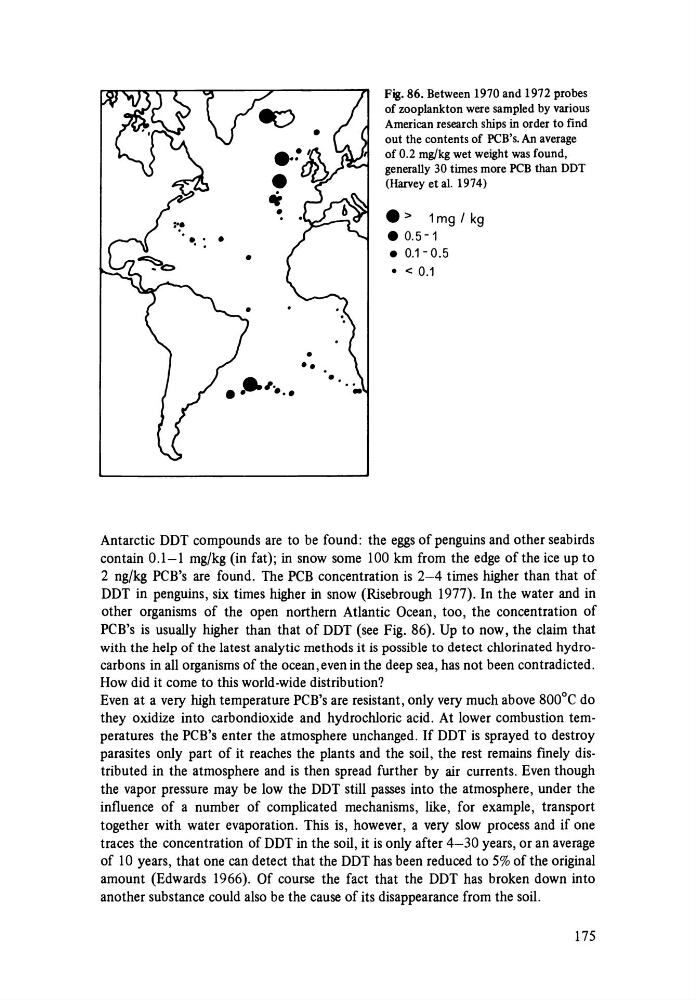
Fig. 86. Between 1970 and 1972 probes
of zooplankton were sampled by various
American research ships in order to find
out the contents of PCB's. An average
of 0.2 mg/kg wet weight was found,
generally 30 times more PCB than DDT
(Harvey et al. 1974)
• > 1mg I kg
• 0.5-1
• 0.1- 0.5
• < 0.1
Antarctic DDT compounds are to be found: the eggs of penguins and other seabirds
contain 0.1-1 mg/kg (in fat); in snow some 100 km from the edge of the ice up to
2 ng/kg PCB's are found. The PCB concentration is 2-4 times higher than that of
DDT in penguins, six times higher in snow (Risebrough 1977). In the water and in
other organisms of the open northern Atlantic Ocean, too, the concentration of
PCB's is usually higher than that of DDT (see Fig. 86). Up to now, the claim that
with the help of the latest analytic methods it is possible to detect chlorinated hydrocarbons in all organisms of the ocean,even in the deep sea, has not been contradicted.
How did it come to this world-wide distribution?
Even at a very high temperature PCB's are resistant, only very much above 800°C do
they oxidize into carbondioxide and hydrochloric acid. At lower combustion temperatures the PCB's enter the atmosphere unchanged. If DDT is sprayed to destroy
parasites only part of it reaches the plants and the soil, the rest remains finely distributed in the atmosphere and is then spread further by air currents. Even though
the vapor pressure may be low the DDT still passes into the atmosphere, under the
influence of a number of complicated mechanisms, like, for example, transport
together with water evaporation. This is, however, a very slow process and if one
traces the concentration of DDT in the soil, it is only after 4-30 years, or an average
of 10 years, that one can detect that the DDT has been reduced to 5% of the original
amount (Edwards 1966). Of course the fact that the DDT has broken down into
another substance could also be the cause of its disappearance from the soil.
175
of zooplankton were sampled by various
American research ships in order to find
out the contents of PCB's. An average
of 0.2 mg/kg wet weight was found,
generally 30 times more PCB than DDT
(Harvey et al. 1974)
• > 1mg I kg
• 0.5-1
• 0.1- 0.5
• < 0.1
Antarctic DDT compounds are to be found: the eggs of penguins and other seabirds
contain 0.1-1 mg/kg (in fat); in snow some 100 km from the edge of the ice up to
2 ng/kg PCB's are found. The PCB concentration is 2-4 times higher than that of
DDT in penguins, six times higher in snow (Risebrough 1977). In the water and in
other organisms of the open northern Atlantic Ocean, too, the concentration of
PCB's is usually higher than that of DDT (see Fig. 86). Up to now, the claim that
with the help of the latest analytic methods it is possible to detect chlorinated hydrocarbons in all organisms of the ocean,even in the deep sea, has not been contradicted.
How did it come to this world-wide distribution?
Even at a very high temperature PCB's are resistant, only very much above 800°C do
they oxidize into carbondioxide and hydrochloric acid. At lower combustion temperatures the PCB's enter the atmosphere unchanged. If DDT is sprayed to destroy
parasites only part of it reaches the plants and the soil, the rest remains finely distributed in the atmosphere and is then spread further by air currents. Even though
the vapor pressure may be low the DDT still passes into the atmosphere, under the
influence of a number of complicated mechanisms, like, for example, transport
together with water evaporation. This is, however, a very slow process and if one
traces the concentration of DDT in the soil, it is only after 4-30 years, or an average
of 10 years, that one can detect that the DDT has been reduced to 5% of the original
amount (Edwards 1966). Of course the fact that the DDT has broken down into
another substance could also be the cause of its disappearance from the soil.
175