

Table 35. It must be feared that the concentration of mercury has changed in museum specimens
during their preservation, but it is nevertheless noteworthy that the meat of tunafish caught 60100 years ago shows similar concentrations of mercury as do specimens caught recently. The
figures are in mg/kg wet weight (Miller et al. 1973)
Year caught
1878
1800
1886
1890
1901
1909
Species, locality
Bonito (Katsuwonus pe/amis), Massachusetts, 2 samples
White Tuna (Thunnus ala/unga). California
Tunafish (Thunnus thynnus). Massachusetts
Bonito, California
Bonito, Hawaii
Bonito, Phillipines
Mercury concentration in mg/kg
0.27
0.64
0.27
0.38
0.45
0.42
0.26
mg/kg,-____________________________ -,
5
1SL.O 1860 1880 1900 1920 191.0 1960 1980
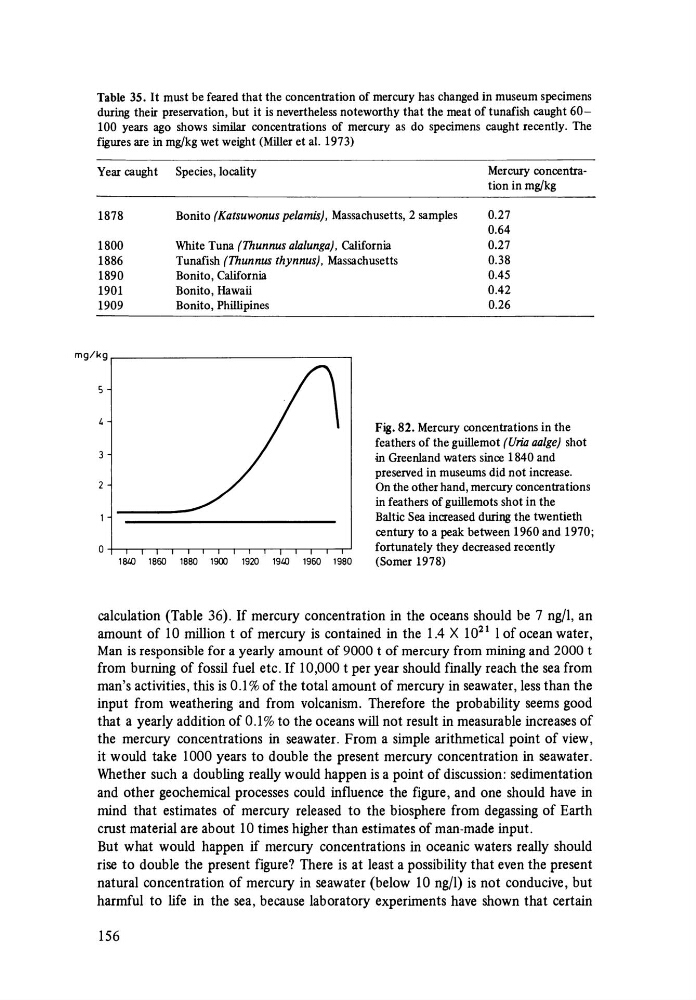
Fig. 82. Mercury concentrations in the
feathers of the guillemot (Una aa/ge) shot
m Greenland waters since 1840 and
preserved in museums did not increase.
On the other hand, mercury concentrations
in feathers of guillemots shot in the
Baltic Sea increased during the twentieth
century to a peak between 1960 and 1970;
fortunately they decreased recently
(Somer 1978)
calculation (Table 36). If mercury concentration in the oceans should be 7 ng/l, an
amount of 10 million t of mercury is contained in the 1.4 X 10 21 I of ocean water,
Man is responsible for a yearly amount of 9000 t of mercury from mining and 2000 t
from burning of fossil fuel etc. If 10,000 t per year should finally reach the sea from
man's activities, this is 0.1 % of the total amount of mercury in seawater, less than the
input from weathering and from volcanism. Therefore the probability seems good
that a yearly addition of 0.1 % to the oceans will not result in measurable increases of
the mercury concentrations in seawater. From a simple arithmetical point of view,
it would take 1000 years to double the present mercury concentration in seawater.
Whether such a doubling really would happen is a point of discussion: sedimentation
and other geochemical processes could influence the figure, and one should have in
mind that estimates of mercury released to the biosphere from degassing of Earth
crust material are about 10 times higher than estimates of man-made input.
But what would happen if mercury concentrations in oceanic waters really should
rise to double the present figure? There is at least a possibility that even the present
natural concentration of mercury in seawater (below 10 ng/l) is not conducive, but
harmful to life in the sea, because laboratory experiments have shown that certain
156
during their preservation, but it is nevertheless noteworthy that the meat of tunafish caught 60100 years ago shows similar concentrations of mercury as do specimens caught recently. The
figures are in mg/kg wet weight (Miller et al. 1973)
Year caught
1878
1800
1886
1890
1901
1909
Species, locality
Bonito (Katsuwonus pe/amis), Massachusetts, 2 samples
White Tuna (Thunnus ala/unga). California
Tunafish (Thunnus thynnus). Massachusetts
Bonito, California
Bonito, Hawaii
Bonito, Phillipines
Mercury concentration in mg/kg
0.27
0.64
0.27
0.38
0.45
0.42
0.26
mg/kg,-____________________________ -,
5
1SL.O 1860 1880 1900 1920 191.0 1960 1980
Fig. 82. Mercury concentrations in the
feathers of the guillemot (Una aa/ge) shot
m Greenland waters since 1840 and
preserved in museums did not increase.
On the other hand, mercury concentrations
in feathers of guillemots shot in the
Baltic Sea increased during the twentieth
century to a peak between 1960 and 1970;
fortunately they decreased recently
(Somer 1978)
calculation (Table 36). If mercury concentration in the oceans should be 7 ng/l, an
amount of 10 million t of mercury is contained in the 1.4 X 10 21 I of ocean water,
Man is responsible for a yearly amount of 9000 t of mercury from mining and 2000 t
from burning of fossil fuel etc. If 10,000 t per year should finally reach the sea from
man's activities, this is 0.1 % of the total amount of mercury in seawater, less than the
input from weathering and from volcanism. Therefore the probability seems good
that a yearly addition of 0.1 % to the oceans will not result in measurable increases of
the mercury concentrations in seawater. From a simple arithmetical point of view,
it would take 1000 years to double the present mercury concentration in seawater.
Whether such a doubling really would happen is a point of discussion: sedimentation
and other geochemical processes could influence the figure, and one should have in
mind that estimates of mercury released to the biosphere from degassing of Earth
crust material are about 10 times higher than estimates of man-made input.
But what would happen if mercury concentrations in oceanic waters really should
rise to double the present figure? There is at least a possibility that even the present
natural concentration of mercury in seawater (below 10 ng/l) is not conducive, but
harmful to life in the sea, because laboratory experiments have shown that certain
156