

c
.!!
ti
~
"
2.0
1.5
~ 1.0
.c
i
2 01
GI
>
~
!
0.5
o
4
7
10 12
14
16 18 20 n 24 26 28
31
35
48
75
hours of incubation
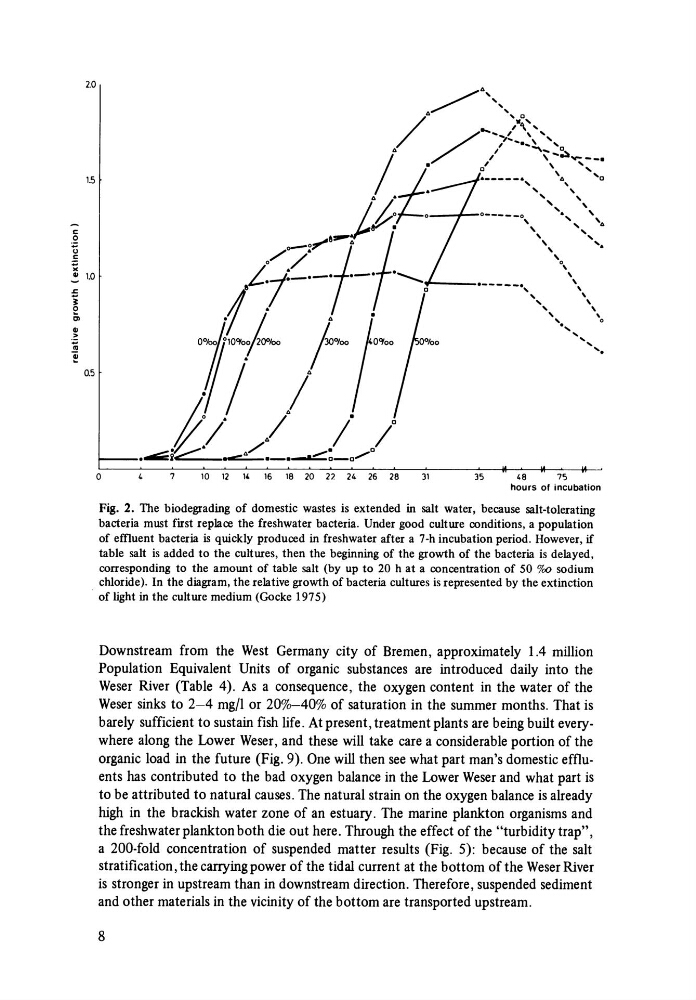
Fig. 2. The biodegrading of domestic wastes is extended in salt water, because salt-tolerating
bacteria must first replace the freshwater bacteria. Under good culture conditions, a population
of effiuent bacteria is quickly produced in freshwater after a 7-h incubation period. However, if
table salt is added to the cultures, then the beginning of the growth of the bacteria is delayed,
corresponding to the amount of table salt (by up to 20 h at a concentration of 50 0/00 sodium
chloride). In the diagram, the relative growth of bacteria cultures is represented by the extinction
of light in the culture medium (Gocke 1975)
Downstream from the West Germany city of Bremen, approximately 1.4 million
Population Equivalent Units of organic substances are introduced daily into the
Weser River (Table 4). As a consequence, the oxygen content in the water of the
Weser sinks to 2-4 mg/l or 200/0-40% of saturation in the summer months. That is
barely sufficient to sustain fish life. At present, treatment plants are being built everywhere along the Lower Weser, and these will take care a considerable portion of the
organic load in the future (Fig. 9). One will then see what part man's domestic effluents has contributed to the bad oxygen balance in the Lower Weser and what part is
to be attributed to natural causes. The natural strain on the oxygen balance is already
high in the brackish water zone of an estuary. The marine plankton organisms and
the freshwater plankton both die out here. Through the effect of the "turbidity trap",
a 200-fold concentration of suspended matter results (Fig. 5): because of the salt
stratification, the carrying power of the tidal current at the bottom of the Weser River
is stronger in upstream than in downstream direction. Therefore, suspended sediment
and other materials in the vicinity of the bottom are transported upstream.
8
.!!
ti
~
"
2.0
1.5
~ 1.0
.c
i
2 01
GI
>
~
!
0.5
o
4
7
10 12
14
16 18 20 n 24 26 28
31
35
48
75
hours of incubation
Fig. 2. The biodegrading of domestic wastes is extended in salt water, because salt-tolerating
bacteria must first replace the freshwater bacteria. Under good culture conditions, a population
of effiuent bacteria is quickly produced in freshwater after a 7-h incubation period. However, if
table salt is added to the cultures, then the beginning of the growth of the bacteria is delayed,
corresponding to the amount of table salt (by up to 20 h at a concentration of 50 0/00 sodium
chloride). In the diagram, the relative growth of bacteria cultures is represented by the extinction
of light in the culture medium (Gocke 1975)
Downstream from the West Germany city of Bremen, approximately 1.4 million
Population Equivalent Units of organic substances are introduced daily into the
Weser River (Table 4). As a consequence, the oxygen content in the water of the
Weser sinks to 2-4 mg/l or 200/0-40% of saturation in the summer months. That is
barely sufficient to sustain fish life. At present, treatment plants are being built everywhere along the Lower Weser, and these will take care a considerable portion of the
organic load in the future (Fig. 9). One will then see what part man's domestic effluents has contributed to the bad oxygen balance in the Lower Weser and what part is
to be attributed to natural causes. The natural strain on the oxygen balance is already
high in the brackish water zone of an estuary. The marine plankton organisms and
the freshwater plankton both die out here. Through the effect of the "turbidity trap",
a 200-fold concentration of suspended matter results (Fig. 5): because of the salt
stratification, the carrying power of the tidal current at the bottom of the Weser River
is stronger in upstream than in downstream direction. Therefore, suspended sediment
and other materials in the vicinity of the bottom are transported upstream.
8