

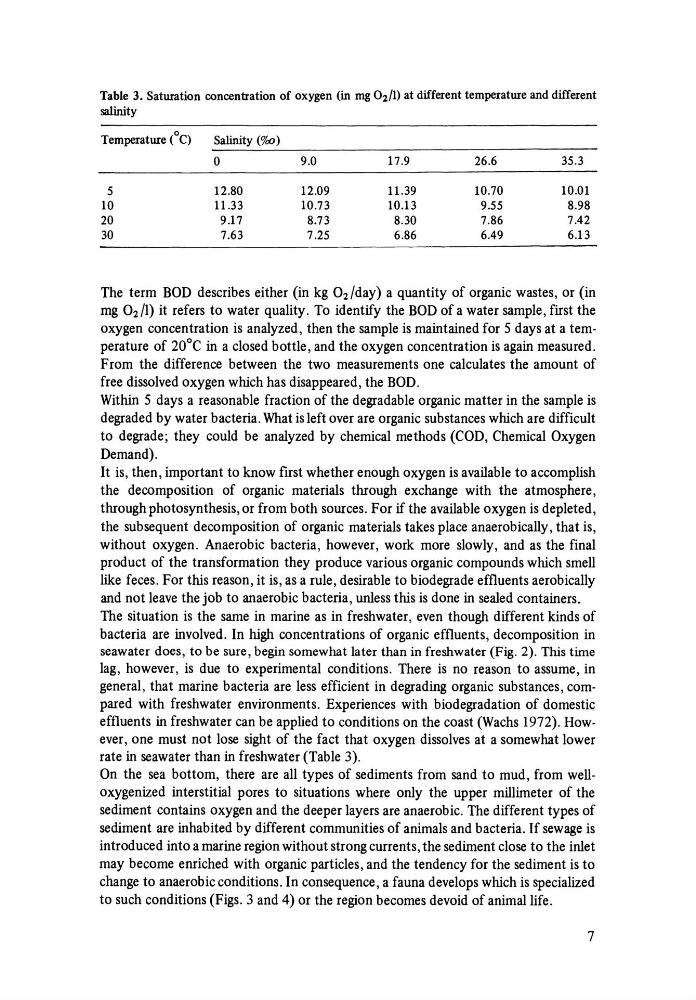
Table 3. Saturation concentration of oxygen (in mg 02/1) at different temperature and different
salinity
Temperature tC)
Salinity ('lcC)
0
9.0
17.9
26.6
35.3
5
12.80
12.09
11.39
10.70
10.01
10
11.33
10.73
10.13
9.55
8.98
20
9.17
8.73
8.30
7.86
7.42
30
7.63
7.25
6.86
6.49
6.13
The term BOD describes either (in kg 02/day) a quantity of organic wastes, or (in
mg O2 II) it refers to water quality. To identify the BOD of a water sample, first the
oxygen concentration is analyzed, then the sample is maintained for 5 days at a temperature of 20°C in a closed bottle, and the oxygen concentration is again measured.
From the difference between the two measurements one calculates the amount of
free dissolved oxygen which has disappeared, the BOD.
Within 5 days a reasonable fraction of the degradable organic matter in the sample is
degraded by water bacteria. What is left over are organic substances which are difficult
to degrade; they could be analyzed by chemical methods (COD, Chemical Oxygen
Demand).
It is, then, important to know first whether enough oxygen is available to accomplish
the decomposition of organic materials through exchange with the atmosphere,
through photosynthesis, or from both sources. For if the available oxygen is depleted,
the subsequent decomposition of organic materials takes place anaerobically, that is,
without oxygen. Anaerobic bacteria, however, work more slowly, and as the final
product of the transformation they produce various organic compounds which smell
like feces. For this reason, it is, as a rule, desirable to biodegrade effluents aerobically
and not leave the job to anaerobic bacteria, unless this is done in sealed containers.
The situation is the same in marine as in freshwater, even though different kinds of
bacteria are involved. In high concentrations of organic effluents, decomposition in
seawater does, to be sure, begin somewhat later than in freshwater (Fig. 2). This time
lag, however, is due to experimental conditions. There is no reason to assume, in
general, that marine bacteria are less efficient in degrading organic substances, compared with freshwater environments. Experiences with biodegradation of domestic
effluents in freshwater can be applied to conditions on the coast (Wachs 1972). However, one must not lose sight of the fact that oxygen dissolves at a somewhat lower
rate in seawater than in freshwater (Table 3).
On the sea bottom, there are all types of sediments from sand to mud, from welloxygenized interstitial pores to situations where only the upper millimeter of the
sediment contains oxygen and the deeper layers are anaerobic. The different types of
sediment are inhabited by different communities of animals and bacteria. If sewage is
introduced into a marine region without strong currents, the sediment close to the inlet
may become enriched with organic particles, and the tendency for the sediment is to
change to anaerobic conditions. In consequence, a fauna develops which is specialized
to such conditions (Figs. 3 and 4) or the region becomes devoid of animal life.
7
salinity
Temperature tC)
Salinity ('lcC)
0
9.0
17.9
26.6
35.3
5
12.80
12.09
11.39
10.70
10.01
10
11.33
10.73
10.13
9.55
8.98
20
9.17
8.73
8.30
7.86
7.42
30
7.63
7.25
6.86
6.49
6.13
The term BOD describes either (in kg 02/day) a quantity of organic wastes, or (in
mg O2 II) it refers to water quality. To identify the BOD of a water sample, first the
oxygen concentration is analyzed, then the sample is maintained for 5 days at a temperature of 20°C in a closed bottle, and the oxygen concentration is again measured.
From the difference between the two measurements one calculates the amount of
free dissolved oxygen which has disappeared, the BOD.
Within 5 days a reasonable fraction of the degradable organic matter in the sample is
degraded by water bacteria. What is left over are organic substances which are difficult
to degrade; they could be analyzed by chemical methods (COD, Chemical Oxygen
Demand).
It is, then, important to know first whether enough oxygen is available to accomplish
the decomposition of organic materials through exchange with the atmosphere,
through photosynthesis, or from both sources. For if the available oxygen is depleted,
the subsequent decomposition of organic materials takes place anaerobically, that is,
without oxygen. Anaerobic bacteria, however, work more slowly, and as the final
product of the transformation they produce various organic compounds which smell
like feces. For this reason, it is, as a rule, desirable to biodegrade effluents aerobically
and not leave the job to anaerobic bacteria, unless this is done in sealed containers.
The situation is the same in marine as in freshwater, even though different kinds of
bacteria are involved. In high concentrations of organic effluents, decomposition in
seawater does, to be sure, begin somewhat later than in freshwater (Fig. 2). This time
lag, however, is due to experimental conditions. There is no reason to assume, in
general, that marine bacteria are less efficient in degrading organic substances, compared with freshwater environments. Experiences with biodegradation of domestic
effluents in freshwater can be applied to conditions on the coast (Wachs 1972). However, one must not lose sight of the fact that oxygen dissolves at a somewhat lower
rate in seawater than in freshwater (Table 3).
On the sea bottom, there are all types of sediments from sand to mud, from welloxygenized interstitial pores to situations where only the upper millimeter of the
sediment contains oxygen and the deeper layers are anaerobic. The different types of
sediment are inhabited by different communities of animals and bacteria. If sewage is
introduced into a marine region without strong currents, the sediment close to the inlet
may become enriched with organic particles, and the tendency for the sediment is to
change to anaerobic conditions. In consequence, a fauna develops which is specialized
to such conditions (Figs. 3 and 4) or the region becomes devoid of animal life.
7