

0°
800W 700W 600W
500W LOoW
300W
200W l00W
0°
l00E
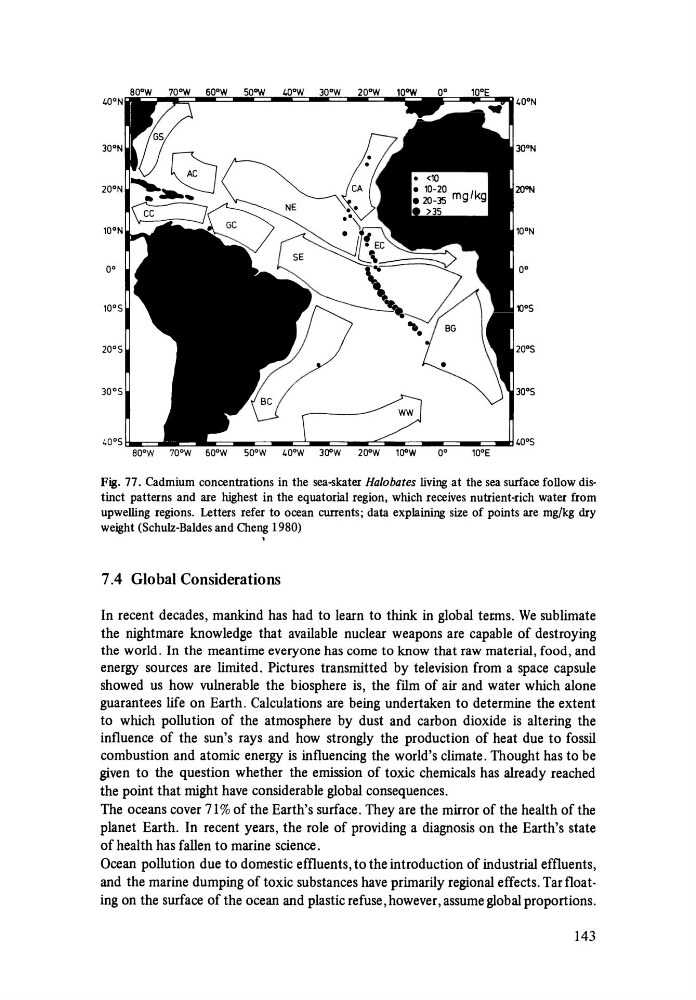
Fig. 77. Cadmium concentrations in the sea-skater Halobates living at the sea surface follow distinct patterns and are highest in the equatorial region, which receives nutrient-rich water from
upwelling regions. Letters refer to ocean currents; data explaining size of points are mg/kg dry
weight (Schulz-Baldes and Cheng 1980)
,
7.4 Global Considerations
In recent decades, mankind has had to learn to think in global temls. We sublimate
the nightmare knowledge that available nuclear weapons are capable of destroying
the world. In the meantime everyone has come to know that raw material, food, and
energy sources are limited. Pictures transmitted by television from a space capsule
showed us how vulnerable the biosphere is, the film of air and water which alone
guarantees life on Earth. Calculations are being undertaken to determine the extent
to which pollution of the atmosphere by dust and carbon dioxide is altering the
influence of the sun's rays and how strongly the production of heat due to fossil
combustion and atomic energy is influencing the world's climate. Thought has to be
given to the question whether the emission of toxic chemicals has already reached
the point that might have considerable global consequences.
The oceans cover 71 % of the Earth's surface. They are the mirror of the health of the
planet Earth. In recent years, the role of providing a diagnosis on the Earth's state
of health has fallen to marine science.
Ocean pollution due to domestic effluents, to the introduction of industrial effluents,
and the marine dumping of toxic substances have primarily regional effects. Tar floating on the surface of the ocean and plastic refuse, however, assume global proportions.
143
800W 700W 600W
500W LOoW
300W
200W l00W
0°
l00E
Fig. 77. Cadmium concentrations in the sea-skater Halobates living at the sea surface follow distinct patterns and are highest in the equatorial region, which receives nutrient-rich water from
upwelling regions. Letters refer to ocean currents; data explaining size of points are mg/kg dry
weight (Schulz-Baldes and Cheng 1980)
,
7.4 Global Considerations
In recent decades, mankind has had to learn to think in global temls. We sublimate
the nightmare knowledge that available nuclear weapons are capable of destroying
the world. In the meantime everyone has come to know that raw material, food, and
energy sources are limited. Pictures transmitted by television from a space capsule
showed us how vulnerable the biosphere is, the film of air and water which alone
guarantees life on Earth. Calculations are being undertaken to determine the extent
to which pollution of the atmosphere by dust and carbon dioxide is altering the
influence of the sun's rays and how strongly the production of heat due to fossil
combustion and atomic energy is influencing the world's climate. Thought has to be
given to the question whether the emission of toxic chemicals has already reached
the point that might have considerable global consequences.
The oceans cover 71 % of the Earth's surface. They are the mirror of the health of the
planet Earth. In recent years, the role of providing a diagnosis on the Earth's state
of health has fallen to marine science.
Ocean pollution due to domestic effluents, to the introduction of industrial effluents,
and the marine dumping of toxic substances have primarily regional effects. Tar floating on the surface of the ocean and plastic refuse, however, assume global proportions.
143