

How much time do we have until we are faced with serious problems of world-wide
ocean pollution?
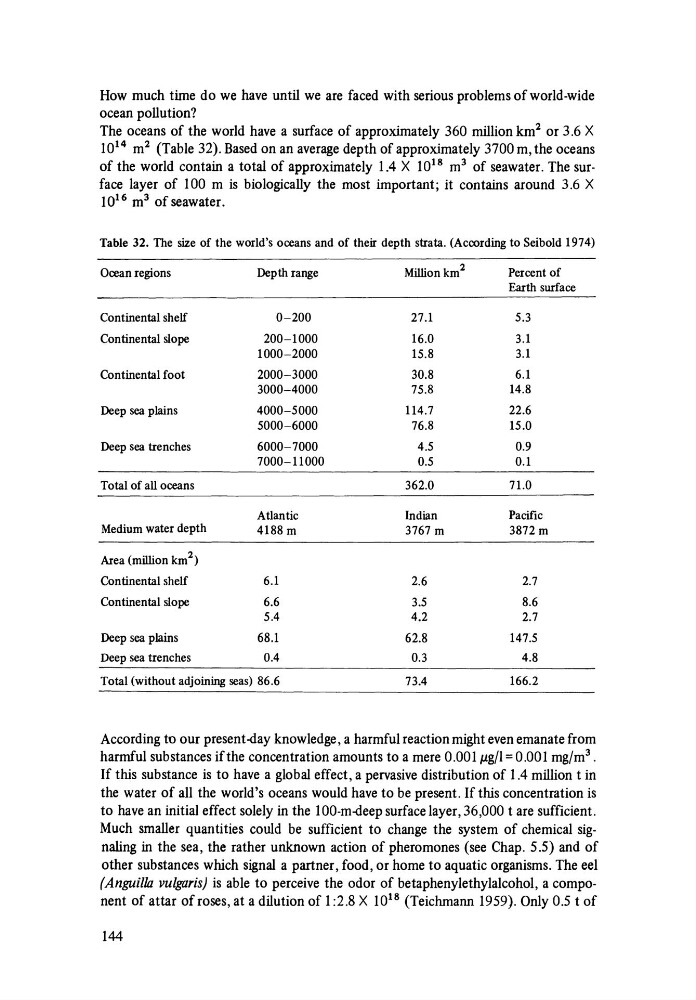
The oceans of the world have a surface of approximately 360 million km 2 or 3.6 X
10 14 m 2 (Table 32). Based on an average depth of approximately 3700 m, the oceans
of the world contain a total of approximately 1.4 X 10 18 m 3 of seawater. The surface layer of 100 m is biologically the most important; it contains around 3.6 X
10 16 m 3 of seawater.
Table 32. The size of the world's oceans and of their depth strata. (According to Seibold 1974)
Ocean regions
Depth range
Million km 2
Percent of
Earth surface
Continental shelf
0-200
27.1
5.3
Continental slope
200-1000
16.0
3.1
1000-2000
15.8
3.1
Continental foot
2000-3000
30.8
6.1
3000-4000
75.8
14.8
Deep sea plains
4000-5000
114.7
22.6
5000-6000
76.8
15.0
Deep sea trenches
6000-7000
4.5
0.9
7000-11000
0.5
0.1
Total of all oceans
362.0
71.0
Atlantic
Indian
Pacific
Medium water depth
4188 m
3767 m
3872m
Area (million km 2 )
Continental shelf
6.1
2.6
2.7
Continental slope
6.6
3.5
8.6
5.4
4.2
2.7
Deep sea plains
68.1
62.8
147.5
Deep sea trenches
0.4
0.3
4.8
Total (without adjoining seas) 86.6
73.4
166.2
According to our present-day knowledge, a harmful reaction might even emanate from
harmful substances if the concentration amounts to a mere 0.001 J.l.g/I = 0.001 mg/m 3 .
If this substance is to have a global effect, a pervasive distribution of 1.4 million tin
the water of all the world's oceans would have to be present. If this concentration is
to have an initial effect solely in the 1 OO-m-deep surface layer, 36,000 t are sufficient.
Much smaller quantities could be sufficient to change the system of chemical signaling in the sea, the rather unknown action of pheromones (see Chap. 5.5) and of
other substances which signal a partner, food, or home to aquatic organisms. The eel
(Anguilla vulgaris) is able to perceive the odor of betaphenylethylalcohol, a component of attar of roses, at a dilution of 1 :2.8 X 10 18 (Teichmann 1959). Only 0.5 t of
144
ocean pollution?
The oceans of the world have a surface of approximately 360 million km 2 or 3.6 X
10 14 m 2 (Table 32). Based on an average depth of approximately 3700 m, the oceans
of the world contain a total of approximately 1.4 X 10 18 m 3 of seawater. The surface layer of 100 m is biologically the most important; it contains around 3.6 X
10 16 m 3 of seawater.
Table 32. The size of the world's oceans and of their depth strata. (According to Seibold 1974)
Ocean regions
Depth range
Million km 2
Percent of
Earth surface
Continental shelf
0-200
27.1
5.3
Continental slope
200-1000
16.0
3.1
1000-2000
15.8
3.1
Continental foot
2000-3000
30.8
6.1
3000-4000
75.8
14.8
Deep sea plains
4000-5000
114.7
22.6
5000-6000
76.8
15.0
Deep sea trenches
6000-7000
4.5
0.9
7000-11000
0.5
0.1
Total of all oceans
362.0
71.0
Atlantic
Indian
Pacific
Medium water depth
4188 m
3767 m
3872m
Area (million km 2 )
Continental shelf
6.1
2.6
2.7
Continental slope
6.6
3.5
8.6
5.4
4.2
2.7
Deep sea plains
68.1
62.8
147.5
Deep sea trenches
0.4
0.3
4.8
Total (without adjoining seas) 86.6
73.4
166.2
According to our present-day knowledge, a harmful reaction might even emanate from
harmful substances if the concentration amounts to a mere 0.001 J.l.g/I = 0.001 mg/m 3 .
If this substance is to have a global effect, a pervasive distribution of 1.4 million tin
the water of all the world's oceans would have to be present. If this concentration is
to have an initial effect solely in the 1 OO-m-deep surface layer, 36,000 t are sufficient.
Much smaller quantities could be sufficient to change the system of chemical signaling in the sea, the rather unknown action of pheromones (see Chap. 5.5) and of
other substances which signal a partner, food, or home to aquatic organisms. The eel
(Anguilla vulgaris) is able to perceive the odor of betaphenylethylalcohol, a component of attar of roses, at a dilution of 1 :2.8 X 10 18 (Teichmann 1959). Only 0.5 t of
144