

10
20
30
40
50 ~mol N03/1
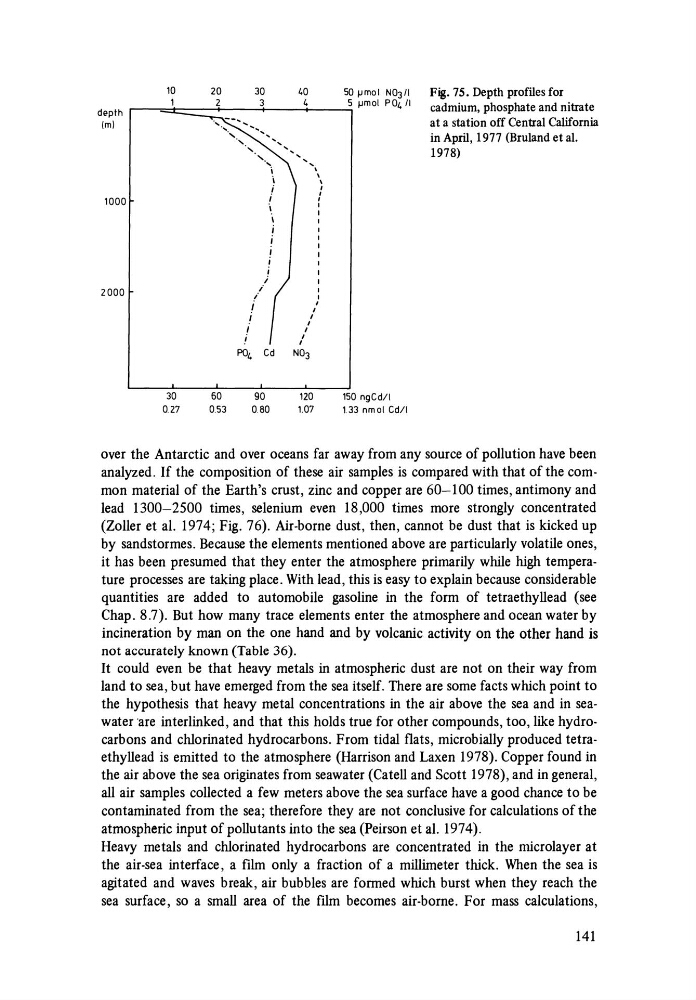
Fig. 75. Depth profiles for
2
3
4
5 IJmol POI. II
cadmium, phosphate and nitrate
"
--, ,
at a station off Central California
.,
'-,
,
- ,
in April, 1977 (Bruland et al.
....
,
depth I---,=.t=====~---+---+------l
1m)
....
, ,
1978)
'.
, ,
...
,
i
\
i
\
\
1000
i
I
i
I
I
i
I
I
\
,
,
i
i
,
!
,
!
I
I
2000
t
I
i
I
I
! I
I
I
POt. Cd
N03
30
60
90
120
150 ngCd/1
0.27
0.53
0.80
107
1.33 nm 01 Cd/I
over the Antarctic and over oceans far away from any source of pollution have been
analyzed. If the composition of these air samples is compared with that of the com·
mon material of the Earth's crust, zinc and copper are 60-100 times, antimony and
lead 1300-2500 times, selenium even 18,000 times more strongly concentrated
(Zoller et al. 1974; Fig. 76). Air-borne dust, then, cannot be dust that is kicked up
by sandstormes. Because the elements mentioned above are particularly volatile ones,
it has been presumed that they enter the atmosphere primarily while high temperature processes are taking place. With lead, this is easy to explain because considerable
quantities are added to automobile gasoline in the form of tetraethyllead (see
Chap. 8.7). But how many trace elements enter the atmosphere and ocean water by
incineration by man on the one hand and by volcanic activity On the other hand is
not accurately known (Table 36).
It could even be that heavy metals in atmospheric dust are not on their way from
land to sea, but have emerged from the sea itself. There are some facts which point to
the hypothesis that heavy metal concentrations in the air above the sea and in seawater ·are interlinked, and that this holds true for other compounds, too, like hydrocarbons and chlorinated hydrocarbons. From tidal flats, microbially produced tetraethyllead is emitted to the atmosphere (Harrison and Laxen 1978). Copper found in
the air above the sea originates from seawater (Catell and Scott 1978), and in general,
all air samples collected a few meters above the sea surface have a good chance to be
contaminated from the sea; therefore they are not conclusive for calculations of the
atmospheric input of pollutants into the sea (Peirson et al. 1974).
Heavy metals and chlorinated hydrocarbons are concentrated in the rnicrolayer at
the air-sea interface, a film only a fraction of a millimeter thick. When the sea is
agitated and waves break, air bubbles are formed which burst when they reach the
sea surface, so a small area of the film becomes air-borne. For mass calculations,
141
20
30
40
50 ~mol N03/1
Fig. 75. Depth profiles for
2
3
4
5 IJmol POI. II
cadmium, phosphate and nitrate
"
--, ,
at a station off Central California
.,
'-,
,
- ,
in April, 1977 (Bruland et al.
....
,
depth I---,=.t=====~---+---+------l
1m)
....
, ,
1978)
'.
, ,
...
,
i
\
i
\
\
1000
i
I
i
I
I
i
I
I
\
,
,
i
i
,
!
,
!
I
I
2000
t
I
i
I
I
! I
I
I
POt. Cd
N03
30
60
90
120
150 ngCd/1
0.27
0.53
0.80
107
1.33 nm 01 Cd/I
over the Antarctic and over oceans far away from any source of pollution have been
analyzed. If the composition of these air samples is compared with that of the com·
mon material of the Earth's crust, zinc and copper are 60-100 times, antimony and
lead 1300-2500 times, selenium even 18,000 times more strongly concentrated
(Zoller et al. 1974; Fig. 76). Air-borne dust, then, cannot be dust that is kicked up
by sandstormes. Because the elements mentioned above are particularly volatile ones,
it has been presumed that they enter the atmosphere primarily while high temperature processes are taking place. With lead, this is easy to explain because considerable
quantities are added to automobile gasoline in the form of tetraethyllead (see
Chap. 8.7). But how many trace elements enter the atmosphere and ocean water by
incineration by man on the one hand and by volcanic activity On the other hand is
not accurately known (Table 36).
It could even be that heavy metals in atmospheric dust are not on their way from
land to sea, but have emerged from the sea itself. There are some facts which point to
the hypothesis that heavy metal concentrations in the air above the sea and in seawater ·are interlinked, and that this holds true for other compounds, too, like hydrocarbons and chlorinated hydrocarbons. From tidal flats, microbially produced tetraethyllead is emitted to the atmosphere (Harrison and Laxen 1978). Copper found in
the air above the sea originates from seawater (Catell and Scott 1978), and in general,
all air samples collected a few meters above the sea surface have a good chance to be
contaminated from the sea; therefore they are not conclusive for calculations of the
atmospheric input of pollutants into the sea (Peirson et al. 1974).
Heavy metals and chlorinated hydrocarbons are concentrated in the rnicrolayer at
the air-sea interface, a film only a fraction of a millimeter thick. When the sea is
agitated and waves break, air bubbles are formed which burst when they reach the
sea surface, so a small area of the film becomes air-borne. For mass calculations,
141