

tED >450 mg I kg
r1a 350-450
I . 250-350
I .<250
m >200 mg/kg
6
150 - 200
o 100-150
0 <100
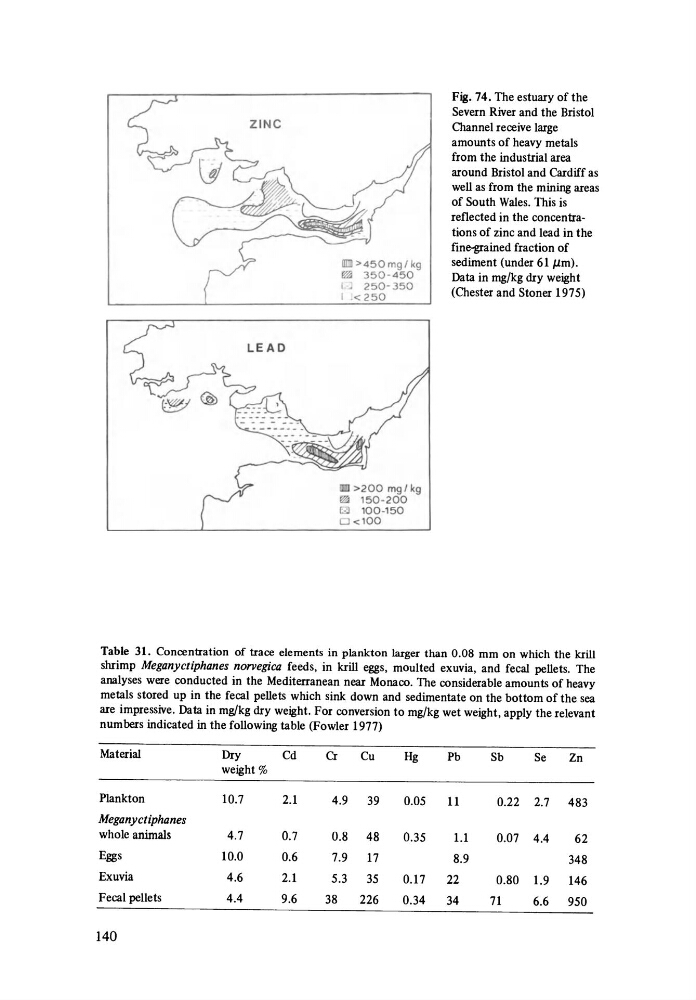
Fig. 74. The estuary of the
Severn River and the Bristol
Channel receive large
amounts of heavy metals
from the industrial area
around Bristol and Cardiff as
well as from the mining areas
of South Wales. This is
reflected in the concentrations of zinc and lead in the
fine-grained fraction of
sediment (under 61 j.lm).
Data in mg/kg dry weight
(Chester and Stoner 1975)
Table 31. Concentration of trace elements in plankton larger than 0.08 mm on which the krill
shrimp Meganyctiphanes norvegica feeds, in krill eggs, moulted exuvia, and fecal pellets. The
analyses were conducted in the Mediterranean near Monaco. The considerable amounts of heavy
metals stored up in the fecal pellets which sink down and sedimentate on the bottom of the sea
are impressive. Data in mg/kg dry weight. For conversion to mg/kg wet weight, apply the relevant
numbers indicated in the following table (Fowler 1977)
Material
Dry
Cd
Cr
Cu
Hg
Pb
Sb
Se
Zn
weight %
Plankton
10.7
2.1
4.9
39
0.05
11
0.22 2.7
483
Meganyctiphanes
whole animals
4.7
0.7
0.8
48
0.35
1.1
0.07 4.4
62
Eggs
10.0
0.6
7.9
17
8.9
348
Exuvia
4.6
2.1
5.3
35
0.17
22
0.80 1.9
146
Fecal pellets
4.4
9.6
38
226
0.34
34
71
6.6
950
140
r1a 350-450
I . 250-350
I .<250
m >200 mg/kg
6
150 - 200
o 100-150
0 <100
Fig. 74. The estuary of the
Severn River and the Bristol
Channel receive large
amounts of heavy metals
from the industrial area
around Bristol and Cardiff as
well as from the mining areas
of South Wales. This is
reflected in the concentrations of zinc and lead in the
fine-grained fraction of
sediment (under 61 j.lm).
Data in mg/kg dry weight
(Chester and Stoner 1975)
Table 31. Concentration of trace elements in plankton larger than 0.08 mm on which the krill
shrimp Meganyctiphanes norvegica feeds, in krill eggs, moulted exuvia, and fecal pellets. The
analyses were conducted in the Mediterranean near Monaco. The considerable amounts of heavy
metals stored up in the fecal pellets which sink down and sedimentate on the bottom of the sea
are impressive. Data in mg/kg dry weight. For conversion to mg/kg wet weight, apply the relevant
numbers indicated in the following table (Fowler 1977)
Material
Dry
Cd
Cr
Cu
Hg
Pb
Sb
Se
Zn
weight %
Plankton
10.7
2.1
4.9
39
0.05
11
0.22 2.7
483
Meganyctiphanes
whole animals
4.7
0.7
0.8
48
0.35
1.1
0.07 4.4
62
Eggs
10.0
0.6
7.9
17
8.9
348
Exuvia
4.6
2.1
5.3
35
0.17
22
0.80 1.9
146
Fecal pellets
4.4
9.6
38
226
0.34
34
71
6.6
950
140