

mg/kg
-: 100
I
.<::
If!J/
01
.;;;
~
QJ 80
t
1;.1
III
.,
·,r 1
:;J
III
60
III
,/
:;:;
.&
>c 40
• T
0
E
N
:;:;
c
II!
20 !
T
T
1:
!
1
01
1
20
.;;;
1
~
QJ
~
15 0
U
~
c
0
10
~ c
.,
u
c
5
0
u
50
100
150
days
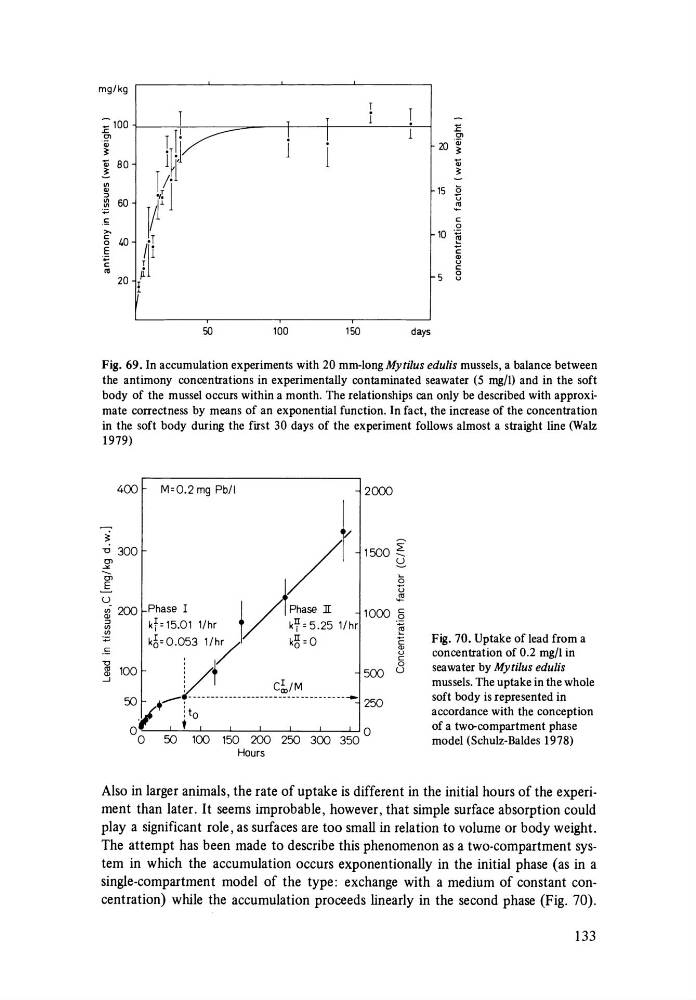
Fig. 69. In accumulation experiments with 20 mm-long Mytilus edulis mussels, a balance between
the antimony concentrations in experimentally contaminated seawater (5 mg/!) and in the soft
body of the mussel occurs within a month. The relationships can only be described with approximate correctness by means of an exponential function. In fact, the increase of the concentration
in the soft body during the first 30 days of the experiment follows almost a straight line (Walz
1979)
400
M=0.2 mg Pb/l
2000
i=
),=,
~- 200 Phase I !/t Phase 1I 1000 ~
.~
kf= 15.01 l/hr
k~= 5.25 l/hr
'§
.~
k6=0.053 1 / /
kg=O
~
m 100
1 ( ! 1
500 8
-.J
:
T
CI/M
50
• ...-: ... ------------------~-------------- 250
I",
: to
OJ't
0
o 50 100 150 200 250 300 350
Hours
Fig. 70. Uptake of lead from a
concentration of 0.2 mg/l in
seawater by Mytilus edulis
mussels. The uptake in the whole
soft body is represented in
accordance with the conception
of a two-compartment phase
model (Schulz-Baldes 1978)
Also in larger animals, the rate of uptake is different in the initial hours of the experiment than later. It seems improbable, however, that simple surface absorption could
playa Significant role, as surfaces are too small in relation to volume or body weight.
The attempt has been made to describe this phenomenon as a two-compartment system in which the accumulation occurs exponentionally in the initial phase (as in a
single-compartment model of the type: exchange with a medium of constant concentration) while the accumulation proceeds linearly in the second phase (Fig. 70).
133
-: 100
I
.<::
If!J/
01
.;;;
~
QJ 80
t
1;.1
III
.,
·,r 1
:;J
III
60
III
,/
:;:;
.&
>c 40
• T
0
E
N
:;:;
c
II!
20 !
T
T
1:
!
1
01
1
20
.;;;
1
~
QJ
~
15 0
U
~
c
0
10
~ c
.,
u
c
5
0
u
50
100
150
days
Fig. 69. In accumulation experiments with 20 mm-long Mytilus edulis mussels, a balance between
the antimony concentrations in experimentally contaminated seawater (5 mg/!) and in the soft
body of the mussel occurs within a month. The relationships can only be described with approximate correctness by means of an exponential function. In fact, the increase of the concentration
in the soft body during the first 30 days of the experiment follows almost a straight line (Walz
1979)
400
M=0.2 mg Pb/l
2000
i=
),=,
~- 200 Phase I !/t Phase 1I 1000 ~
.~
kf= 15.01 l/hr
k~= 5.25 l/hr
'§
.~
k6=0.053 1 / /
kg=O
~
m 100
1 ( ! 1
500 8
-.J
:
T
CI/M
50
• ...-: ... ------------------~-------------- 250
I",
: to
OJ't
0
o 50 100 150 200 250 300 350
Hours
Fig. 70. Uptake of lead from a
concentration of 0.2 mg/l in
seawater by Mytilus edulis
mussels. The uptake in the whole
soft body is represented in
accordance with the conception
of a two-compartment phase
model (Schulz-Baldes 1978)
Also in larger animals, the rate of uptake is different in the initial hours of the experiment than later. It seems improbable, however, that simple surface absorption could
playa Significant role, as surfaces are too small in relation to volume or body weight.
The attempt has been made to describe this phenomenon as a two-compartment system in which the accumulation occurs exponentionally in the initial phase (as in a
single-compartment model of the type: exchange with a medium of constant concentration) while the accumulation proceeds linearly in the second phase (Fig. 70).
133