

The difference might be found in the diversely rapid uptake of heavy metals into the
various tissues of an animal, in the different concentration factors achieved in various
tissues, and in different elimination characteristics.
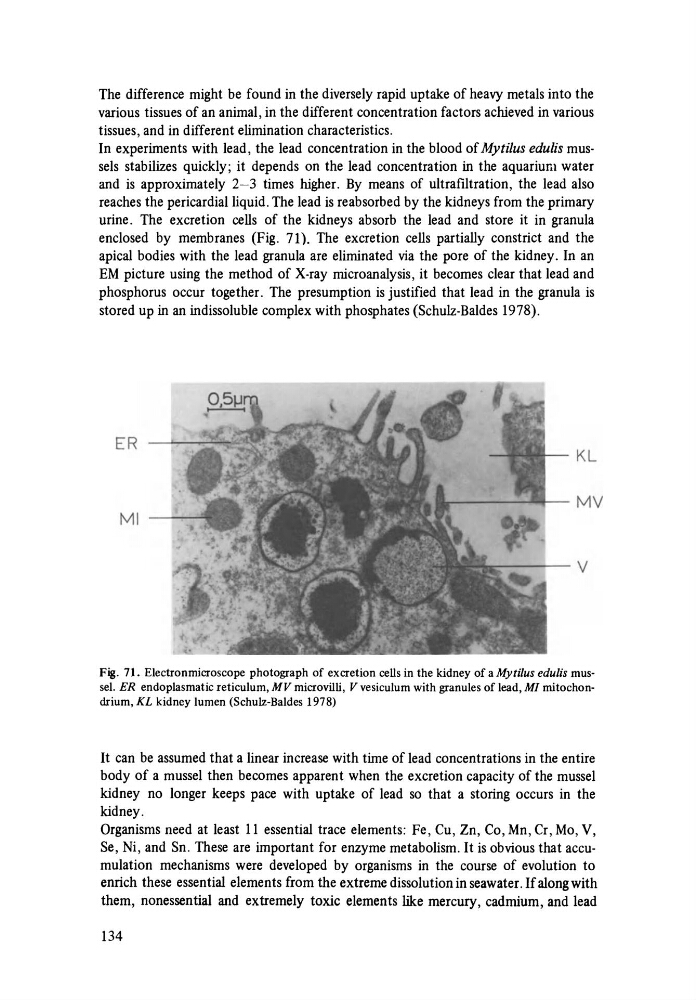
In experiments with lead, the lead concentration in the blood of Mytilus edulis mussels stabilizes quickly; it depends on the lead concentration in the aquarium water
and is approximately 2-3 times higher. By means of ultrafiltration, the lead also
reaches the pericardialliquid. The lead is reabsorbed by the kidneys from the primary
urine. The excretion cells of the kidneys absorb the lead and store it in granula
enclosed by membranes (Fig. 71). The excretion cells partially constrict and the
apical bodies with the lead granula are eliminated via the pore of the kidney. In an
EM picture using the method of X-ray microanalysis, it becomes clear that lead and
phosphorus occur together. The presumption is justified that lead in the granula is
stored up in an indissoluble complex with phosphates (Schulz-Baldes 1978).
ER
KL
..... - - -....... f--- MV
M I
Fig. 71. Electronmicroscope photograph of excretion cells in the kidney of a Mytilus edulis mussel. ER endoplasmatic reticulum, MV microvilli, V vesiculum with granules of lead, MI mitochondrium, KL kidney lumen (Schulz-Baldes 1978)
It can be assumed that a linear increase with time of lead concentrations in the entire
body of a mussel then becomes apparent when the excretion capacity of the mussel
kidney no longer keeps pace with uptake of lead so that a storing occurs in the
kidney.
Organisms need at least 11 essential trace elements: Fe, Cu, Zn, Co, Mn, Cr, Mo, V,
Se, Ni, and Sn. These are important for enzyme metabolism. It is obvious that accumulation mechanisms were developed by organisms in the course of evolution to
enrich these essential elements from the extreme dissolution in seawater. If along with
them, nonessential and extremely toxic elements like mercury, cadmium, and lead
134
various tissues of an animal, in the different concentration factors achieved in various
tissues, and in different elimination characteristics.
In experiments with lead, the lead concentration in the blood of Mytilus edulis mussels stabilizes quickly; it depends on the lead concentration in the aquarium water
and is approximately 2-3 times higher. By means of ultrafiltration, the lead also
reaches the pericardialliquid. The lead is reabsorbed by the kidneys from the primary
urine. The excretion cells of the kidneys absorb the lead and store it in granula
enclosed by membranes (Fig. 71). The excretion cells partially constrict and the
apical bodies with the lead granula are eliminated via the pore of the kidney. In an
EM picture using the method of X-ray microanalysis, it becomes clear that lead and
phosphorus occur together. The presumption is justified that lead in the granula is
stored up in an indissoluble complex with phosphates (Schulz-Baldes 1978).
ER
KL
..... - - -....... f--- MV
M I
Fig. 71. Electronmicroscope photograph of excretion cells in the kidney of a Mytilus edulis mussel. ER endoplasmatic reticulum, MV microvilli, V vesiculum with granules of lead, MI mitochondrium, KL kidney lumen (Schulz-Baldes 1978)
It can be assumed that a linear increase with time of lead concentrations in the entire
body of a mussel then becomes apparent when the excretion capacity of the mussel
kidney no longer keeps pace with uptake of lead so that a storing occurs in the
kidney.
Organisms need at least 11 essential trace elements: Fe, Cu, Zn, Co, Mn, Cr, Mo, V,
Se, Ni, and Sn. These are important for enzyme metabolism. It is obvious that accumulation mechanisms were developed by organisms in the course of evolution to
enrich these essential elements from the extreme dissolution in seawater. If along with
them, nonessential and extremely toxic elements like mercury, cadmium, and lead
134