

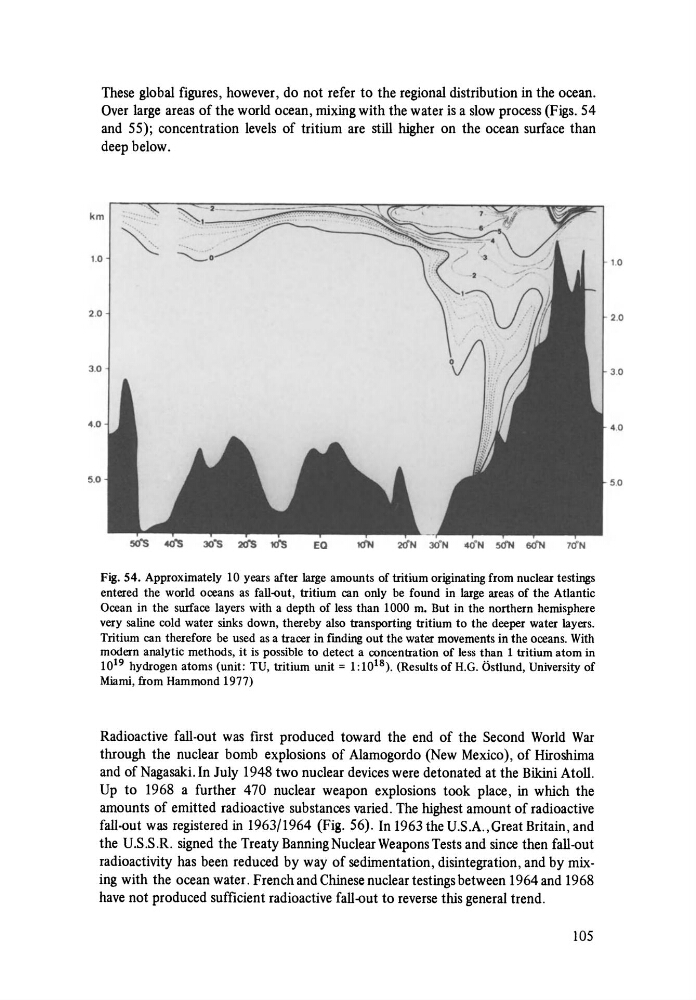
These global figures, however, do not refer to the regional distribution in the ocean.
Over large areas of the world ocean, mixing with the water is a slow process (Figs. 54
and 55); concentration levels of tritium are still higher on the ocean surface than
deep below.
Fig. 54. Approximately 10 years after large amounts of tritium originating from nuclear testings
entered the world oceans as fall-Qut, tritium can only be found in large areas of the Atlantic
Ocean in the surface layers with a depth of less than 1000 m. But in the northern hemisphere
very saline cold water sinks down, thereby also transporting tritium to the deeper water layers.
Tritium can therefore be used as a tracer in fmding out the water movements in the oceans. With
modern analytic methods, it is possible to detect a concentration of less than 1 tritium atom in
10 19 hydrogen atoms (unit: TU, tritium unit = 1 :10 18 ) . (Results of H.G. Ostlund, University of
Miami, from Hammond 1977)
Radioactive fall-out was first produced toward the end of the Second World War
through the nuclear bomb explosions of Alamogordo (New Mexico), of Hiroshima
and of Nagasaki. In July 1948 two nuclear devices were detonated at the Bikini Atoll.
Up to 1968 a further 470 nuclear weapon explosions took place, in which the
amounts of emitted radioactive substances varied. The highest amount of radioactive
fall-out was registered in 1963/1964 (Fig. 56). In 1963 the U.S.A.,Great Britain, and
the U.S.S .R. signed the Treaty Banning Nuclear Weapons Tests and since then fall-out
radioactivity has been reduced by way of sedimentation, disintegration, and by mixing with the ocean water. French and Chinese nuclear testings between 1964 and 1968
have not produced sufficient radioactive fall-out to reverse this general trend.
105
1.0
2 .0
3 .0
4.0
5.0
Over large areas of the world ocean, mixing with the water is a slow process (Figs. 54
and 55); concentration levels of tritium are still higher on the ocean surface than
deep below.
Fig. 54. Approximately 10 years after large amounts of tritium originating from nuclear testings
entered the world oceans as fall-Qut, tritium can only be found in large areas of the Atlantic
Ocean in the surface layers with a depth of less than 1000 m. But in the northern hemisphere
very saline cold water sinks down, thereby also transporting tritium to the deeper water layers.
Tritium can therefore be used as a tracer in fmding out the water movements in the oceans. With
modern analytic methods, it is possible to detect a concentration of less than 1 tritium atom in
10 19 hydrogen atoms (unit: TU, tritium unit = 1 :10 18 ) . (Results of H.G. Ostlund, University of
Miami, from Hammond 1977)
Radioactive fall-out was first produced toward the end of the Second World War
through the nuclear bomb explosions of Alamogordo (New Mexico), of Hiroshima
and of Nagasaki. In July 1948 two nuclear devices were detonated at the Bikini Atoll.
Up to 1968 a further 470 nuclear weapon explosions took place, in which the
amounts of emitted radioactive substances varied. The highest amount of radioactive
fall-out was registered in 1963/1964 (Fig. 56). In 1963 the U.S.A.,Great Britain, and
the U.S.S .R. signed the Treaty Banning Nuclear Weapons Tests and since then fall-out
radioactivity has been reduced by way of sedimentation, disintegration, and by mixing with the ocean water. French and Chinese nuclear testings between 1964 and 1968
have not produced sufficient radioactive fall-out to reverse this general trend.
105
1.0
2 .0
3 .0
4.0
5.0