

6 Radioactivity
6.1 Natural Background Radioactivity and Fall-out
In the marine environment, too, there is a natural basic exposure to radioactivity
caused by radioactive potassium-40, rubidium-87 and the elements of the natural
disintegration series from uranium to thorium. Added to these are radioactive hydro·
gen eH, tritium) and carbon·14, that develops through the influence of cosmic rays
upon the atmosphere. The natural radioactivity of potassium40 in the ocean is esti·
mated at 5 X 10¹¹ Ci 3.
In comparison to the natural background radioactivity, induced radioactivity caused
by man in the ocean is still relatively low and estimated to be somewhwat above
10 9 Ci (preston et al. 1971). The radioactivity of tritium released up to now through
nuclear testings amounts to 10 9 Ci, together with 0.2-0.6 X 10 9 Ci of radioactivity
in form of other radioactive fission products and radioisotopes originating from
neutron activation and nuclear fusion. Compared to this radioactive fall-out, the
amounts of the radioactivity in the ocean caused by nuclear plants and reprocessing
plants are relatively low: approximately 3 X 10 5 Ci of tritium and 3 X 10 5 Ci of
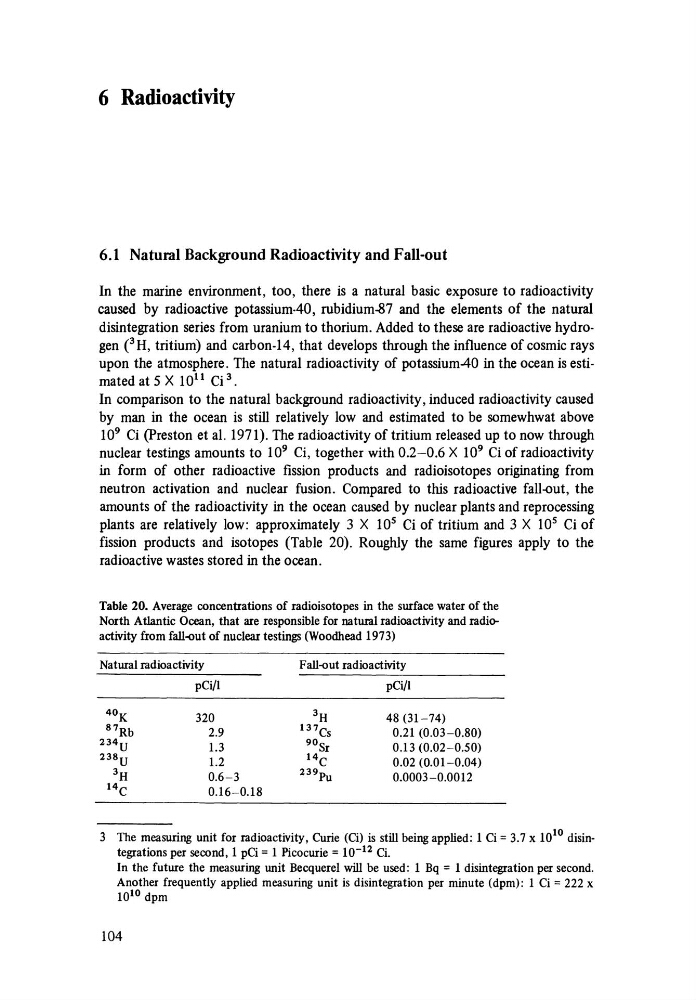
fission products and isotopes (Table 20). Roughly the same figures apply to the
radioactive wastes stored in the ocean.
Table 20. Average concentrations of radioisotopes in the surface water of the
North Atlantic Ocean, that are responsible for natural radioactivity and radioactivity from fall~ut of nuclear testings (Woodhead 1973)
Natural radioactivity
pCi/1
320
2.9
1.3
1.2
0.6-3
0.16-0.18
Fall-out radioactivity
pCi/1
48 (31-74)
0.21 (0.03-0.80)
0.13 (0.02-0.50)
0.02 (0.01-0.04)
0.0003 -0.0012
3 The measuring unit for radioactivity, Curie (Ci) is still being applied: 1 Ci = 3.7 X 10 10 disintegrations per second, 1 pCi = 1 Picocurie = 10- 12 Ci.
In the future the measuring unit Becquerel will be used: 1 Bq = 1 disintegration per second.
Another frequently applied measuring unit is disintegration per minute (dpm): 1 Ci = 222 x
10 10 dpm
104
6.1 Natural Background Radioactivity and Fall-out
In the marine environment, too, there is a natural basic exposure to radioactivity
caused by radioactive potassium-40, rubidium-87 and the elements of the natural
disintegration series from uranium to thorium. Added to these are radioactive hydro·
gen eH, tritium) and carbon·14, that develops through the influence of cosmic rays
upon the atmosphere. The natural radioactivity of potassium40 in the ocean is esti·
mated at 5 X 10¹¹ Ci 3.
In comparison to the natural background radioactivity, induced radioactivity caused
by man in the ocean is still relatively low and estimated to be somewhwat above
10 9 Ci (preston et al. 1971). The radioactivity of tritium released up to now through
nuclear testings amounts to 10 9 Ci, together with 0.2-0.6 X 10 9 Ci of radioactivity
in form of other radioactive fission products and radioisotopes originating from
neutron activation and nuclear fusion. Compared to this radioactive fall-out, the
amounts of the radioactivity in the ocean caused by nuclear plants and reprocessing
plants are relatively low: approximately 3 X 10 5 Ci of tritium and 3 X 10 5 Ci of
fission products and isotopes (Table 20). Roughly the same figures apply to the
radioactive wastes stored in the ocean.
Table 20. Average concentrations of radioisotopes in the surface water of the
North Atlantic Ocean, that are responsible for natural radioactivity and radioactivity from fall~ut of nuclear testings (Woodhead 1973)
Natural radioactivity
pCi/1
320
2.9
1.3
1.2
0.6-3
0.16-0.18
Fall-out radioactivity
pCi/1
48 (31-74)
0.21 (0.03-0.80)
0.13 (0.02-0.50)
0.02 (0.01-0.04)
0.0003 -0.0012
3 The measuring unit for radioactivity, Curie (Ci) is still being applied: 1 Ci = 3.7 X 10 10 disintegrations per second, 1 pCi = 1 Picocurie = 10- 12 Ci.
In the future the measuring unit Becquerel will be used: 1 Bq = 1 disintegration per second.
Another frequently applied measuring unit is disintegration per minute (dpm): 1 Ci = 222 x
10 10 dpm
104