

both think that the most important item is shelter, warm water, and appropriate
food, conditions which can only be provided by professional units which have made
preparations to deal with oiled birds before an oil accident occurs. But even with
such preparations the percentage of birds rescued will be very low; amateurs should
not try to do better.
The most important damage from oil accidents occurs if oil or "chocolate mousse"
are driven by wind and tides onto the shore. The effects are different according to
the type of shore. In principal, oil will be physically broken into minute particles on
wave-exposed beaches, and the particles will accumulate in protected areas, like other
detritus and clay material. In protected areas without heavy wave activity, the largest
oil amounts are deposited right at the high water line. The oil remains stranded if the
wind is onshore,and the next tide brings more oil in. The coastal areas below the high
tide level do not suffer so much from the oil because the water enters between sediment and oil slick and tends to float the oil free, so that relatively little oil becomes
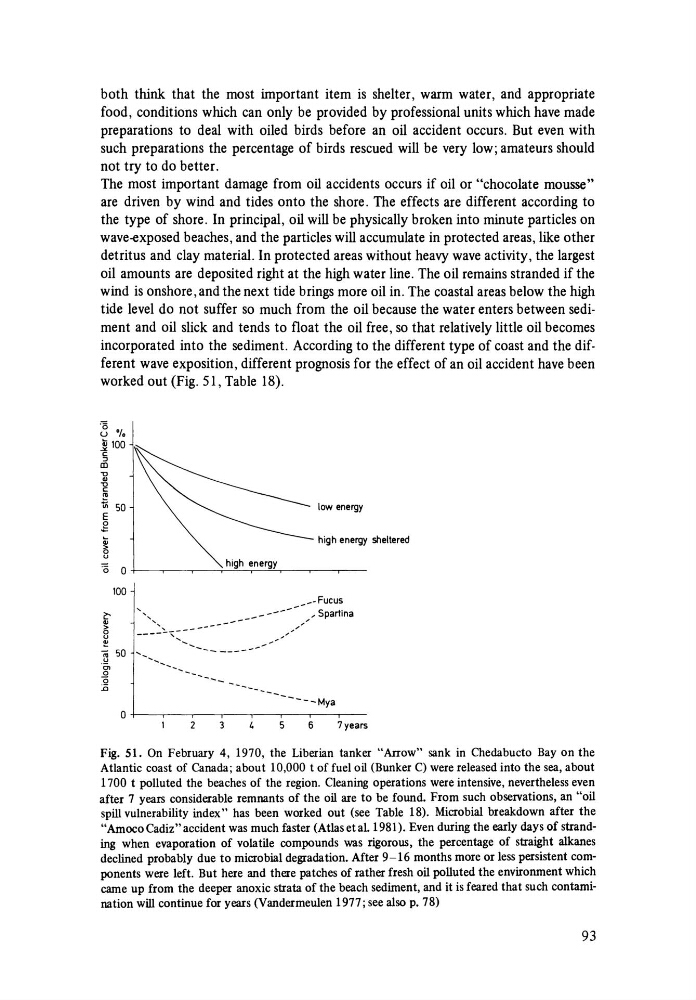
incorporated into the sediment. According to the different type of coast and the different wave exposition, different prognosis for the effect of an oil accident have been
worked out (Fig. 51, Table 18).
'5 '/,
u
~ 100
c
:J
III
"0
"
"0
C
~
iii 50
E
.g
:u
~
u
·0 0
100
n; 50
.!,1
Cl
o
"0
:0
low energy
high energy sheltered
high energy
, , , ,
----~,--- --.................. - -- ------- --- --_-Fucus
-----,' Spartina
, /
.......... "
-----Mya
0 + - - - , - - - , - - - , - - , , - - , - - - , - - - , - - -
5
6
7 years
Fig. 51. On February 4, 1970, the Liberian tanker "Arrow" sank in Chedabucto Bay on the
Atlantic coast of Canada; about 10,000 t of fuel oil (Bunker C) were released into the sea, about
1700 t polluted the beaches of the region. Cleaning operations were intensive, nevertheless even
after 7 years considerable remnants of the oil are to be found. From such observations, an "oil
spill vulnerability index" has been worked out (see Table 18). Microbial breakdown after the
"Amoco Cadiz" accident was much faster (Atlas et al. 1981). Even during the early days of stranding when evaporation of volatile compounds was rigorous, the percentage of straight alkanes
declined probably due to microbial degradation. After 9-16 months more or less persistent components were left. But here and there patches of rather fresh oil polluted the environment which
came up from the deeper anoxic strata of the beach sediment, and it is feared that such contamination will continue for years (Vandermeulen 1977; see also p. 78)
93
food, conditions which can only be provided by professional units which have made
preparations to deal with oiled birds before an oil accident occurs. But even with
such preparations the percentage of birds rescued will be very low; amateurs should
not try to do better.
The most important damage from oil accidents occurs if oil or "chocolate mousse"
are driven by wind and tides onto the shore. The effects are different according to
the type of shore. In principal, oil will be physically broken into minute particles on
wave-exposed beaches, and the particles will accumulate in protected areas, like other
detritus and clay material. In protected areas without heavy wave activity, the largest
oil amounts are deposited right at the high water line. The oil remains stranded if the
wind is onshore,and the next tide brings more oil in. The coastal areas below the high
tide level do not suffer so much from the oil because the water enters between sediment and oil slick and tends to float the oil free, so that relatively little oil becomes
incorporated into the sediment. According to the different type of coast and the different wave exposition, different prognosis for the effect of an oil accident have been
worked out (Fig. 51, Table 18).
'5 '/,
u
~ 100
c
:J
III
"0
"
"0
C
~
iii 50
E
.g
:u
~
u
·0 0
100
n; 50
.!,1
Cl
o
"0
:0
low energy
high energy sheltered
high energy
, , , ,
----~,--- --.................. - -- ------- --- --_-Fucus
-----,' Spartina
, /
.......... "
-----Mya
0 + - - - , - - - , - - - , - - , , - - , - - - , - - - , - - -
5
6
7 years
Fig. 51. On February 4, 1970, the Liberian tanker "Arrow" sank in Chedabucto Bay on the
Atlantic coast of Canada; about 10,000 t of fuel oil (Bunker C) were released into the sea, about
1700 t polluted the beaches of the region. Cleaning operations were intensive, nevertheless even
after 7 years considerable remnants of the oil are to be found. From such observations, an "oil
spill vulnerability index" has been worked out (see Table 18). Microbial breakdown after the
"Amoco Cadiz" accident was much faster (Atlas et al. 1981). Even during the early days of stranding when evaporation of volatile compounds was rigorous, the percentage of straight alkanes
declined probably due to microbial degradation. After 9-16 months more or less persistent components were left. But here and there patches of rather fresh oil polluted the environment which
came up from the deeper anoxic strata of the beach sediment, and it is feared that such contamination will continue for years (Vandermeulen 1977; see also p. 78)
93