

Ecological Constraints for Sound Communication: From Grasshoppers to Elephants 71
longer concerned with transmission over a few kilometers, but thousands of
kilometers!
Sound travels about five times faster in water than in air, at a speed of about
1500 ms·'- Propagation velocity is a function of the temperature, pressure and
salinity of water. For example, the speed increases by 4.8 ms·' per degree of
temperature increase, whereas the effects of pressure and salinity are
comparatively small. In aquatic environments horizontal stratifications of these
parameters result in changes in sound velocity. This in tum redirects sound waves
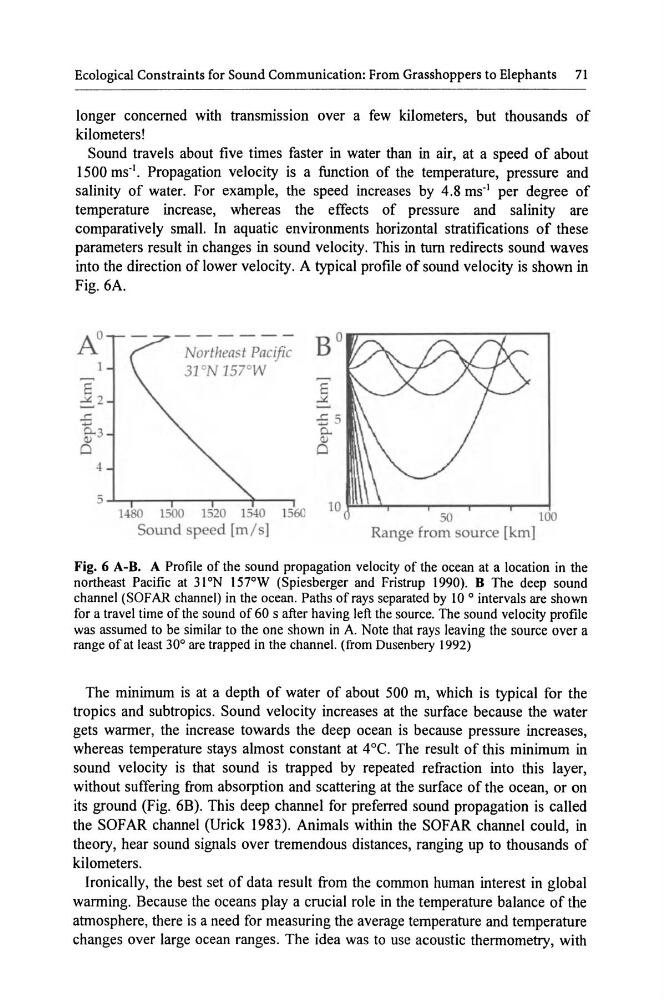
into the direction of lower velocity. A typical profile of sound velocity is shown in
Fig. 6A.
4
Northeast Pacific
31 °N 157°W
1480 1500 1520 1540 1560
Sound speed [ m Is]
£5
0...
Q)
0
10 ~~~--~--,----r--~
50
100
Range from ource [km]
Fig. 6 A-B. A Profile of the sound propagation velocity of the ocean at a location in the
northeast Pacific at 31 °N 157°W (Spiesberger and Fristrup 1990). B The deep sound
channel (SOFAR channel) in the ocean. Paths of rays separated by 10 ° intervals are shown
for a travel time of the sound of 60 s after having left the source. The sound velocity profile
was assumed to be similar to the one shown in A. Note that rays leaving the source over a
range of at least 30° are trapped in the channel. (from Dusenbery 1992)
The minimum is at a depth of water of about 500 m, which is typical for the
tropics and subtropics. Sound velocity increases at the surface because the water
gets warmer, the increase towards the deep ocean is because pressure increases,
whereas temperature stays almost constant at 4°C. The result of this minimum in
sound velocity is that sound is trapped by repeated refraction into this layer,
without suffering from absorption and scattering at the surface of the ocean, or on
its ground (Fig. 6B). This deep channel for preferred sound propagation is called
the SOFAR channel (Urick 1983). Animals within the SOFAR channel could, in
theory, hear sound signals over tremendous distances, ranging up to thousands of
kilometers.
Ironically, the best set of data result from the common human interest in global
warming. Because the oceans play a crucial role in the temperature balance of the
atmosphere, there is a need for measuring the average temperature and temperature
changes over large ocean ranges. The idea was to use acoustic thermometry, with
longer concerned with transmission over a few kilometers, but thousands of
kilometers!
Sound travels about five times faster in water than in air, at a speed of about
1500 ms·'- Propagation velocity is a function of the temperature, pressure and
salinity of water. For example, the speed increases by 4.8 ms·' per degree of
temperature increase, whereas the effects of pressure and salinity are
comparatively small. In aquatic environments horizontal stratifications of these
parameters result in changes in sound velocity. This in tum redirects sound waves
into the direction of lower velocity. A typical profile of sound velocity is shown in
Fig. 6A.
4
Northeast Pacific
31 °N 157°W
1480 1500 1520 1540 1560
Sound speed [ m Is]
£5
0...
Q)
0
10 ~~~--~--,----r--~
50
100
Range from ource [km]
Fig. 6 A-B. A Profile of the sound propagation velocity of the ocean at a location in the
northeast Pacific at 31 °N 157°W (Spiesberger and Fristrup 1990). B The deep sound
channel (SOFAR channel) in the ocean. Paths of rays separated by 10 ° intervals are shown
for a travel time of the sound of 60 s after having left the source. The sound velocity profile
was assumed to be similar to the one shown in A. Note that rays leaving the source over a
range of at least 30° are trapped in the channel. (from Dusenbery 1992)
The minimum is at a depth of water of about 500 m, which is typical for the
tropics and subtropics. Sound velocity increases at the surface because the water
gets warmer, the increase towards the deep ocean is because pressure increases,
whereas temperature stays almost constant at 4°C. The result of this minimum in
sound velocity is that sound is trapped by repeated refraction into this layer,
without suffering from absorption and scattering at the surface of the ocean, or on
its ground (Fig. 6B). This deep channel for preferred sound propagation is called
the SOFAR channel (Urick 1983). Animals within the SOFAR channel could, in
theory, hear sound signals over tremendous distances, ranging up to thousands of
kilometers.
Ironically, the best set of data result from the common human interest in global
warming. Because the oceans play a crucial role in the temperature balance of the
atmosphere, there is a need for measuring the average temperature and temperature
changes over large ocean ranges. The idea was to use acoustic thermometry, with