

70
Heiner Romer
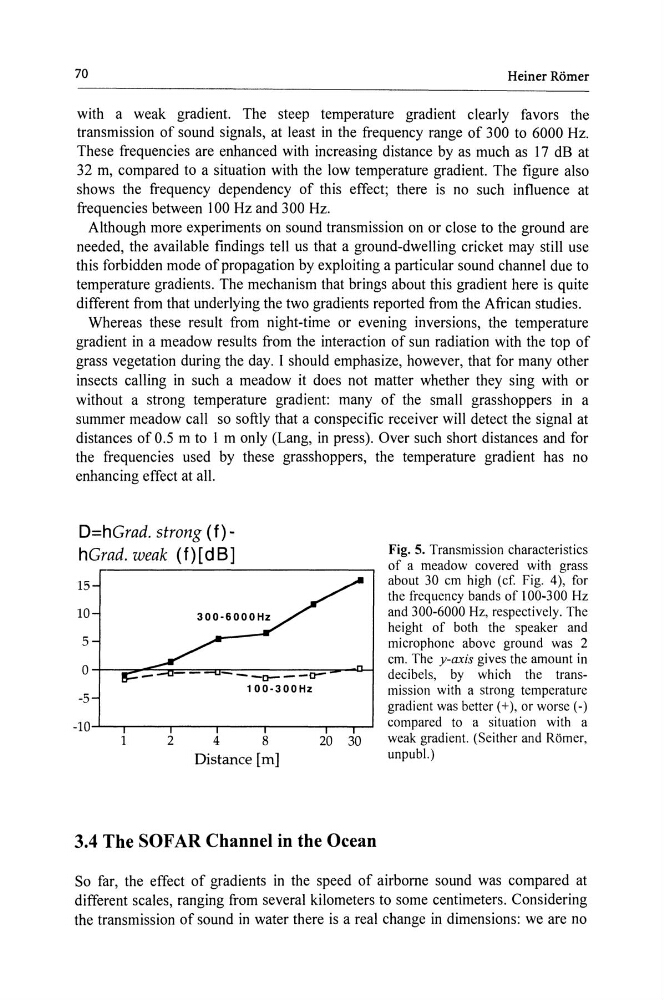
with a weak gradient. The steep temperature gradient clearly favors the
transmission of sound signals, at least in the frequency range of 300 to 6000 Hz.
These frequencies are enhanced with increasing distance by as much as 17 dB at
32 m, compared to a situation with the low temperature gradient. The figure also
shows the frequency dependency of this effect; there is no such influence at
frequencies between I 00 Hz and 300 Hz.
Although more experiments on sound transmission on or close to the ground are
needed, the available findings tell us that a ground-dwelling cricket may still use
this forbidden mode of propagation by exploiting a particular sound channel due to
temperature gradients. The mechanism that brings about this gradient here is quite
different from that underlying the two gradients reported from the African studies.
Whereas these result from night-time or evening inversions, the temperature
gradient in a meadow results from the interaction of sun radiation with the top of
grass vegetation during the day. I should emphasize, however, that for many other
insects calling in such a meadow it does not matter whether they sing with or
without a strong temperature gradient: many of the small grasshoppers in a
summer meadow call so softly that a conspecific receiver will detect the signal at
distances of 0.5 m to I m only (Lang, in press). Over such short distances and for
the frequencies used by these grasshoppers, the temperature gradient has no
enhancing effect at all.
D=hGrad. strong (f)hGrad. weak (f)[ dB]
15
10
5
04-~~~~~~~-~-----~------~~~~-o~
1 00-300Hz
-5
-10-'---r--...----r--.,.-----r-.,---'
1
2
4
8
20 30
Distance [m]
3.4 The SOF AR Channel in the Ocean
Fig. 5. Transmission characteristics
of a meadow covered with grass
about 30 em high (cf. Fig. 4), for
the frequency bands of 100-300 Hz
and 300-6000 Hz, respectively. The
height of both the speaker and
microphone above ground was 2
em. The y-axis gives the amount in
decibels, by which the transmission with a strong temperature
gradient was better ( + ), or worse (-)
compared to a situation with a
weak gradient. (Seither and Romer,
unpubl.)
So far, the effect of gradients in the speed of airborne sound was compared at
different scales, ranging from several kilometers to some centimeters. Considering
the transmission of sound in water there is a real change in dimensions: we are no
Heiner Romer
with a weak gradient. The steep temperature gradient clearly favors the
transmission of sound signals, at least in the frequency range of 300 to 6000 Hz.
These frequencies are enhanced with increasing distance by as much as 17 dB at
32 m, compared to a situation with the low temperature gradient. The figure also
shows the frequency dependency of this effect; there is no such influence at
frequencies between I 00 Hz and 300 Hz.
Although more experiments on sound transmission on or close to the ground are
needed, the available findings tell us that a ground-dwelling cricket may still use
this forbidden mode of propagation by exploiting a particular sound channel due to
temperature gradients. The mechanism that brings about this gradient here is quite
different from that underlying the two gradients reported from the African studies.
Whereas these result from night-time or evening inversions, the temperature
gradient in a meadow results from the interaction of sun radiation with the top of
grass vegetation during the day. I should emphasize, however, that for many other
insects calling in such a meadow it does not matter whether they sing with or
without a strong temperature gradient: many of the small grasshoppers in a
summer meadow call so softly that a conspecific receiver will detect the signal at
distances of 0.5 m to I m only (Lang, in press). Over such short distances and for
the frequencies used by these grasshoppers, the temperature gradient has no
enhancing effect at all.
D=hGrad. strong (f)hGrad. weak (f)[ dB]
15
10
5
04-~~~~~~~-~-----~------~~~~-o~
1 00-300Hz
-5
-10-'---r--...----r--.,.-----r-.,---'
1
2
4
8
20 30
Distance [m]
3.4 The SOF AR Channel in the Ocean
Fig. 5. Transmission characteristics
of a meadow covered with grass
about 30 em high (cf. Fig. 4), for
the frequency bands of 100-300 Hz
and 300-6000 Hz, respectively. The
height of both the speaker and
microphone above ground was 2
em. The y-axis gives the amount in
decibels, by which the transmission with a strong temperature
gradient was better ( + ), or worse (-)
compared to a situation with a
weak gradient. (Seither and Romer,
unpubl.)
So far, the effect of gradients in the speed of airborne sound was compared at
different scales, ranging from several kilometers to some centimeters. Considering
the transmission of sound in water there is a real change in dimensions: we are no