

72
Heiner Romer
two simple considerations in mind: (1) the travel time of sound between 2 points in
the ocean is a sensitive indicator of the ocean temperature in between, and (2) as
mentioned above, the ocean is a good propagator of sound, and therefore the two
points between which the sound travels can be thousands of kilometers apart. If we
take 0.02 °C year·' at the top of the ocean as a typical estimate of greenhouse
warming, this decreases exponentially to 0.005 °C year·' at a depth of I km, that is
roughly at the depth of the SOF AR channel. If we take the latter change at the
sound channel axis due to global warming effect, this would change the travel time
for sound by 100 ms over a path of 10 000 km.
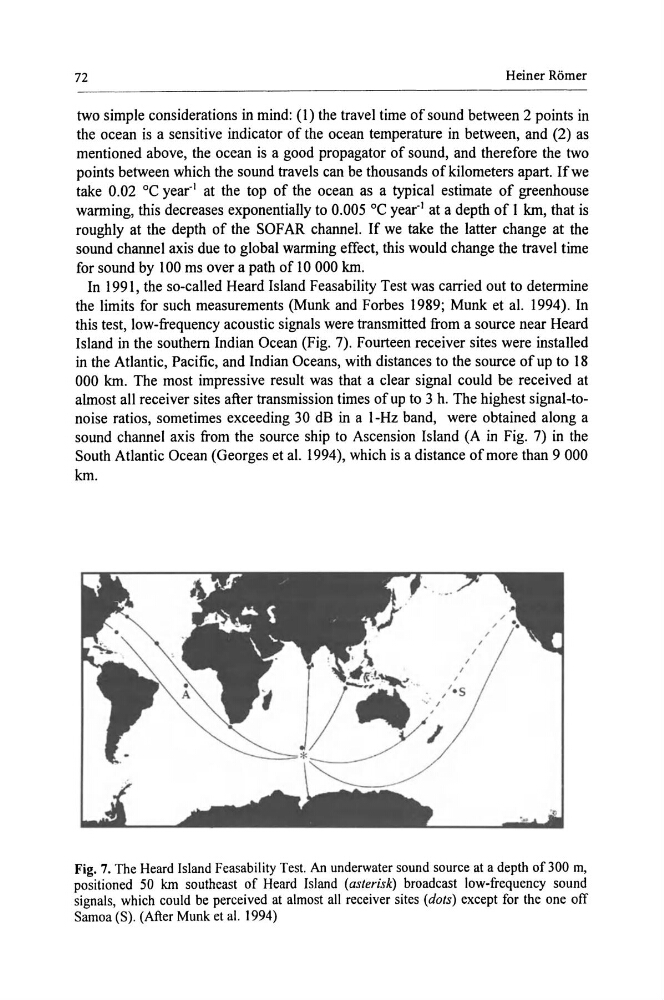
In 1991, the so-called Heard Island Feasability Test was carried out to determine
the limits for such measurements (Munk and Forbes 1989; Munk et al. 1994). In
this test, low-frequency acoustic signals were transmitted from a source near Heard
Island in the southern Indian Ocean (Fig. 7). Fourteen receiver sites were installed
in the Atlantic, Pacific, and Indian Oceans, with distances to the source of up to 18
000 km. The most impressive result was that a clear signal could be received at
almost all receiver sites after transmission times of up to 3 h. The highest signal-tonoise ratios, sometimes exceeding 30 dB in a 1-Hz band, were obtained along a
sound channel axis from the source ship to Ascension Island (A in Fig. 7) in the
South Atlantic Ocean (Georges et al. 1994 ), which is a distance of more than 9 000
km.
Fig. 7. The Heard Island Feasability Test. An underwater sound source at a depth of 300 m,
positioned 50 km southeast of Heard Island (asterisk) broadcast low-frequency sound
signals, which could be perceived at almost all receiver sites (dots) except for the one off
Samoa (S). (After Munk et al. 1994)
Heiner Romer
two simple considerations in mind: (1) the travel time of sound between 2 points in
the ocean is a sensitive indicator of the ocean temperature in between, and (2) as
mentioned above, the ocean is a good propagator of sound, and therefore the two
points between which the sound travels can be thousands of kilometers apart. If we
take 0.02 °C year·' at the top of the ocean as a typical estimate of greenhouse
warming, this decreases exponentially to 0.005 °C year·' at a depth of I km, that is
roughly at the depth of the SOF AR channel. If we take the latter change at the
sound channel axis due to global warming effect, this would change the travel time
for sound by 100 ms over a path of 10 000 km.
In 1991, the so-called Heard Island Feasability Test was carried out to determine
the limits for such measurements (Munk and Forbes 1989; Munk et al. 1994). In
this test, low-frequency acoustic signals were transmitted from a source near Heard
Island in the southern Indian Ocean (Fig. 7). Fourteen receiver sites were installed
in the Atlantic, Pacific, and Indian Oceans, with distances to the source of up to 18
000 km. The most impressive result was that a clear signal could be received at
almost all receiver sites after transmission times of up to 3 h. The highest signal-tonoise ratios, sometimes exceeding 30 dB in a 1-Hz band, were obtained along a
sound channel axis from the source ship to Ascension Island (A in Fig. 7) in the
South Atlantic Ocean (Georges et al. 1994 ), which is a distance of more than 9 000
km.
Fig. 7. The Heard Island Feasability Test. An underwater sound source at a depth of 300 m,
positioned 50 km southeast of Heard Island (asterisk) broadcast low-frequency sound
signals, which could be perceived at almost all receiver sites (dots) except for the one off
Samoa (S). (After Munk et al. 1994)