

46
Henry C. Bennet-Clark
Over a range of sound frequencies between 2 and 100 kHz, there is an
approximately linear fit between the source size and the sound frequency produced
by many groups of insects (Bennet-Clark 1998) and one species of frog, Hyla
cineraria, (see Duellman and Trueb 1985; pers. observ.; Fig. 2). This suggests that
the sound-producing mechanisms are of appropriate size for good impedance
matching. However, in all the cases shown in Fig. 2, the source size is smaller than
the minimum for ideal impedance matching (as shown by the diagonal lines on
Fig. 2) which suggests that overlarge sound sources may be avoided because they
are otherwise disadvantageous.
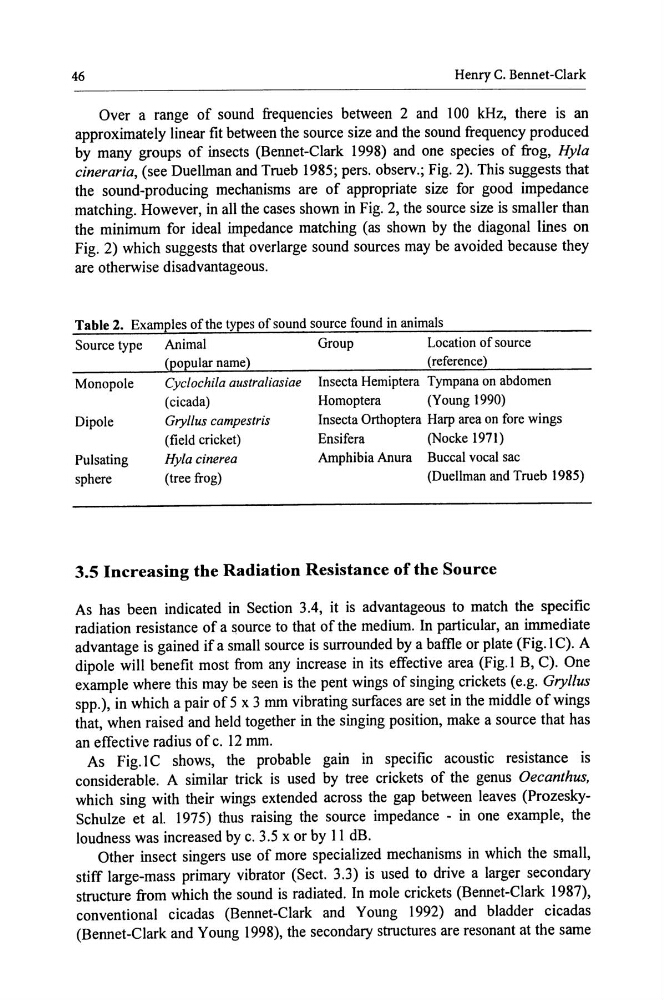
Table 2. Examples of the types of sound source found in animals
Source type
Animal
Group
Location of source
Monopole
Dipole
Pulsating
sphere
(popular name)
(reference)
Cyclochila australiasiae
(cicada)
Gryllus campestris
(field cricket)
Hyla cinerea
(tree frog)
Insecta Hemiptera Tympana on abdomen
Homoptera
(Young 1990)
Insecta Orthoptera Harp area on fore wings
Ensifera
(Nocke 1971)
Amphibia Anura Buccal vocal sac
(Duellman and Trueb 1985)
3.5 Increasing the Radiation Resistance of the Source
As has been indicated in Section 3.4, it is advantageous to match the specific
radiation resistance of a source to that of the medium. In particular, an immediate
advantage is gained if a small source is surrounded by a baffle or plate (Fig. I C). A
dipole will benefit most from any increase in its effective area (Fig.1 B, C). One
example where this may be seen is the pent wings of singing crickets (e.g. Gryl/us
spp. ), in which a pair of 5 x 3 mm vibrating surfaces are set in the middle of wings
that, when raised and held together in the singing position, make a source that has
an effective radius of c. 12 mm.
As Fig.1 C shows, the probable gain in specific acoustic resistance is
considerable. A similar trick is used by tree crickets of the genus Oecanthus,
which sing with their wings extended across the gap between leaves (ProzeskySchulze et al. 1975) thus raising the source impedance - in one example, the
loudness was increased by c. 3.5 x or by 11 dB.
Other insect singers use of more specialized mechanisms in which the small,
stiff large-mass primary vibrator (Sect. 3.3) is used to drive a larger secondary
structure from which the sound is radiated. In mole crickets (Bennet-Clark 1987),
conventional cicadas (Bennet-Clark and Young 1992) and bladder cicadas
(Bennet-Clark and Young 1998), the secondary structures are resonant at the same
Henry C. Bennet-Clark
Over a range of sound frequencies between 2 and 100 kHz, there is an
approximately linear fit between the source size and the sound frequency produced
by many groups of insects (Bennet-Clark 1998) and one species of frog, Hyla
cineraria, (see Duellman and Trueb 1985; pers. observ.; Fig. 2). This suggests that
the sound-producing mechanisms are of appropriate size for good impedance
matching. However, in all the cases shown in Fig. 2, the source size is smaller than
the minimum for ideal impedance matching (as shown by the diagonal lines on
Fig. 2) which suggests that overlarge sound sources may be avoided because they
are otherwise disadvantageous.
Table 2. Examples of the types of sound source found in animals
Source type
Animal
Group
Location of source
Monopole
Dipole
Pulsating
sphere
(popular name)
(reference)
Cyclochila australiasiae
(cicada)
Gryllus campestris
(field cricket)
Hyla cinerea
(tree frog)
Insecta Hemiptera Tympana on abdomen
Homoptera
(Young 1990)
Insecta Orthoptera Harp area on fore wings
Ensifera
(Nocke 1971)
Amphibia Anura Buccal vocal sac
(Duellman and Trueb 1985)
3.5 Increasing the Radiation Resistance of the Source
As has been indicated in Section 3.4, it is advantageous to match the specific
radiation resistance of a source to that of the medium. In particular, an immediate
advantage is gained if a small source is surrounded by a baffle or plate (Fig. I C). A
dipole will benefit most from any increase in its effective area (Fig.1 B, C). One
example where this may be seen is the pent wings of singing crickets (e.g. Gryl/us
spp. ), in which a pair of 5 x 3 mm vibrating surfaces are set in the middle of wings
that, when raised and held together in the singing position, make a source that has
an effective radius of c. 12 mm.
As Fig.1 C shows, the probable gain in specific acoustic resistance is
considerable. A similar trick is used by tree crickets of the genus Oecanthus,
which sing with their wings extended across the gap between leaves (ProzeskySchulze et al. 1975) thus raising the source impedance - in one example, the
loudness was increased by c. 3.5 x or by 11 dB.
Other insect singers use of more specialized mechanisms in which the small,
stiff large-mass primary vibrator (Sect. 3.3) is used to drive a larger secondary
structure from which the sound is radiated. In mole crickets (Bennet-Clark 1987),
conventional cicadas (Bennet-Clark and Young 1992) and bladder cicadas
(Bennet-Clark and Young 1998), the secondary structures are resonant at the same