

Impedance Matching in Sound Production and Hearing: a Comparative Study
45
Monopole EJ
s o u r c +
+ -
+ -
A
.
Dipole
source++ -
B
s ::;
:.a
(!)
s
.......
0
.... o:s
-s
8
(!)
~
-~
"§
(!)
0.1
§ 0.01
.;!l
"' ~
c
0
·~
:.s
~ 0.001
optimal source : load matching - - _.-?J- - - ·t· .... ·'"'
•'
I
cicada
•••• ••
1
I
tympana •••• ••••
••••
1
cricket burrow
cicada ----······
.11 • I
mouth of mole
•• ••••••
cricket wings
tymbals
••• ••
!'-....... entire
..
'
monopole source
••• ····'harps of mole
or piston in enclosure
•• •·••• crickets \
(A)
~
•••• ·••
e
~
I
......
/~
..
..
•• •••••
cricket harps
•••• •••
alone
..
..
.........
. . . . . . . . . . · dipole source
..
•••• ••
or free-edged
.......
..
..
..
..
piston
(B)
(A) (B)
I
minimum source
radii for optimal
impedance
matching
..
0.0001 ¥···-~----.-----.-----Af----r---...--'--,-1-----.-----.
0.001 0.002 0.004
0.01
0.02 0.04
0.1
0.2
0.4
c
Radius of source I sound wavelength
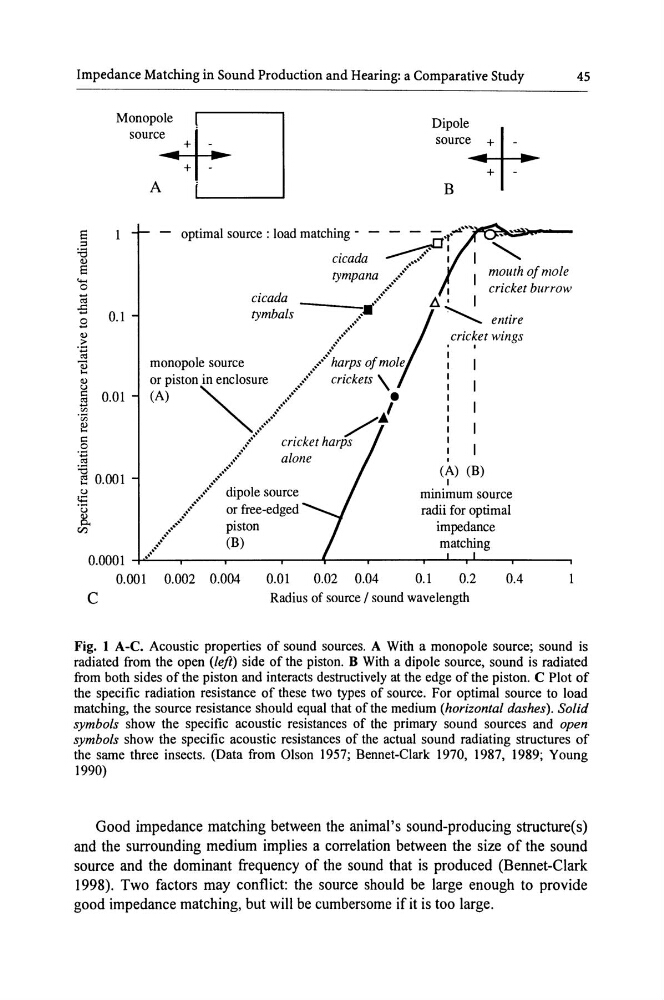
Fig. I A-C. Acoustic properties of sound sources. A With a monopole source; sound is
radiated from the open (left) side of the piston. B With a dipole source, sound is radiated
from both sides of the piston and interacts destructively at the edge of the piston. C Plot of
the specific radiation resistance of these two types of source. For optimal source to load
matching, the source resistance should equal that of the medium (horizontal dashes). Solid
symbols show the specific acoustic resistances of the primary sound sources and open
symbols show the specific acoustic resistances of the actual sound radiating structures of
the same three insects. (Data from Olson 1957; Bennet-Clark 1970, 1987, 1989; Young
1990)
Good impedance matching between the animal's sound-producing structure(s)
and the surrounding medium implies a correlation between the size of the sound
source and the dominant frequency of the sound that is produced (Bennet-Clark
1998). Two factors may conflict: the source should be large enough to provide
good impedance matching, but will be cumbersome if it is too large.
45
Monopole EJ
s o u r c +
+ -
+ -
A
.
Dipole
source++ -
B
s ::;
:.a
(!)
s
.......
0
.... o:s
-s
8
(!)
~
-~
"§
(!)
0.1
§ 0.01
.;!l
"' ~
c
0
·~
:.s
~ 0.001
optimal source : load matching - - _.-?J- - - ·t· .... ·'"'
•'
I
cicada
•••• ••
1
I
tympana •••• ••••
••••
1
cricket burrow
cicada ----······
.11 • I
mouth of mole
•• ••••••
cricket wings
tymbals
••• ••
!'-....... entire
..
'
monopole source
••• ····'harps of mole
or piston in enclosure
•• •·••• crickets \
(A)
~
•••• ·••
e
~
I
......
/~
..
..
•• •••••
cricket harps
•••• •••
alone
..
..
.........
. . . . . . . . . . · dipole source
..
•••• ••
or free-edged
.......
..
..
..
..
piston
(B)
(A) (B)
I
minimum source
radii for optimal
impedance
matching
..
0.0001 ¥···-~----.-----.-----Af----r---...--'--,-1-----.-----.
0.001 0.002 0.004
0.01
0.02 0.04
0.1
0.2
0.4
c
Radius of source I sound wavelength
Fig. I A-C. Acoustic properties of sound sources. A With a monopole source; sound is
radiated from the open (left) side of the piston. B With a dipole source, sound is radiated
from both sides of the piston and interacts destructively at the edge of the piston. C Plot of
the specific radiation resistance of these two types of source. For optimal source to load
matching, the source resistance should equal that of the medium (horizontal dashes). Solid
symbols show the specific acoustic resistances of the primary sound sources and open
symbols show the specific acoustic resistances of the actual sound radiating structures of
the same three insects. (Data from Olson 1957; Bennet-Clark 1970, 1987, 1989; Young
1990)
Good impedance matching between the animal's sound-producing structure(s)
and the surrounding medium implies a correlation between the size of the sound
source and the dominant frequency of the sound that is produced (Bennet-Clark
1998). Two factors may conflict: the source should be large enough to provide
good impedance matching, but will be cumbersome if it is too large.