

Impedance Matching in Sound Production and Hearing: a Comparative Study
47
frequency as the primary one. In such a system, the purely resistive impedance of
the secondary resonator provides a mechanism for drawing power from the
primary resonator without altering its resonant frequency (Bennet-Clark 1987,
1995).
Male mole crickets (Orthoptera-Ensifera) sing from burrows (Bennet-Clark
1970, 1987; Daws 1996) which have two main elements, an outer hom that opens
at the soil surface and an inner ovoid bulb (Fig.3). The insect sings at the junction
between these with its wings raised across the throat of the hom (Bennet-Clark
1970).
1000
0.1
minimum for
dipole sources
mole cricket
burrows
0 dipole
•
monopole
* pulsating sphere
I , , J
minimum for
monopole sources
' , A
conventional
~~
cicadas
0.2
/*
bladder
cicada
~~~
£tl o .,,L , ,
tree
fieV~\1:)', _
0
crickets
~
crickets
'
""-Drosophila
bush
/ •
crickets wax moths
0.5
2
5
10
20
50
100
Frequency in kilohertz
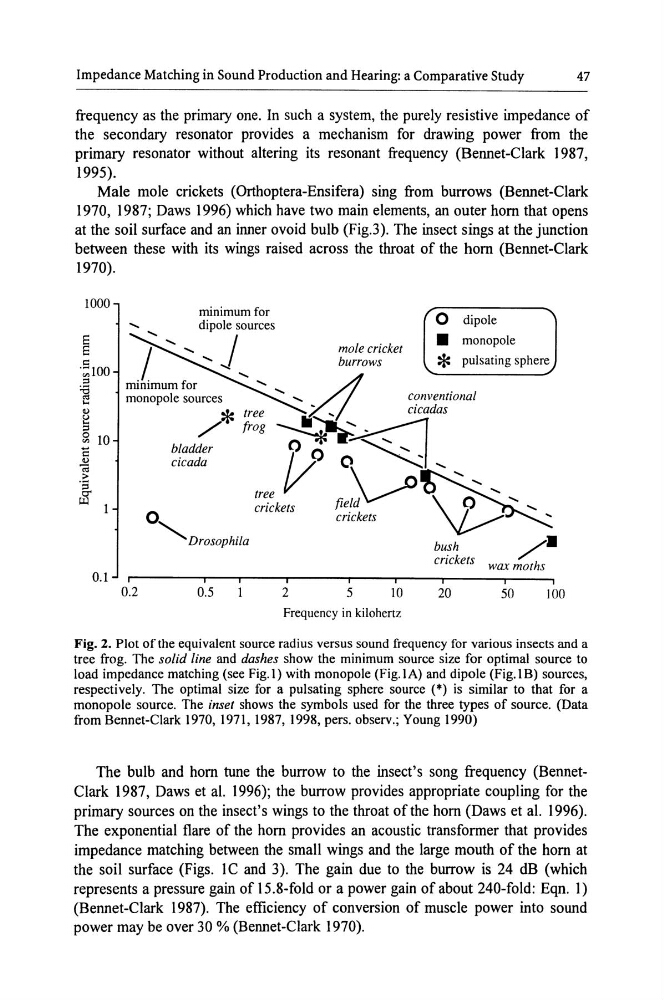
Fig. 2. Plot of the equivalent source radius versus sound frequency for various insects and a
tree frog. The solid line and dashes show the minimum source size for optimal source to
load impedance matching (see Fig. I) with monopole (Fig. lA) and dipole (Fig.IB) sources,
respectively. The optimal size for a pulsating sphere source (*) is similar to that for a
monopole source. The inset shows the symbols used for the three types of source. (Data
from Bennet-Clark 1970, 1971, 1987, 1998, pers. observ.; Young 1990)
The bulb and hom tune the burrow to the insect's song frequency (BennetClark 1987, Daws eta!. 1996); the burrow provides appropriate coupling for the
primary sources on the insect's wings to the throat of the hom (Daws et a!. 1996).
The exponential flare of the hom provides an acoustic transformer that provides
impedance matching between the small wings and the large mouth of the horn at
the soil surface (Figs. 1C and 3). The gain due to the burrow is 24 dB (which
represents a pressure gain of 15.8-fold or a power gain of about 240-fold: Eqn. 1)
(Bennet-Clark 1987). The efficiency of conversion of muscle power into sound
power may be over 30 % (Bennet-Clark 1970).
47
frequency as the primary one. In such a system, the purely resistive impedance of
the secondary resonator provides a mechanism for drawing power from the
primary resonator without altering its resonant frequency (Bennet-Clark 1987,
1995).
Male mole crickets (Orthoptera-Ensifera) sing from burrows (Bennet-Clark
1970, 1987; Daws 1996) which have two main elements, an outer hom that opens
at the soil surface and an inner ovoid bulb (Fig.3). The insect sings at the junction
between these with its wings raised across the throat of the hom (Bennet-Clark
1970).
1000
0.1
minimum for
dipole sources
mole cricket
burrows
0 dipole
•
monopole
* pulsating sphere
I , , J
minimum for
monopole sources
' , A
conventional
~~
cicadas
0.2
/*
bladder
cicada
~~~
£tl o .,,L , ,
tree
fieV~\1:)', _
0
crickets
~
crickets
'
""-Drosophila
bush
/ •
crickets wax moths
0.5
2
5
10
20
50
100
Frequency in kilohertz
Fig. 2. Plot of the equivalent source radius versus sound frequency for various insects and a
tree frog. The solid line and dashes show the minimum source size for optimal source to
load impedance matching (see Fig. I) with monopole (Fig. lA) and dipole (Fig.IB) sources,
respectively. The optimal size for a pulsating sphere source (*) is similar to that for a
monopole source. The inset shows the symbols used for the three types of source. (Data
from Bennet-Clark 1970, 1971, 1987, 1998, pers. observ.; Young 1990)
The bulb and hom tune the burrow to the insect's song frequency (BennetClark 1987, Daws eta!. 1996); the burrow provides appropriate coupling for the
primary sources on the insect's wings to the throat of the hom (Daws et a!. 1996).
The exponential flare of the hom provides an acoustic transformer that provides
impedance matching between the small wings and the large mouth of the horn at
the soil surface (Figs. 1C and 3). The gain due to the burrow is 24 dB (which
represents a pressure gain of 15.8-fold or a power gain of about 240-fold: Eqn. 1)
(Bennet-Clark 1987). The efficiency of conversion of muscle power into sound
power may be over 30 % (Bennet-Clark 1970).