

The Geomagnetic Field and its Role in Directional Orientation
295
suggests that their compass is also based on the polarity of the field lines (Arendse
and Vrins 1975). It is unknown whether this also applies to other crustacean and
insect species and how widespread a polarity compass might be among
arthropods.
N
mN
s
local geomagnetic field
N
mS
s
mN
honzontat component
reversed
N
mN
s
vertical componenl
reversed
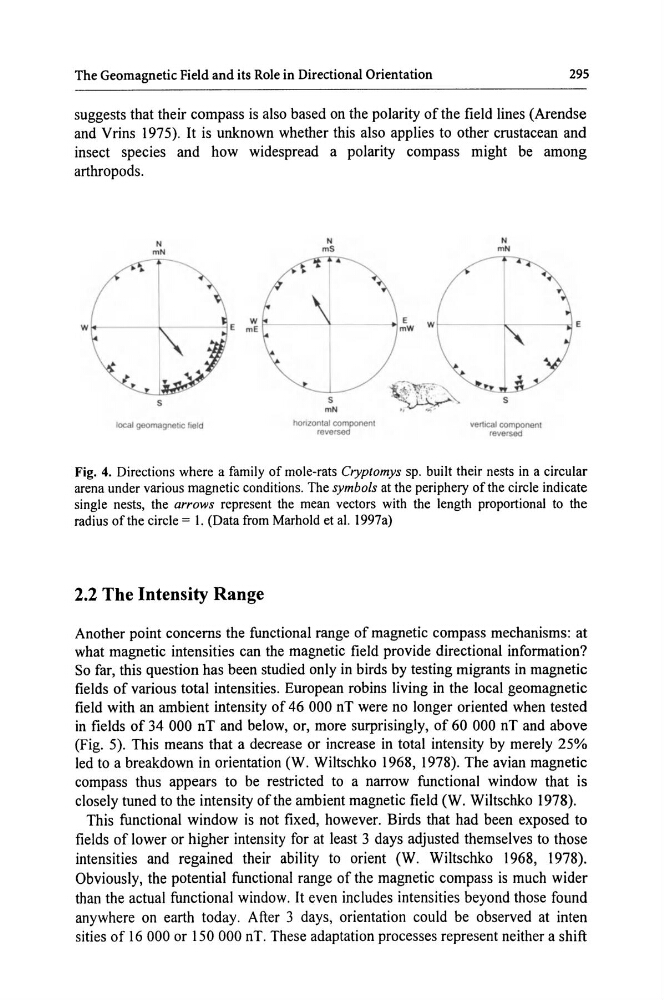
Fig. 4. Directions where a family of mole-rats Cryptomys sp. built their nests in a circular
arena under various magnetic conditions. The symbols at the periphery of the circle indicate
single nests, the arrows represent the mean vectors with the length proportional to the
radius of the circle= I. (Data from Marhold et al. 1997a)
2.2 The Intensity Range
Another point concerns the functional range of magnetic compass mechanisms: at
what magnetic intensities can the magnetic field provide directional information?
So far, this question has been studied only in birds by testing migrants in magnetic
fields of various total intensities. European robins living in the local geomagnetic
field with an ambient intensity of 46 000 nT were no longer oriented when tested
in fields of 34 000 nT and below, or, more surprisingly, of 60 000 nT and above
(Fig. 5). This means that a decrease or increase in total intensity by merely 25%
led to a breakdown in orientation (W. Wiltschko 1968, 1978). The avian magnetic
compass thus appears to be restricted to a narrow functional window that is
closely tuned to the intensity of the ambient magnetic field (W. Wiltschko 1978).
This functional window is not fixed, however. Birds that had been exposed to
fields of lower or higher intensity for at least 3 days adjusted themselves to those
intensities and regained their ability to orient (W. Wiltschko 1968, 1978).
Obviously, the potential functional range of the magnetic compass is much wider
than the actual functional window. It even includes intensities beyond those found
anywhere on earth today. After 3 days, orientation could be observed at inten
sities of 16 000 or 150 000 nT. These adaptation processes represent neither a shift
295
suggests that their compass is also based on the polarity of the field lines (Arendse
and Vrins 1975). It is unknown whether this also applies to other crustacean and
insect species and how widespread a polarity compass might be among
arthropods.
N
mN
s
local geomagnetic field
N
mS
s
mN
honzontat component
reversed
N
mN
s
vertical componenl
reversed
Fig. 4. Directions where a family of mole-rats Cryptomys sp. built their nests in a circular
arena under various magnetic conditions. The symbols at the periphery of the circle indicate
single nests, the arrows represent the mean vectors with the length proportional to the
radius of the circle= I. (Data from Marhold et al. 1997a)
2.2 The Intensity Range
Another point concerns the functional range of magnetic compass mechanisms: at
what magnetic intensities can the magnetic field provide directional information?
So far, this question has been studied only in birds by testing migrants in magnetic
fields of various total intensities. European robins living in the local geomagnetic
field with an ambient intensity of 46 000 nT were no longer oriented when tested
in fields of 34 000 nT and below, or, more surprisingly, of 60 000 nT and above
(Fig. 5). This means that a decrease or increase in total intensity by merely 25%
led to a breakdown in orientation (W. Wiltschko 1968, 1978). The avian magnetic
compass thus appears to be restricted to a narrow functional window that is
closely tuned to the intensity of the ambient magnetic field (W. Wiltschko 1978).
This functional window is not fixed, however. Birds that had been exposed to
fields of lower or higher intensity for at least 3 days adjusted themselves to those
intensities and regained their ability to orient (W. Wiltschko 1968, 1978).
Obviously, the potential functional range of the magnetic compass is much wider
than the actual functional window. It even includes intensities beyond those found
anywhere on earth today. After 3 days, orientation could be observed at inten
sities of 16 000 or 150 000 nT. These adaptation processes represent neither a shift