

296
150
50
-+8
8
8
8
8
+
--+------:~:-----+---+- 8
16
46
150 x10 3 nT
Magnetic intensity, housing cages
Wolfgang Wiltschko and Roswitha Wiltschko
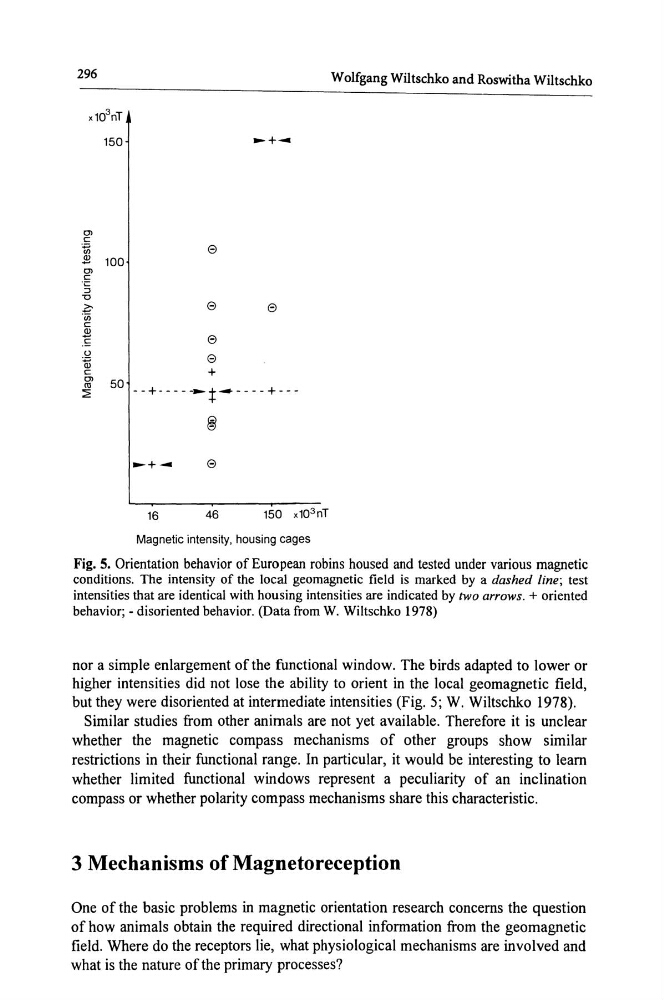
Fig. 5. Orientation behavior of European robins housed and tested under various magnetic
conditions. The intensity of the local geomagnetic field is marked by a dashed line; test
intensities that are identical with housing intensities are indicated by two arrows. + oriented
behavior; - disoriented behavior. (Data from W. Wiltschko 1978)
nor a simple enlargement of the functional window. The birds adapted to lower or
higher intensities did not lose the ability to orient in the local geomagnetic field,
but they were disoriented at intermediate intensities (Fig. 5; W. Wiltschko 1978).
Similar studies from other animals are not yet available. Therefore it is unclear
whether the magnetic compass mechanisms of other groups show similar
restrictions in their functional range. In particular, it would be interesting to learn
whether limited functional windows represent a peculiarity of an inclination
compass or whether polarity compass mechanisms share this characteristic.
3 Mechanisms of Magneto reception
One of the basic problems in magnetic orientation research concerns the question
of how animals obtain the required directional information from the geomagnetic
field. Where do the receptors lie, what physiological mechanisms are involved and
what is the nature of the primary processes?
150
50
-+8
8
8
8
8
+
--+------:~:-----+---+- 8
16
46
150 x10 3 nT
Magnetic intensity, housing cages
Wolfgang Wiltschko and Roswitha Wiltschko
Fig. 5. Orientation behavior of European robins housed and tested under various magnetic
conditions. The intensity of the local geomagnetic field is marked by a dashed line; test
intensities that are identical with housing intensities are indicated by two arrows. + oriented
behavior; - disoriented behavior. (Data from W. Wiltschko 1978)
nor a simple enlargement of the functional window. The birds adapted to lower or
higher intensities did not lose the ability to orient in the local geomagnetic field,
but they were disoriented at intermediate intensities (Fig. 5; W. Wiltschko 1978).
Similar studies from other animals are not yet available. Therefore it is unclear
whether the magnetic compass mechanisms of other groups show similar
restrictions in their functional range. In particular, it would be interesting to learn
whether limited functional windows represent a peculiarity of an inclination
compass or whether polarity compass mechanisms share this characteristic.
3 Mechanisms of Magneto reception
One of the basic problems in magnetic orientation research concerns the question
of how animals obtain the required directional information from the geomagnetic
field. Where do the receptors lie, what physiological mechanisms are involved and
what is the nature of the primary processes?