

Selectivity in Chemical Communication Systems of Arthropods
0
0
0
AACP~ r HOA_)l_CoA
OH 0
'
OH 0
f
II
0
~ACP
2x
=>
f
II
~OH
~0
0
~
11
)-_)lOH
0
12
"""-~H
13
- -
fatty acid synthesis
243
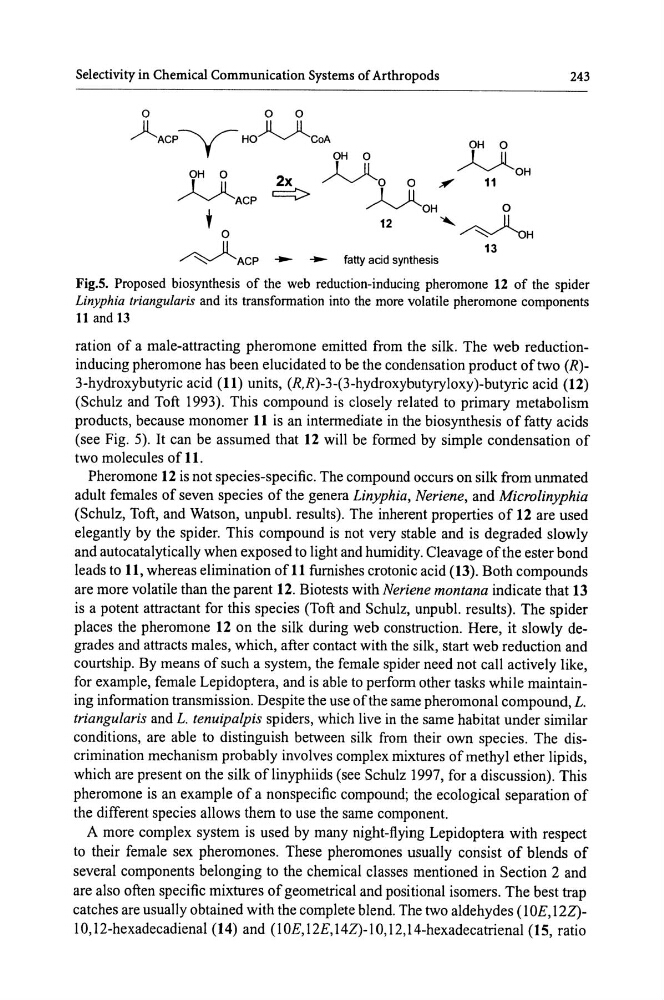
Fig.5. Proposed biosynthesis of the web reduction-inducing pheromone 12 of the spider
Linyphia triangularis and its transformation into the more volatile pheromone components
11 and 13
ration of a male-attracting pheromone emitted from the silk. The web reductioninducing pheromone has been elucidated to be the condensation product of two (R)3-hydroxybutyric acid (11) units, (R,R)-3-(3-hydroxybutyryloxy)-butyric acid (12)
(Schulz and Toft 1993). This compound is closely related to primary metabolism
products, because monomer 11 is an intermediate in the biosynthesis of fatty acids
(see Fig. 5). It can be assumed that 12 will be formed by simple condensation of
two molecules of 11.
Pheromone 12 is not species-specific. The compound occurs on silk from unmated
adult females of seven species of the genera Linyphia, Neriene, and Microlinyphia
(Schulz, Toft, and Watson, unpubl. results). The inherent properties of 12 are used
elegantly by the spider. This compound is not very stable and is degraded slowly
and autocatalytically when exposed to light and humidity. Cleavage of the ester bond
leads to 11, whereas elimination of 11 furnishes crotonic acid (13). Both compounds
are more volatile than the parent 12. Biotests with Neriene montana indicate that 13
is a potent attractant for this species (Toft and Schulz, unpubl. results). The spider
places the pheromone 12 on the silk during web construction. Here, it slowly degrades and attracts males, which, after contact with the silk, start web reduction and
courtship. By means of such a system, the female spider need not call actively like,
for example, female Lepidoptera, and is able to perform other tasks while maintaining information transmission. Despite the use of the same pheromonal compound, L.
triangularis and L. tenuipalpis spiders, which live in the same habitat under similar
conditions, are able to distinguish between silk from their own species. The discrimination mechanism probably involves complex mixtures of methyl ether lipids,
which are present on the silk oflinyphiids (see Schulz 1997, for a discussion). This
pheromone is an example of a nonspecific compound; the ecological separation of
the different species allows them to use the same component.
A more complex system is used by many night-flying Lepidoptera with respect
to their female sex pheromones. These pheromones usually consist of blends of
several components belonging to the chemical classes mentioned in Section 2 and
are also often specific mixtures of geometrical and positional isomers. The best trap
catches are usually obtained with the complete blend. The two aldehydes (10£,12Z)10,12-hexadecadienal (14) and (10£,12£,14Z)-10,12,14-hexadecatrienal (15, ratio
0
0
0
AACP~ r HOA_)l_CoA
OH 0
'
OH 0
f
II
0
~ACP
2x
=>
f
II
~OH
~0
0
~
11
)-_)lOH
0
12
"""-~H
13
- -
fatty acid synthesis
243
Fig.5. Proposed biosynthesis of the web reduction-inducing pheromone 12 of the spider
Linyphia triangularis and its transformation into the more volatile pheromone components
11 and 13
ration of a male-attracting pheromone emitted from the silk. The web reductioninducing pheromone has been elucidated to be the condensation product of two (R)3-hydroxybutyric acid (11) units, (R,R)-3-(3-hydroxybutyryloxy)-butyric acid (12)
(Schulz and Toft 1993). This compound is closely related to primary metabolism
products, because monomer 11 is an intermediate in the biosynthesis of fatty acids
(see Fig. 5). It can be assumed that 12 will be formed by simple condensation of
two molecules of 11.
Pheromone 12 is not species-specific. The compound occurs on silk from unmated
adult females of seven species of the genera Linyphia, Neriene, and Microlinyphia
(Schulz, Toft, and Watson, unpubl. results). The inherent properties of 12 are used
elegantly by the spider. This compound is not very stable and is degraded slowly
and autocatalytically when exposed to light and humidity. Cleavage of the ester bond
leads to 11, whereas elimination of 11 furnishes crotonic acid (13). Both compounds
are more volatile than the parent 12. Biotests with Neriene montana indicate that 13
is a potent attractant for this species (Toft and Schulz, unpubl. results). The spider
places the pheromone 12 on the silk during web construction. Here, it slowly degrades and attracts males, which, after contact with the silk, start web reduction and
courtship. By means of such a system, the female spider need not call actively like,
for example, female Lepidoptera, and is able to perform other tasks while maintaining information transmission. Despite the use of the same pheromonal compound, L.
triangularis and L. tenuipalpis spiders, which live in the same habitat under similar
conditions, are able to distinguish between silk from their own species. The discrimination mechanism probably involves complex mixtures of methyl ether lipids,
which are present on the silk oflinyphiids (see Schulz 1997, for a discussion). This
pheromone is an example of a nonspecific compound; the ecological separation of
the different species allows them to use the same component.
A more complex system is used by many night-flying Lepidoptera with respect
to their female sex pheromones. These pheromones usually consist of blends of
several components belonging to the chemical classes mentioned in Section 2 and
are also often specific mixtures of geometrical and positional isomers. The best trap
catches are usually obtained with the complete blend. The two aldehydes (10£,12Z)10,12-hexadecadienal (14) and (10£,12£,14Z)-10,12,14-hexadecatrienal (15, ratio