

242
Stefan Schulz
I
I
OH
HO~
5
6
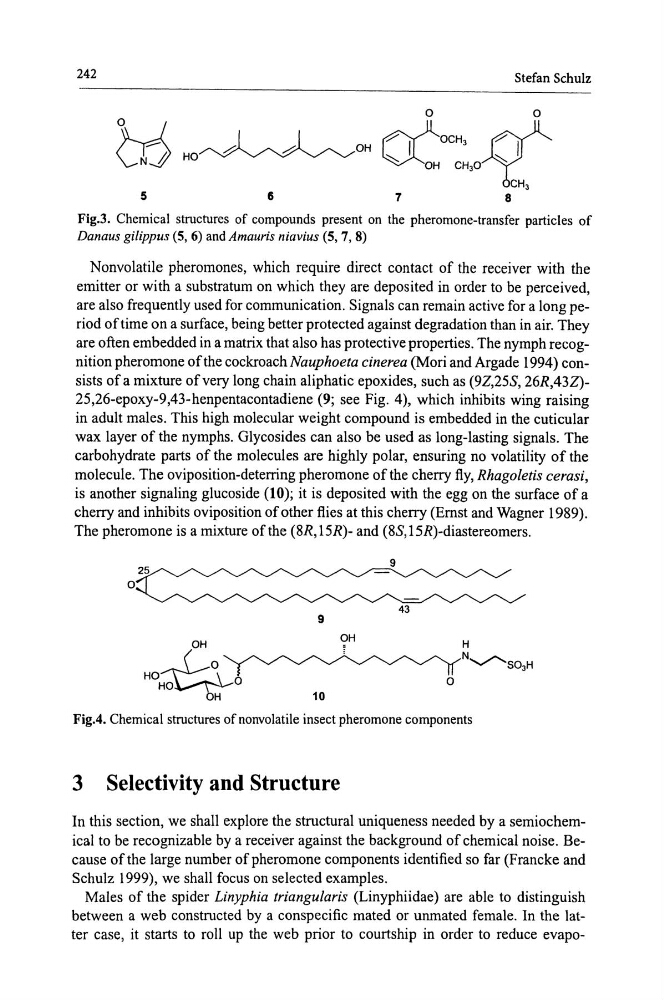
Fig.3. Chemical structures of compounds present on the pheromone-transfer particles of
Danaus gilippus (5, 6) and Amauris niavius (5, 7, 8)
Nonvolatile pheromones, which require direct contact of the receiver with the
emitter or with a substratum on which they are deposited in order to be perceived,
are also frequently used for communication. Signals can remain active for a long period of time on a surface, being better protected against degradation than in air. They
are often embedded in a matrix that also has protective properties. The nymph recognition pheromone of the cockroach Nauphoeta cinerea (Mori and Argade 1994) consists of a mixture ofvery long chain aliphatic epoxides, such as (9Z,25S, 26R,43Z)25,26-epoxy-9,43-henpentacontadiene (9; see Fig. 4), which inhibits wing raising
in adult males. This high molecular weight compound is embedded in the cuticular
wax layer of the nymphs. Glycosides can also be used as long-lasting signals. The
carbohydrate parts of the molecules are highly polar, ensuring no volatility of the
molecule. The oviposition-deterring pheromone of the cherry fly, Rhago/etis cerasi,
is another signaling glucoside (10); it is deposited with the egg on the surface of a
cherry and inhibits oviposition of other flies at this cherry (Ernst and Wagner 1989).
The pheromone is a mixture of the (8R, 15R)- and (8S, 15R)-diastereomers.
HO#OHO 0
HO
H
9
10
43
OH
0
Fig.4. Chemical structures of nonvolatile insect pheromone components
3 Selectivity and Structure
In this section, we shall explore the structural uniqueness needed by a semiochemical to be recognizable by a receiver against the background of chemical noise. Because of the large number of pheromone components identified so far (Francke and
Schulz 1999), we shall focus on selected examples.
Males of the spider Linyphia triangularis (Linyphiidae) are able to distinguish
between a web constructed by a conspecific mated or unmated female. In the latter case, it starts to roll up the web prior to courtship in order to reduce evapo-
Stefan Schulz
I
I
OH
HO~
5
6
Fig.3. Chemical structures of compounds present on the pheromone-transfer particles of
Danaus gilippus (5, 6) and Amauris niavius (5, 7, 8)
Nonvolatile pheromones, which require direct contact of the receiver with the
emitter or with a substratum on which they are deposited in order to be perceived,
are also frequently used for communication. Signals can remain active for a long period of time on a surface, being better protected against degradation than in air. They
are often embedded in a matrix that also has protective properties. The nymph recognition pheromone of the cockroach Nauphoeta cinerea (Mori and Argade 1994) consists of a mixture ofvery long chain aliphatic epoxides, such as (9Z,25S, 26R,43Z)25,26-epoxy-9,43-henpentacontadiene (9; see Fig. 4), which inhibits wing raising
in adult males. This high molecular weight compound is embedded in the cuticular
wax layer of the nymphs. Glycosides can also be used as long-lasting signals. The
carbohydrate parts of the molecules are highly polar, ensuring no volatility of the
molecule. The oviposition-deterring pheromone of the cherry fly, Rhago/etis cerasi,
is another signaling glucoside (10); it is deposited with the egg on the surface of a
cherry and inhibits oviposition of other flies at this cherry (Ernst and Wagner 1989).
The pheromone is a mixture of the (8R, 15R)- and (8S, 15R)-diastereomers.
HO#OHO 0
HO
H
9
10
43
OH
0
Fig.4. Chemical structures of nonvolatile insect pheromone components
3 Selectivity and Structure
In this section, we shall explore the structural uniqueness needed by a semiochemical to be recognizable by a receiver against the background of chemical noise. Because of the large number of pheromone components identified so far (Francke and
Schulz 1999), we shall focus on selected examples.
Males of the spider Linyphia triangularis (Linyphiidae) are able to distinguish
between a web constructed by a conspecific mated or unmated female. In the latter case, it starts to roll up the web prior to courtship in order to reduce evapo-