

Selectivity in Chemical Communication Systems of Arthropods
241
0
)(0
4
2
3
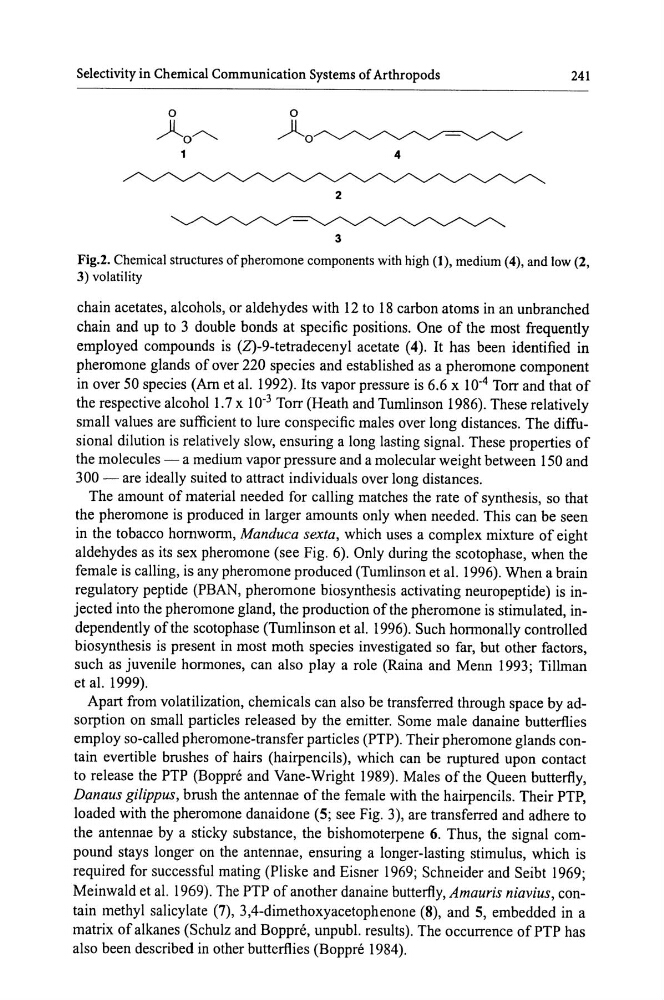
Fig.2. Chemical structures of pheromone components with high (1), medium (4), and low (2,
3) volatility
chain acetates, alcohols, or aldehydes with 12 to 18 carbon atoms in an unbranched
chain and up to 3 double bonds at specific positions. One of the most frequently
employed compounds is (Z)-9-tetradecenyl acetate (4). It has been identified in
pheromone glands of over 220 species and established as a pheromone component
in over 50 species (Am et al. 1992). Its vapor pressure is 6.6 x 10 4 Torr and that of
the respective alcohol 1. 7 x 1 o- 3 Torr (Heath and Tumlinson 1986). These relatively
small values are sufficient to lure conspecific males over long distances. The diffusional dilution is relatively slow, ensuring a long lasting signal. These properties of
the molecules - a medium vapor pressure and a molecular weight between 150 and
300- are ideally suited to attract individuals over long distances.
The amount of material needed for calling matches the rate of synthesis, so that
the pheromone is produced in larger amounts only when needed. This can be seen
in the tobacco hornworm, Manduca sexta, which uses a complex mixture of eight
aldehydes as its sex pheromone (see Fig. 6). Only during the scotophase, when the
female is calling, is any pheromone produced (Tumlinson eta!. 1996). When a brain
regulatory peptide (PBAN, pheromone biosynthesis activating neuropeptide) is injected into the pheromone gland, the production of the pheromone is stimulated, independently of the scotophase (Tumlinson eta!. 1996). Such hormonally controlled
biosynthesis is present in most moth species investigated so far, but other factors,
such as juvenile hormones, can also play a role (Raina and Menn 1993; Tillman
et a!. 1999).
Apart from volatilization, chemicals can also be transferred through space by adsorption on small particles released by the emitter. Some male danaine butterflies
employ so-called pheromone-transfer particles (PTP). Their pheromone glands contain evertible brushes of hairs (hairpencils), which can be ruptured upon contact
to release the PTP (Boppre and Vane-Wright 1989). Males of the Queen butterfly,
Danaus gilippus, brush the antennae of the female with the hairpencils. Their PTP,
loaded with the pheromone danaidone (5; see Fig. 3), are transferred and adhere to
the antennae by a sticky substance, the bishomoterpene 6. Thus, the signal compound stays longer on the antennae, ensuring a longer-lasting stimulus, which is
required for successful mating (Pliske and Eisner 1969; Schneider and Seibt 1969;
Meinwald eta!. 1969). The PTP of another danaine butterfly, Amauris niavius, contain methyl salicylate (7), 3,4-dimethoxyacetophenone (8), and 5, embedded in a
matrix of alkanes (Schulz and Boppre, unpubl. results). The occurrence of PTP has
also been described in other butterflies (Boppre 1984).
241
0
)(0
4
2
3
Fig.2. Chemical structures of pheromone components with high (1), medium (4), and low (2,
3) volatility
chain acetates, alcohols, or aldehydes with 12 to 18 carbon atoms in an unbranched
chain and up to 3 double bonds at specific positions. One of the most frequently
employed compounds is (Z)-9-tetradecenyl acetate (4). It has been identified in
pheromone glands of over 220 species and established as a pheromone component
in over 50 species (Am et al. 1992). Its vapor pressure is 6.6 x 10 4 Torr and that of
the respective alcohol 1. 7 x 1 o- 3 Torr (Heath and Tumlinson 1986). These relatively
small values are sufficient to lure conspecific males over long distances. The diffusional dilution is relatively slow, ensuring a long lasting signal. These properties of
the molecules - a medium vapor pressure and a molecular weight between 150 and
300- are ideally suited to attract individuals over long distances.
The amount of material needed for calling matches the rate of synthesis, so that
the pheromone is produced in larger amounts only when needed. This can be seen
in the tobacco hornworm, Manduca sexta, which uses a complex mixture of eight
aldehydes as its sex pheromone (see Fig. 6). Only during the scotophase, when the
female is calling, is any pheromone produced (Tumlinson eta!. 1996). When a brain
regulatory peptide (PBAN, pheromone biosynthesis activating neuropeptide) is injected into the pheromone gland, the production of the pheromone is stimulated, independently of the scotophase (Tumlinson eta!. 1996). Such hormonally controlled
biosynthesis is present in most moth species investigated so far, but other factors,
such as juvenile hormones, can also play a role (Raina and Menn 1993; Tillman
et a!. 1999).
Apart from volatilization, chemicals can also be transferred through space by adsorption on small particles released by the emitter. Some male danaine butterflies
employ so-called pheromone-transfer particles (PTP). Their pheromone glands contain evertible brushes of hairs (hairpencils), which can be ruptured upon contact
to release the PTP (Boppre and Vane-Wright 1989). Males of the Queen butterfly,
Danaus gilippus, brush the antennae of the female with the hairpencils. Their PTP,
loaded with the pheromone danaidone (5; see Fig. 3), are transferred and adhere to
the antennae by a sticky substance, the bishomoterpene 6. Thus, the signal compound stays longer on the antennae, ensuring a longer-lasting stimulus, which is
required for successful mating (Pliske and Eisner 1969; Schneider and Seibt 1969;
Meinwald eta!. 1969). The PTP of another danaine butterfly, Amauris niavius, contain methyl salicylate (7), 3,4-dimethoxyacetophenone (8), and 5, embedded in a
matrix of alkanes (Schulz and Boppre, unpubl. results). The occurrence of PTP has
also been described in other butterflies (Boppre 1984).