

244
Stefan Schulz
0
0
H
H
14
15
Fig.6. Chemical structures of the major sex pheromone components of Manduca sexta
2 : 1) are essential for trapping M. sexta, but the complete pheromone containing 8
components gives optimized trap catches (Tumlinson et al. 1994 ).
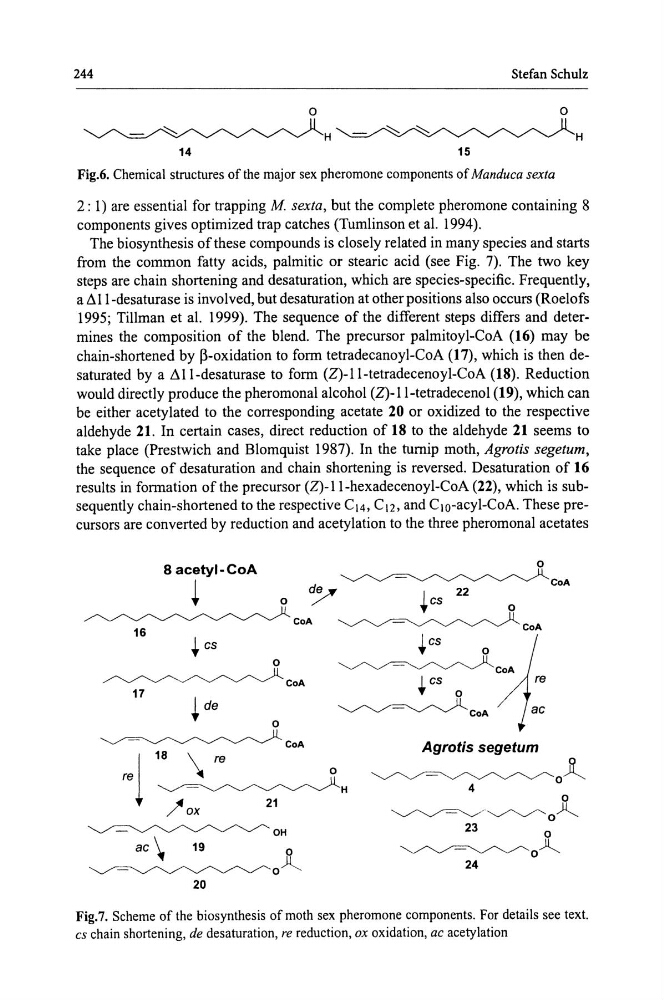
The biosynthesis of these compounds is closely related in many species and starts
from the common fatty acids, palmitic or stearic acid (see Fig. 7). The two key
steps are chain shortening and desaturation, which are species-specific. Frequently,
a 1111-desaturase is involved, but desaturation at other positions also occurs (Roelofs
1995; Tillman et al. 1999). The sequence of the different steps differs and determines the composition of the blend. The precursor palmitoyl-CoA (16) may be
chain-shortened by ~-oxidation to form tetradecanoyl-CoA (17), which is then desaturated by a 1111-desaturase to form (Z)-11-tetradecenoyl-CoA (18). Reduction
would directly produce the pheromonal alcohol (Z)-11-tetradecenol (19), which can
be either acetylated to the corresponding acetate 20 or oxidized to the respective
aldehyde 21. In certain cases, direct reduction of 18 to the aldehyde 21 seems to
take place (Prestwich and Blomquist 1987). In the turnip moth, Agrotis segetum,
the sequence of desaturation and chain shortening is reversed. Desaturation of 16
results in formation of the precursor (Z)-11-hexadecenoyl-CoA (22), which is subsequently chain-shortened to the respective C14, C12, and C10-acy!-CoA. These precursors are converted by reduction and acetylation to the three pheromonal acetates
~de
0
~CoA
+cs
0
~CoA
+ cs 0
~CoA
0
Agrotis segetum
Co A
re
o
1
18
\
re
~H
~OJl
~
21
/ ox
~OH
ac \
19
0
~0~
20
0
.. ,...__/,,/-=-'---.,/~ )-l...__
0
23
0
~0~
24
Fig.7. Scheme of the biosynthesis of moth sex pheromone components. For details see text.
cs chain shortening, de desaturation, re reduction, ox oxidation, ac acetylation
Stefan Schulz
0
0
H
H
14
15
Fig.6. Chemical structures of the major sex pheromone components of Manduca sexta
2 : 1) are essential for trapping M. sexta, but the complete pheromone containing 8
components gives optimized trap catches (Tumlinson et al. 1994 ).
The biosynthesis of these compounds is closely related in many species and starts
from the common fatty acids, palmitic or stearic acid (see Fig. 7). The two key
steps are chain shortening and desaturation, which are species-specific. Frequently,
a 1111-desaturase is involved, but desaturation at other positions also occurs (Roelofs
1995; Tillman et al. 1999). The sequence of the different steps differs and determines the composition of the blend. The precursor palmitoyl-CoA (16) may be
chain-shortened by ~-oxidation to form tetradecanoyl-CoA (17), which is then desaturated by a 1111-desaturase to form (Z)-11-tetradecenoyl-CoA (18). Reduction
would directly produce the pheromonal alcohol (Z)-11-tetradecenol (19), which can
be either acetylated to the corresponding acetate 20 or oxidized to the respective
aldehyde 21. In certain cases, direct reduction of 18 to the aldehyde 21 seems to
take place (Prestwich and Blomquist 1987). In the turnip moth, Agrotis segetum,
the sequence of desaturation and chain shortening is reversed. Desaturation of 16
results in formation of the precursor (Z)-11-hexadecenoyl-CoA (22), which is subsequently chain-shortened to the respective C14, C12, and C10-acy!-CoA. These precursors are converted by reduction and acetylation to the three pheromonal acetates
~de
0
~CoA
+cs
0
~CoA
+ cs 0
~CoA
0
Agrotis segetum
Co A
re
o
1
18
\
re
~H
~OJl
~
21
/ ox
~OH
ac \
19
0
~0~
20
0
.. ,...__/,,/-=-'---.,/~ )-l...__
0
23
0
~0~
24
Fig.7. Scheme of the biosynthesis of moth sex pheromone components. For details see text.
cs chain shortening, de desaturation, re reduction, ox oxidation, ac acetylation