

The Ecology of Teleost Fish Visual Pigments
227
1990; Hawryshyn and Harosi 1991, 1994; Bowmaker eta!. 1991; Novales-Flamarique
et al. 1998) with many species having four cone visual pigments in their retinae (Fig.
9). Pigments absorbing maximally in the ultraviolet also occur in marine fish
(McFarland and Loew 1994).
Q)
g 0.8
cu
..c ...
g 0.6
..c
cu
"C
Q)
~ 0.4
cu
E
g 0.2
300
400
500
Wavelength (nm)
600
700
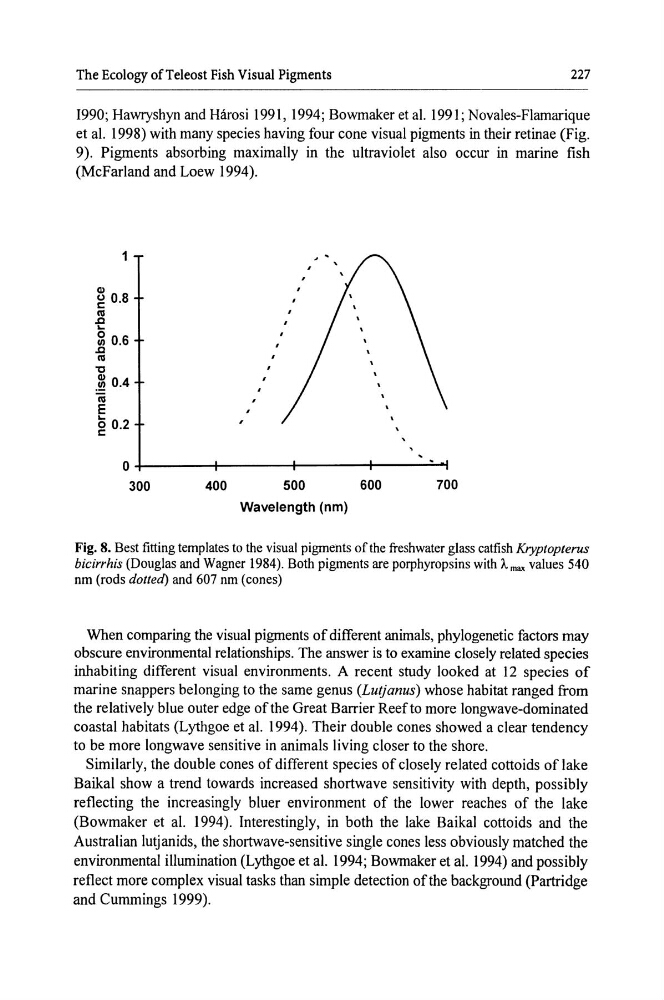
Fig. 8. Best fitting templates to the visual pigments of the freshwater glass catfish Kryptopterus
bicirrhis (Douglas and Wagner 1984). Both pigments are porphyropsins with A max values 540
nm (rods dotted) and 607 nm (cones)
When comparing the visual pigments of different animals, phylogenetic factors may
obscure environmental relationships. The answer is to examine closely related species
inhabiting different visual environments. A recent study looked at 12 species of
marine snappers belonging to the same genus (Lutjanus) whose habitat ranged from
the relatively blue outer edge of the Great Barrier Reef to more longwave-dominated
coastal habitats (Lythgoe et al. 1994 ). Their double cones showed a clear tendency
to be more longwave sensitive in animals living closer to the shore.
Similarly, the double cones of different species of closely related cottoids of lake
Baikal show a trend towards increased shortwave sensitivity with depth, possibly
reflecting the increasingly bluer environment of the lower reaches of the lake
(Bowmaker et al. 1994). Interestingly, in both the lake Baikal cottoids and the
Australian lutjanids, the shortwave-sensitive single cones less obviously matched the
environmental illumination (Lythgoe et al. 1994; Bowmaker et al. 1994) and possibly
reflect more complex visual tasks than simple detection ofthe background (Partridge
and Cummings 1999).
227
1990; Hawryshyn and Harosi 1991, 1994; Bowmaker eta!. 1991; Novales-Flamarique
et al. 1998) with many species having four cone visual pigments in their retinae (Fig.
9). Pigments absorbing maximally in the ultraviolet also occur in marine fish
(McFarland and Loew 1994).
Q)
g 0.8
cu
..c ...
g 0.6
..c
cu
"C
Q)
~ 0.4
cu
E
g 0.2
300
400
500
Wavelength (nm)
600
700
Fig. 8. Best fitting templates to the visual pigments of the freshwater glass catfish Kryptopterus
bicirrhis (Douglas and Wagner 1984). Both pigments are porphyropsins with A max values 540
nm (rods dotted) and 607 nm (cones)
When comparing the visual pigments of different animals, phylogenetic factors may
obscure environmental relationships. The answer is to examine closely related species
inhabiting different visual environments. A recent study looked at 12 species of
marine snappers belonging to the same genus (Lutjanus) whose habitat ranged from
the relatively blue outer edge of the Great Barrier Reef to more longwave-dominated
coastal habitats (Lythgoe et al. 1994 ). Their double cones showed a clear tendency
to be more longwave sensitive in animals living closer to the shore.
Similarly, the double cones of different species of closely related cottoids of lake
Baikal show a trend towards increased shortwave sensitivity with depth, possibly
reflecting the increasingly bluer environment of the lower reaches of the lake
(Bowmaker et al. 1994). Interestingly, in both the lake Baikal cottoids and the
Australian lutjanids, the shortwave-sensitive single cones less obviously matched the
environmental illumination (Lythgoe et al. 1994; Bowmaker et al. 1994) and possibly
reflect more complex visual tasks than simple detection ofthe background (Partridge
and Cummings 1999).