

226
1
8 0.8
c
.! ...
~ 0.6
.g
ca
"C
CD
.!! 0.4
ii
E
g 0.2
0+-----~------~----~~~--~
300
400
500
Wavelength (nm)
600
700
Ron H. Douglas
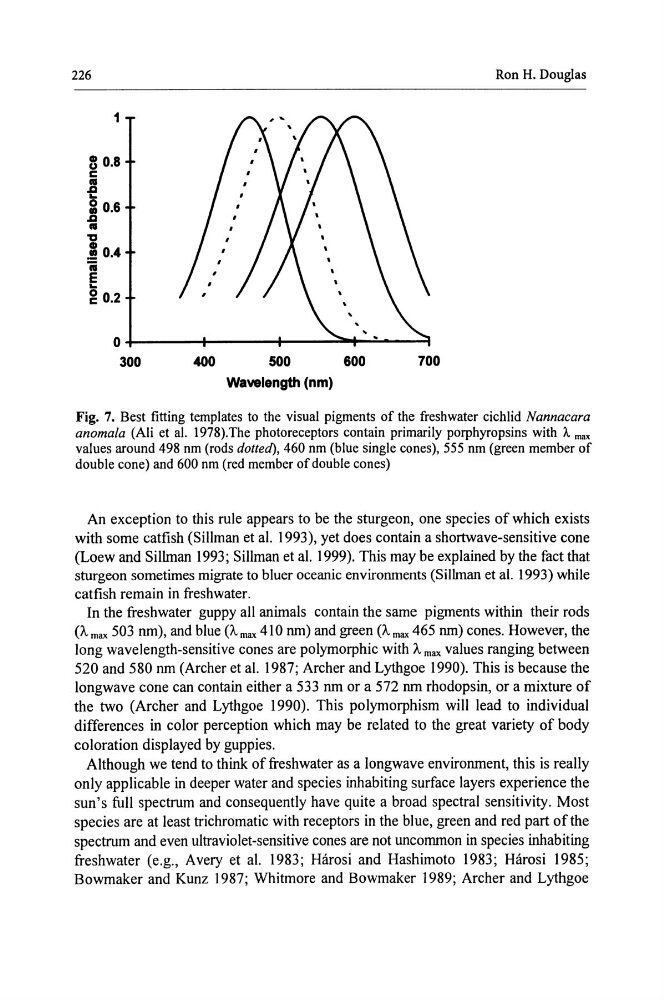
Fig. 7. Best fitting templates to the visual pigments of the freshwater cichlid Nannacara
anomala (Ali et a!. 1978).The photoreceptors contain primarily porphyropsins with A. max
values around 498 nm (rods dotted), 460 nm (blue single cones), 555 nm (green member of
double cone) and 600 nm (red member of double cones)
An exception to this rule appears to be the sturgeon, one species of which exists
with some catfish (Sillman et al. 1993), yet does contain a shortwave-sensitive cone
(Loew and Sillman 1993; Sillman et al. 1999). This may be explained by the fact that
sturgeon sometimes migrate to bluer oceanic environments (Silhnan et a!. 1993) while
catfish remain in freshwater.
In the freshwater guppy all animals contain the same pigments within their rods
(A max 503 nm), and blue (A max 410 nm) and green (A max 465 nm) cones. However, the
long wavelength-sensitive cones are polymorphic with A max values ranging between
520 and 580 nm (Archer et al. 1987; Archer and Lythgoe 1990). This is because the
longwave cone can contain either a 533 nm or a 572 nm rhodopsin, or a mixture of
the two (Archer and Lythgoe 1990). This polymorphism will lead to individual
differences in color perception which may be related to the great variety of body
coloration displayed by guppies.
Although we tend to think of freshwater as a longwave environment, this is really
only applicable in deeper water and species inhabiting surface layers experience the
sun's full spectrum and consequently have quite a broad spectral sensitivity. Most
species are at least trichromatic with receptors in the blue, green and red part of the
spectrum and even ultraviolet-sensitive cones are not uncommon in species inhabiting
freshwater (e.g., Avery et al. 1983; Harosi and Hashimoto 1983; Harosi 1985;
Bowmaker and Kunz 1987; Whitmore and Bowmaker 1989; Archer and Lythgoe
1
8 0.8
c
.! ...
~ 0.6
.g
ca
"C
CD
.!! 0.4
ii
E
g 0.2
0+-----~------~----~~~--~
300
400
500
Wavelength (nm)
600
700
Ron H. Douglas
Fig. 7. Best fitting templates to the visual pigments of the freshwater cichlid Nannacara
anomala (Ali et a!. 1978).The photoreceptors contain primarily porphyropsins with A. max
values around 498 nm (rods dotted), 460 nm (blue single cones), 555 nm (green member of
double cone) and 600 nm (red member of double cones)
An exception to this rule appears to be the sturgeon, one species of which exists
with some catfish (Sillman et al. 1993), yet does contain a shortwave-sensitive cone
(Loew and Sillman 1993; Sillman et al. 1999). This may be explained by the fact that
sturgeon sometimes migrate to bluer oceanic environments (Silhnan et a!. 1993) while
catfish remain in freshwater.
In the freshwater guppy all animals contain the same pigments within their rods
(A max 503 nm), and blue (A max 410 nm) and green (A max 465 nm) cones. However, the
long wavelength-sensitive cones are polymorphic with A max values ranging between
520 and 580 nm (Archer et al. 1987; Archer and Lythgoe 1990). This is because the
longwave cone can contain either a 533 nm or a 572 nm rhodopsin, or a mixture of
the two (Archer and Lythgoe 1990). This polymorphism will lead to individual
differences in color perception which may be related to the great variety of body
coloration displayed by guppies.
Although we tend to think of freshwater as a longwave environment, this is really
only applicable in deeper water and species inhabiting surface layers experience the
sun's full spectrum and consequently have quite a broad spectral sensitivity. Most
species are at least trichromatic with receptors in the blue, green and red part of the
spectrum and even ultraviolet-sensitive cones are not uncommon in species inhabiting
freshwater (e.g., Avery et al. 1983; Harosi and Hashimoto 1983; Harosi 1985;
Bowmaker and Kunz 1987; Whitmore and Bowmaker 1989; Archer and Lythgoe