

The Ecology of Teleost Fish Visual Pigments
1
~ 0.8
c
.e i 0.6
.a
1"11
-g
.!! 0.4
iii
E ...
g 0.2
0+-----~r------+--~--~~--~
300
400
500
Wavelength (nm)
600
700
225
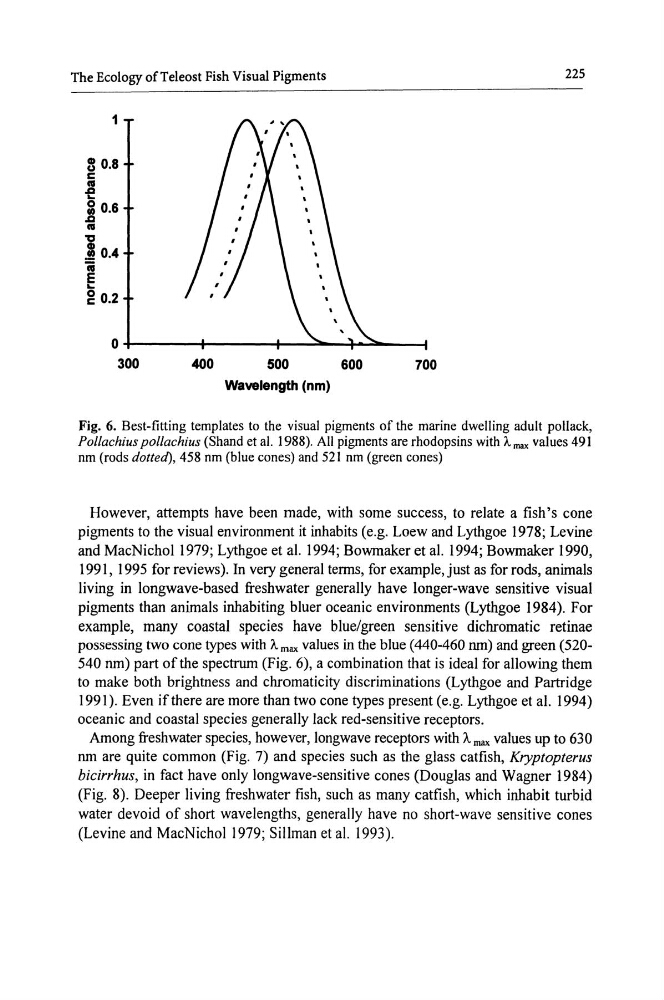
Fig. 6. Best-fitting templates to the visual pigments of the marine dwelling adult pollack,
Pollachius pollachius (Shand et a!. 1988). All pigments are rhodopsins with A. max values 491
nm (rods dotted), 458 nm (blue cones) and 521 nm (green cones)
However, attempts have been made, with some success, to relate a fish's cone
pigments to the visual environment it inhabits (e.g. Loew and Lythgoe 1978; Levine
and MacNichol 1979; Lythgoe eta!. 1994; Bowmaker eta!. 1994; Bowmaker 1990,
1991, 1995 for reviews). In very general terms, for example, just as for rods, animals
living in Iongwave-based freshwater generally have longer-wave sensitive visual
pigments than animals inhabiting bluer oceanic environments (Lythgoe 1984). For
example, many coastal species have blue/green sensitive dichromatic retinae
possessing two cone types with A max values in the blue (440-460 nm) and green (520540 nm) part of the spectrum (Fig. 6), a combination that is ideal for allowing them
to make both brightness and chromaticity discriminations (Lythgoe and Partridge
1991). Even ifthere are more than two cone types present (e.g. Lythgoe eta!. 1994)
oceanic and coastal species generally lack red-sensitive receptors.
Among freshwater species, however, longwave receptors with A. max values up to 630
nm are quite common (Fig. 7) and species such as the glass catfish, Kryptopterus
bicirrhus, in fact have only longwave-sensitive cones (Douglas and Wagner 1984)
(Fig. 8). Deeper living freshwater fish, such as many catfish, which inhabit turbid
water devoid of short wavelengths, generally have no short-wave sensitive cones
(Levine and MacNichol 1979; Sillman eta!. 1993).
1
~ 0.8
c
.e i 0.6
.a
1"11
-g
.!! 0.4
iii
E ...
g 0.2
0+-----~r------+--~--~~--~
300
400
500
Wavelength (nm)
600
700
225
Fig. 6. Best-fitting templates to the visual pigments of the marine dwelling adult pollack,
Pollachius pollachius (Shand et a!. 1988). All pigments are rhodopsins with A. max values 491
nm (rods dotted), 458 nm (blue cones) and 521 nm (green cones)
However, attempts have been made, with some success, to relate a fish's cone
pigments to the visual environment it inhabits (e.g. Loew and Lythgoe 1978; Levine
and MacNichol 1979; Lythgoe eta!. 1994; Bowmaker eta!. 1994; Bowmaker 1990,
1991, 1995 for reviews). In very general terms, for example, just as for rods, animals
living in Iongwave-based freshwater generally have longer-wave sensitive visual
pigments than animals inhabiting bluer oceanic environments (Lythgoe 1984). For
example, many coastal species have blue/green sensitive dichromatic retinae
possessing two cone types with A max values in the blue (440-460 nm) and green (520540 nm) part of the spectrum (Fig. 6), a combination that is ideal for allowing them
to make both brightness and chromaticity discriminations (Lythgoe and Partridge
1991). Even ifthere are more than two cone types present (e.g. Lythgoe eta!. 1994)
oceanic and coastal species generally lack red-sensitive receptors.
Among freshwater species, however, longwave receptors with A. max values up to 630
nm are quite common (Fig. 7) and species such as the glass catfish, Kryptopterus
bicirrhus, in fact have only longwave-sensitive cones (Douglas and Wagner 1984)
(Fig. 8). Deeper living freshwater fish, such as many catfish, which inhabit turbid
water devoid of short wavelengths, generally have no short-wave sensitive cones
(Levine and MacNichol 1979; Sillman eta!. 1993).