

228
1
0.9
~ 0.8
1:
1l 0.7
....
~ 0.6
.c
:0.5
Ill
.!!! 0.4
iii
E 0.3
....
~ 0.2
0.1
0~~~--~--~---+----~~~--~~
300
400
500
Wavelength (nm)
600
700
Ron H. Douglas
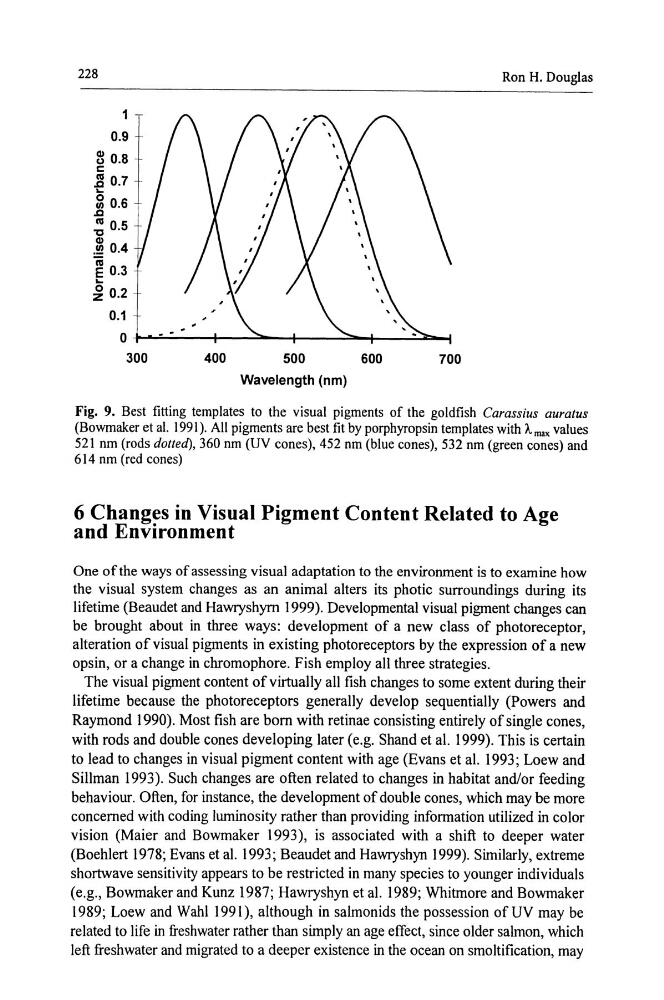
Fig. 9. Best fitting templates to the visual pigments of the goldfish Carassius auratus
(Bowmaker et al. 1991 ). All pigments are best fit by porphyropsin templates with A max values
521 nm (rods dotted), 360 nm (UV cones), 452 nm (blue cones), 532 nm (green cones) and
614 nm (red cones)
6 Changes in Visual Pigment Content Related to Age
and Environment
One of the ways of assessing visual adaptation to the environment is to examine how
the visual system changes as an animal alters its photic surroundings during its
lifetime (Beaudet and Hawryshym 1999). Developmental visual pigment changes can
be brought about in three ways: development of a new class of photoreceptor,
alteration of visual pigments in existing photoreceptors by the expression of a new
opsin, or a change in chromophore. Fish employ all three strategies.
The visual pigment content of virtually all fish changes to some extent during their
lifetime because the photoreceptors generally develop sequentially (Powers and
Raymond 1990). Most fish are born with retinae consisting entirely of single cones,
with rods and double cones developing later (e.g. Shand et al. 1999). This is certain
to lead to changes in visual pigment content with age (Evans et al. 1993; Loew and
Sillman 1993). Such changes are often related to changes in habitat and/or feeding
behaviour. Often, for instance, the development of double cones, which may be more
concerned with coding luminosity rather than providing information utilized in color
vision (Maier and Bowmaker 1993), is associated with a shift to deeper water
(Boehlert 1978; Evans et al. 1993; Beaudet and Hawryshyn 1999). Similarly, extreme
shortwave sensitivity appears to be restricted in many species to younger individuals
(e.g., Bowmaker and Kunz 1987; Hawryshyn et al. 1989;Whitmore and Bowmaker
1989; Loew and Wahl 1991 ), although in salmon ids the possession of UV may be
related to life in freshwater rather than simply an age effect, since older salmon, which
left freshwater and migrated to a deeper existence in the ocean on smoltification, may
1
0.9
~ 0.8
1:
1l 0.7
....
~ 0.6
.c
:0.5
Ill
.!!! 0.4
iii
E 0.3
....
~ 0.2
0.1
0~~~--~--~---+----~~~--~~
300
400
500
Wavelength (nm)
600
700
Ron H. Douglas
Fig. 9. Best fitting templates to the visual pigments of the goldfish Carassius auratus
(Bowmaker et al. 1991 ). All pigments are best fit by porphyropsin templates with A max values
521 nm (rods dotted), 360 nm (UV cones), 452 nm (blue cones), 532 nm (green cones) and
614 nm (red cones)
6 Changes in Visual Pigment Content Related to Age
and Environment
One of the ways of assessing visual adaptation to the environment is to examine how
the visual system changes as an animal alters its photic surroundings during its
lifetime (Beaudet and Hawryshym 1999). Developmental visual pigment changes can
be brought about in three ways: development of a new class of photoreceptor,
alteration of visual pigments in existing photoreceptors by the expression of a new
opsin, or a change in chromophore. Fish employ all three strategies.
The visual pigment content of virtually all fish changes to some extent during their
lifetime because the photoreceptors generally develop sequentially (Powers and
Raymond 1990). Most fish are born with retinae consisting entirely of single cones,
with rods and double cones developing later (e.g. Shand et al. 1999). This is certain
to lead to changes in visual pigment content with age (Evans et al. 1993; Loew and
Sillman 1993). Such changes are often related to changes in habitat and/or feeding
behaviour. Often, for instance, the development of double cones, which may be more
concerned with coding luminosity rather than providing information utilized in color
vision (Maier and Bowmaker 1993), is associated with a shift to deeper water
(Boehlert 1978; Evans et al. 1993; Beaudet and Hawryshyn 1999). Similarly, extreme
shortwave sensitivity appears to be restricted in many species to younger individuals
(e.g., Bowmaker and Kunz 1987; Hawryshyn et al. 1989;Whitmore and Bowmaker
1989; Loew and Wahl 1991 ), although in salmon ids the possession of UV may be
related to life in freshwater rather than simply an age effect, since older salmon, which
left freshwater and migrated to a deeper existence in the ocean on smoltification, may