

222
Ron H. Douglas
attractant to prey, and a way of simply illuminating their darkened world (Herring
1996: Widder 1999). Theoretical calculations indicate clearly that the absorption
maxima of deepsea fish visual pigments are in most cases a good match to such
biological sources of illumination (Partridge, pers. comm.; Douglas l998a).
Unquestionably, the best illustration of how visual pigments are matched to a fish's
bioluminescence is provided by three genera of deepsea stomiid dragon fish
(Malacosteus, Aristostomias and Pachystomias). Whereas most deepsea organisms
produce just one form of bioluminescence, these dragon fish have two light-producing
organs around their eyes; a postorbital photophore producing blue-green
bioluminescence similar to that produced by most other deepsea organisms, and a
second, suborbital photophore producing far-red bioluminescence with spectral
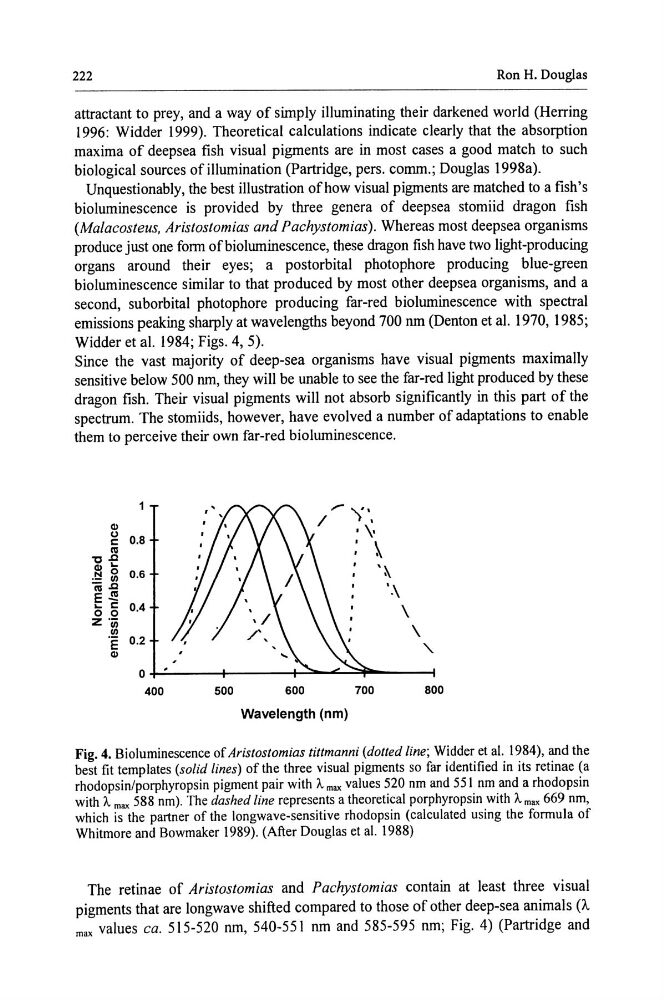
emissions peaking sharply at wavelengths beyond 700 nm (Denton et al. 1970, 1985;
Widder et al. 1984; Figs. 4, 5).
Since the vast majority of deep-sea organisms have visual pigments maximally
sensitive below 500 nm, they will be unable to see the far-red light produced by these
dragon fish. Their visual pigments will not absorb significantly in this part of the
spectrum. The stomiids, however, have evolved a number of adaptations to enable
them to perceive their own far-red bioluminescence.
Q)
0
0.8
s:::
co
't:J.C
Q) ...
N 0
0.6
·- Ill
-.c co co
E... s:::
0.4
0 0
z·u;
Ill
.E 0.2
Q)
'}..
'.\
\
\ "
0
400
500
600
700
800
Wavelength (nm)
Fig. 4. Bioluminescence of Aristostomias tittmanni (dotted line; Widder et al. 1984), and the
best fit templates (solid lines) of the three visual pigments so far identified in its retinae (a
rhodopsin/porphyropsin pigment pair with A max values 520 nm and 551 nm and a rhodopsin
with A max 588 nm). The dashed line represents a theoretical porphyropsin with A max 669 nm,
which is the partner of the longwave-sensitive rhodopsin (calculated using the formula of
Whitmore and Bowmaker 1989). (After Douglas et al. 1988)
The retinae of Aristostomias and Pachystomias contain at least three visual
pigments that are longwave shifted compared to those of other deep-sea animals (A.
max values ca. 515-520 nm, 540-551 nm and 585-595 nm; Fig. 4) (Partridge and
Ron H. Douglas
attractant to prey, and a way of simply illuminating their darkened world (Herring
1996: Widder 1999). Theoretical calculations indicate clearly that the absorption
maxima of deepsea fish visual pigments are in most cases a good match to such
biological sources of illumination (Partridge, pers. comm.; Douglas l998a).
Unquestionably, the best illustration of how visual pigments are matched to a fish's
bioluminescence is provided by three genera of deepsea stomiid dragon fish
(Malacosteus, Aristostomias and Pachystomias). Whereas most deepsea organisms
produce just one form of bioluminescence, these dragon fish have two light-producing
organs around their eyes; a postorbital photophore producing blue-green
bioluminescence similar to that produced by most other deepsea organisms, and a
second, suborbital photophore producing far-red bioluminescence with spectral
emissions peaking sharply at wavelengths beyond 700 nm (Denton et al. 1970, 1985;
Widder et al. 1984; Figs. 4, 5).
Since the vast majority of deep-sea organisms have visual pigments maximally
sensitive below 500 nm, they will be unable to see the far-red light produced by these
dragon fish. Their visual pigments will not absorb significantly in this part of the
spectrum. The stomiids, however, have evolved a number of adaptations to enable
them to perceive their own far-red bioluminescence.
Q)
0
0.8
s:::
co
't:J.C
Q) ...
N 0
0.6
·- Ill
-.c co co
E... s:::
0.4
0 0
z·u;
Ill
.E 0.2
Q)
'}..
'.\
\
\ "
0
400
500
600
700
800
Wavelength (nm)
Fig. 4. Bioluminescence of Aristostomias tittmanni (dotted line; Widder et al. 1984), and the
best fit templates (solid lines) of the three visual pigments so far identified in its retinae (a
rhodopsin/porphyropsin pigment pair with A max values 520 nm and 551 nm and a rhodopsin
with A max 588 nm). The dashed line represents a theoretical porphyropsin with A max 669 nm,
which is the partner of the longwave-sensitive rhodopsin (calculated using the formula of
Whitmore and Bowmaker 1989). (After Douglas et al. 1988)
The retinae of Aristostomias and Pachystomias contain at least three visual
pigments that are longwave shifted compared to those of other deep-sea animals (A.
max values ca. 515-520 nm, 540-551 nm and 585-595 nm; Fig. 4) (Partridge and