

The Ecology of Teleost Fish Visual Pigments
221
14
12
10
U)
Cll
·u
Cll
8
c.
U)
- 0
... Cll 6
.c
E
:::>
z
4
2
440
460
480
500
520
540
560
580
!..max (nm)
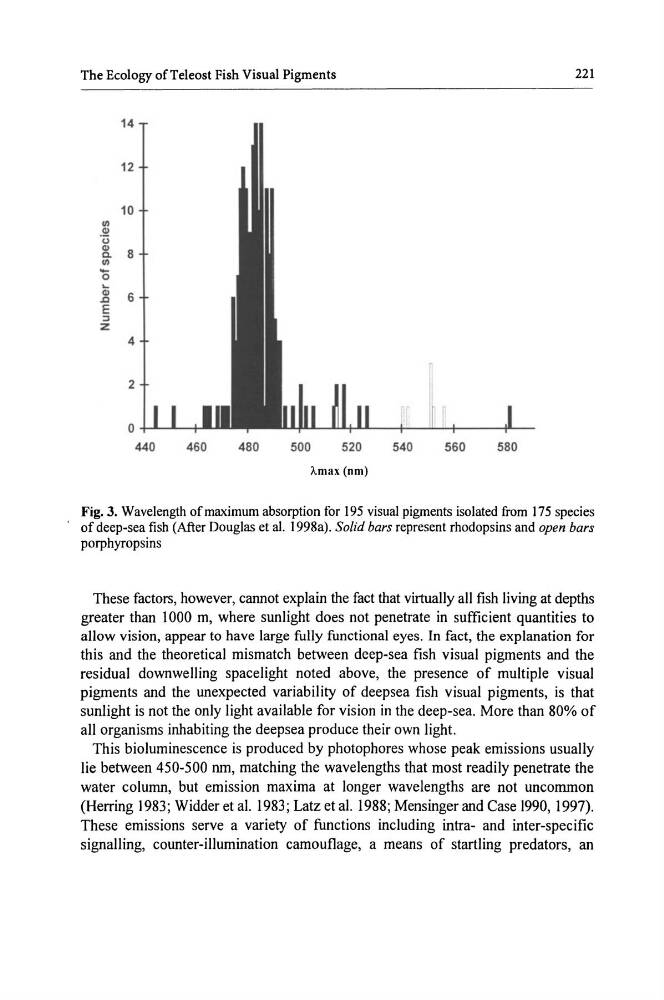
Fig. 3. Wavelength ofmaximum absorption for 195 visual pigments isolated from 175 species
of deep-sea fish (After Douglas et al. 1998a). Solid bars represent rhodopsins and open bars
porphyropsins
These factors, however, cannot explain the fact that virtually all fish living at depths
greater than 1000 m, where sunlight does not penetrate in sufficient quantities to
allow vision, appear to have large fully functional eyes. In fact, the explanation for
this and the theoretical mismatch between deep-sea fish visual pigments and the
residual downwelling spacelight noted above, the presence of multiple visual
pigments and the unexpected variability of deepsea fish visual pigments, is that
sunlight is not the only light available for vision in the deep-sea. More than 80% of
all organisms inhabiting the deepsea produce their own light.
This bioluminescence is produced by photophores whose peak emissions usually
lie between 450-500 nm, matching the wavelengths that most readily penetrate the
water column, but emission maxima at longer wavelengths are not uncommon
(Herring 1983; Widder et al. 1983; Latz et al. 1988; Mensinger and Case 1990, 1997).
These emissions serve a variety of functions including intra- and inter-specific
signalling, counter-illumination camouflage, a means of startling predators, an
221
14
12
10
U)
Cll
·u
Cll
8
c.
U)
- 0
... Cll 6
.c
E
:::>
z
4
2
440
460
480
500
520
540
560
580
!..max (nm)
Fig. 3. Wavelength ofmaximum absorption for 195 visual pigments isolated from 175 species
of deep-sea fish (After Douglas et al. 1998a). Solid bars represent rhodopsins and open bars
porphyropsins
These factors, however, cannot explain the fact that virtually all fish living at depths
greater than 1000 m, where sunlight does not penetrate in sufficient quantities to
allow vision, appear to have large fully functional eyes. In fact, the explanation for
this and the theoretical mismatch between deep-sea fish visual pigments and the
residual downwelling spacelight noted above, the presence of multiple visual
pigments and the unexpected variability of deepsea fish visual pigments, is that
sunlight is not the only light available for vision in the deep-sea. More than 80% of
all organisms inhabiting the deepsea produce their own light.
This bioluminescence is produced by photophores whose peak emissions usually
lie between 450-500 nm, matching the wavelengths that most readily penetrate the
water column, but emission maxima at longer wavelengths are not uncommon
(Herring 1983; Widder et al. 1983; Latz et al. 1988; Mensinger and Case 1990, 1997).
These emissions serve a variety of functions including intra- and inter-specific
signalling, counter-illumination camouflage, a means of startling predators, an