

The Ecology of Teleost Fish Visual Pigments
223
Douglas 1995; Douglas et al. 1998a). The two most shortwave-sensitive pigments in
each retina form a rhodopsin/ porphyropsin pigment pair in which the same shortwave
opsin is bound to the two chromophores retinal and 3-dehydroretinal in different
photoreceptors (Bowmaker et al. 1988; Partridge et al. 1989). The third, longer wave
absorbing pigment, is a rhodopsin housed in a third class of rod and is most likely
composed of a second longwave opsin bound to retinal (Partridge and Douglas 1995;
Douglas et al. 1998a). This latter pigment is by far the most longwave-sensitive rod
pigment ever described. However, even this pigment, although it fits this animal's
bioluminescence much better than any other deep-sea visual pigment so far described,
is still not a perfect match to a bioluminescent emission peaking sharply above 700
nm (Fig. 4).
1.00
')(''
,.
J I \ \
s::::
I, I
\ \
0
0.80
"iii
I f
\ \
II)
.E
I t'·
\ \
~
s::::
0.60
I I ,
\ \
0
:p
II
\ \
a..
....
0
I
It
\
\
II)
.c 0.40
Ill
I
, ,
\
\
"C
Q)
\
\
.!::!
iii 0.20
\
\
E ....
\
0
z
0.00
400
500
600
700
800
Wavelength (nm)
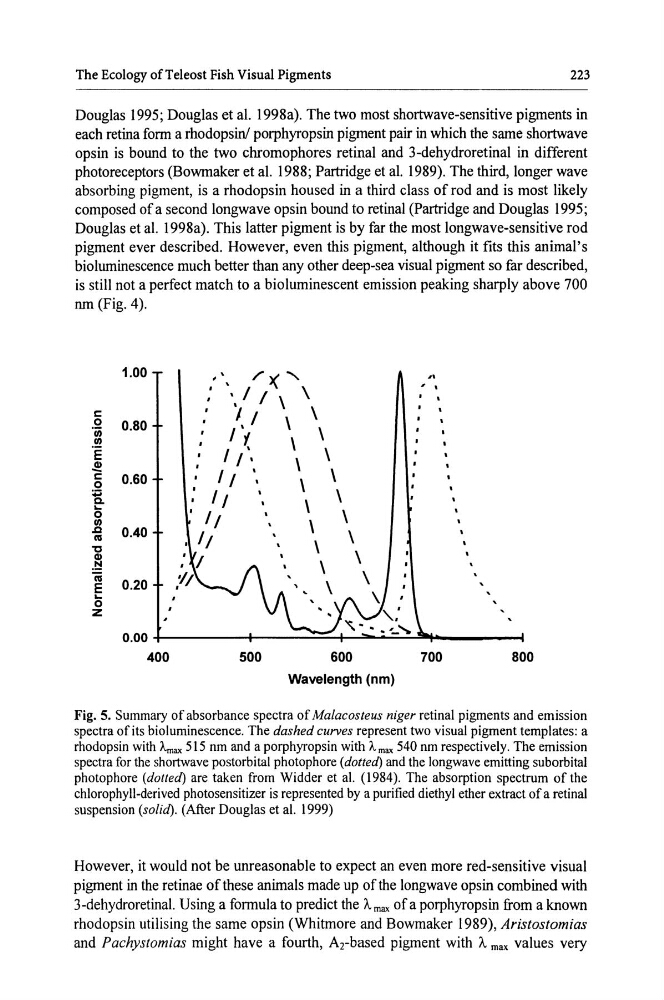
Fig. 5. Summary of absorbance spectra of Malacosteus niger retinal pigments and emission
spectra of its bioluminescence. The dashed curves represent two visual pigment templates: a
rhodopsin with Amax 515 nm and a porphyropsin with A max 540 nm respectively. The emission
spectra for the shortwave postorbital photophore (dotted) and the longwave emitting suborbital
photophore (dotted) are taken from Widder et al. (1984). The absorption spectrum of the
chlorophyll-derived photosensitizer is represented by a purified diethyl ether extract of a retinal
suspension (solid). (After Douglas eta!. 1999)
However, it would not be unreasonable to expect an even more red-sensitive visual
pigment in the retinae of these animals made up of the longwave opsin combined with
3-dehydroretinal. Using a formula to predict the A max of a porphyropsin from a known
rhodopsin utilising the same opsin (Whitmore and Bowmaker 1989), Aristostomias
and Pachystomias might have a fourth, ATbased pigment with A. max values very
223
Douglas 1995; Douglas et al. 1998a). The two most shortwave-sensitive pigments in
each retina form a rhodopsin/ porphyropsin pigment pair in which the same shortwave
opsin is bound to the two chromophores retinal and 3-dehydroretinal in different
photoreceptors (Bowmaker et al. 1988; Partridge et al. 1989). The third, longer wave
absorbing pigment, is a rhodopsin housed in a third class of rod and is most likely
composed of a second longwave opsin bound to retinal (Partridge and Douglas 1995;
Douglas et al. 1998a). This latter pigment is by far the most longwave-sensitive rod
pigment ever described. However, even this pigment, although it fits this animal's
bioluminescence much better than any other deep-sea visual pigment so far described,
is still not a perfect match to a bioluminescent emission peaking sharply above 700
nm (Fig. 4).
1.00
')(''
,.
J I \ \
s::::
I, I
\ \
0
0.80
"iii
I f
\ \
II)
.E
I t'·
\ \
~
s::::
0.60
I I ,
\ \
0
:p
II
\ \
a..
....
0
I
It
\
\
II)
.c 0.40
Ill
I
, ,
\
\
"C
Q)
\
\
.!::!
iii 0.20
\
\
E ....
\
0
z
0.00
400
500
600
700
800
Wavelength (nm)
Fig. 5. Summary of absorbance spectra of Malacosteus niger retinal pigments and emission
spectra of its bioluminescence. The dashed curves represent two visual pigment templates: a
rhodopsin with Amax 515 nm and a porphyropsin with A max 540 nm respectively. The emission
spectra for the shortwave postorbital photophore (dotted) and the longwave emitting suborbital
photophore (dotted) are taken from Widder et al. (1984). The absorption spectrum of the
chlorophyll-derived photosensitizer is represented by a purified diethyl ether extract of a retinal
suspension (solid). (After Douglas eta!. 1999)
However, it would not be unreasonable to expect an even more red-sensitive visual
pigment in the retinae of these animals made up of the longwave opsin combined with
3-dehydroretinal. Using a formula to predict the A max of a porphyropsin from a known
rhodopsin utilising the same opsin (Whitmore and Bowmaker 1989), Aristostomias
and Pachystomias might have a fourth, ATbased pigment with A. max values very