

118
Joseph A. C. Humphrey et al.
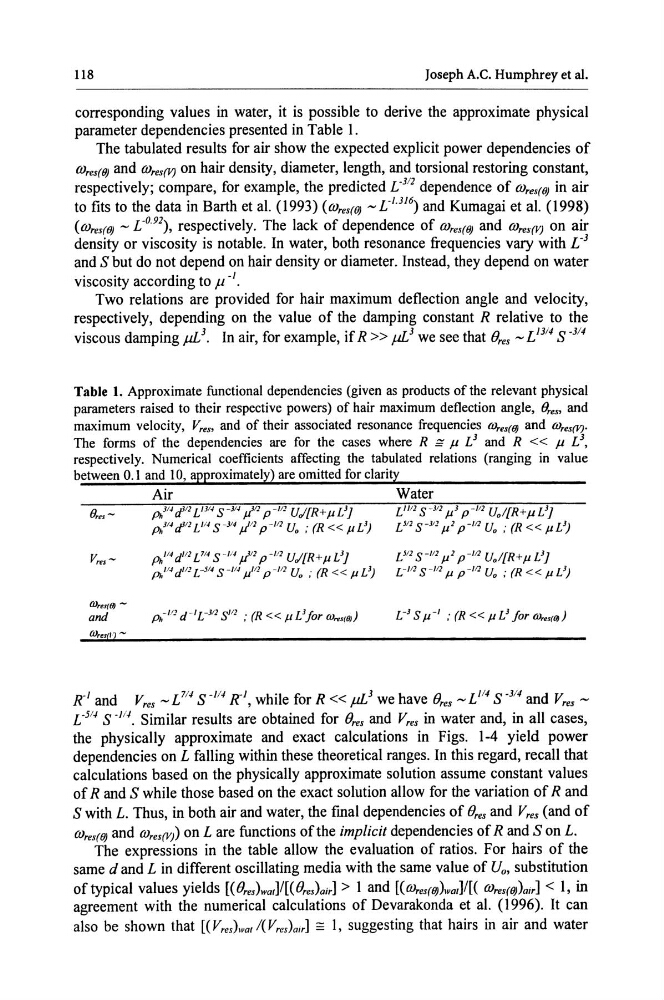
corresponding values in water, it is possible to derive the approximate physical
parameter dependencies presented in Table I.
The tabulated results for air show the expected explicit power dependencies of
OJres((J) and OJres(VJ on hair density, diameter, length, and torsional restoring constant,
respectively; compare, for example, the predicted L- 312 dependence of mres((J) in air
to fits to the data in Barth et al. (I 993) ( mresre; - L 1 ' 316 ) and Kumagai et al. ( 1998)
(mres((J) - L 092 ), respectively. The lack of dependence of OJres(OJ and OJres(V) on air
density or viscosity is notable. In water, both resonance frequencies vary with L 3
and S but do not depend on hair density or diameter. Instead, they depend on water
viscosity according to J.l- 1 •
Two relations are provided for hair maximum deflection angle and velocity,
respectively, depending on the value of the damping constant R relative to the
viscous damping J.Llf In air, for example, if R >> J.LL 3 we see that Bres - L 1314 S - 314
Table I. Approximate functional dependencies (given as products of the relevant physical
parameters raised to their respective powers) of hair maximum deflection angle, 0, • ., and
maximum velocity, V, • ., and of their associated resonance frequencies mres(B) and mres(V)·
The forms of the dependencies are for the cases where R = J.l L 3 and R << J.l L 3 ,
respectively. Numerical coefficients affecting the tabulated relations (ranging in value
between 0.1 and 10, approximately) are omitted for clarity
r.tJ,..s(O}and
Air
Water
p/Nrf12 L/314 S 314 Ji1z p 111 U,/[R+f-1L3]
p/14rf12 LJ/4 s-314 Jil2 p-111 u. ; (R << f-lL3)
p/14 dill L714 s-IN Jil2 p-Ill U,/{R+f-1 LJ]
p,/14 d112 r-514 S -114 f.l112 P -Jtz u. ; (R < < f.l LJ)
L1111 S 112 f-lJ P 111 U.I[R+f-1L3]
L512 s-312 f-12 P-112 u. ; (R << f-lL3)
Ls12 s-112 f-12 p-112 U.I[R+f-1 LJ]
C112 S -112 f-l P -112 u. ; (R < < f.l LJ)
K 1 and Vres - L 714 S -I/4 K 1 , while for R << J.LL 3 we have Bres- L 114 S - 314 and Vres -
L 514 S -/14. Similar results are obtained for Bres and Vres in water and, in all cases,
the physically approximate and exact calculations in Figs. 1-4 yield power
dependencies on L falling within these theoretical ranges. In this regard, recall that
calculations based on the physically approximate solution assume constant values
of R and S while those based on the exact solution allow for the variation of R and
S with L. Thus, in both air and water, the fmal dependencies of (}res and Vres (and of
Wres(OJ and Wres(V)) on L are functions of the implicit dependencies of RandS on L.
The expressions in the table allow the evaluation of ratios. For hairs of the
same d and L in different oscillating media with the same value of U0 , substitution
oftypical values yields [(Bres)wat]I[(B,es)a;r] > 1 and [(mresre;)wat]l[( Wres((Jj)a;r] < I, in
agreement with the numerical calculations of Devarakonda et al. (I 996). It can
also be shown that [ ( Vres)wat I( Vres)a;r] = I, suggesting that hairs in air and water
Joseph A. C. Humphrey et al.
corresponding values in water, it is possible to derive the approximate physical
parameter dependencies presented in Table I.
The tabulated results for air show the expected explicit power dependencies of
OJres((J) and OJres(VJ on hair density, diameter, length, and torsional restoring constant,
respectively; compare, for example, the predicted L- 312 dependence of mres((J) in air
to fits to the data in Barth et al. (I 993) ( mresre; - L 1 ' 316 ) and Kumagai et al. ( 1998)
(mres((J) - L 092 ), respectively. The lack of dependence of OJres(OJ and OJres(V) on air
density or viscosity is notable. In water, both resonance frequencies vary with L 3
and S but do not depend on hair density or diameter. Instead, they depend on water
viscosity according to J.l- 1 •
Two relations are provided for hair maximum deflection angle and velocity,
respectively, depending on the value of the damping constant R relative to the
viscous damping J.Llf In air, for example, if R >> J.LL 3 we see that Bres - L 1314 S - 314
Table I. Approximate functional dependencies (given as products of the relevant physical
parameters raised to their respective powers) of hair maximum deflection angle, 0, • ., and
maximum velocity, V, • ., and of their associated resonance frequencies mres(B) and mres(V)·
The forms of the dependencies are for the cases where R = J.l L 3 and R << J.l L 3 ,
respectively. Numerical coefficients affecting the tabulated relations (ranging in value
between 0.1 and 10, approximately) are omitted for clarity
r.tJ,..s(O}and
Air
Water
p/Nrf12 L/314 S 314 Ji1z p 111 U,/[R+f-1L3]
p/14rf12 LJ/4 s-314 Jil2 p-111 u. ; (R << f-lL3)
p/14 dill L714 s-IN Jil2 p-Ill U,/{R+f-1 LJ]
p,/14 d112 r-514 S -114 f.l112 P -Jtz u. ; (R < < f.l LJ)
L1111 S 112 f-lJ P 111 U.I[R+f-1L3]
L512 s-312 f-12 P-112 u. ; (R << f-lL3)
Ls12 s-112 f-12 p-112 U.I[R+f-1 LJ]
C112 S -112 f-l P -112 u. ; (R < < f.l LJ)
K 1 and Vres - L 714 S -I/4 K 1 , while for R << J.LL 3 we have Bres- L 114 S - 314 and Vres -
L 514 S -/14. Similar results are obtained for Bres and Vres in water and, in all cases,
the physically approximate and exact calculations in Figs. 1-4 yield power
dependencies on L falling within these theoretical ranges. In this regard, recall that
calculations based on the physically approximate solution assume constant values
of R and S while those based on the exact solution allow for the variation of R and
S with L. Thus, in both air and water, the fmal dependencies of (}res and Vres (and of
Wres(OJ and Wres(V)) on L are functions of the implicit dependencies of RandS on L.
The expressions in the table allow the evaluation of ratios. For hairs of the
same d and L in different oscillating media with the same value of U0 , substitution
oftypical values yields [(Bres)wat]I[(B,es)a;r] > 1 and [(mresre;)wat]l[( Wres((Jj)a;r] < I, in
agreement with the numerical calculations of Devarakonda et al. (I 996). It can
also be shown that [ ( Vres)wat I( Vres)a;r] = I, suggesting that hairs in air and water